
#On the Square in the File
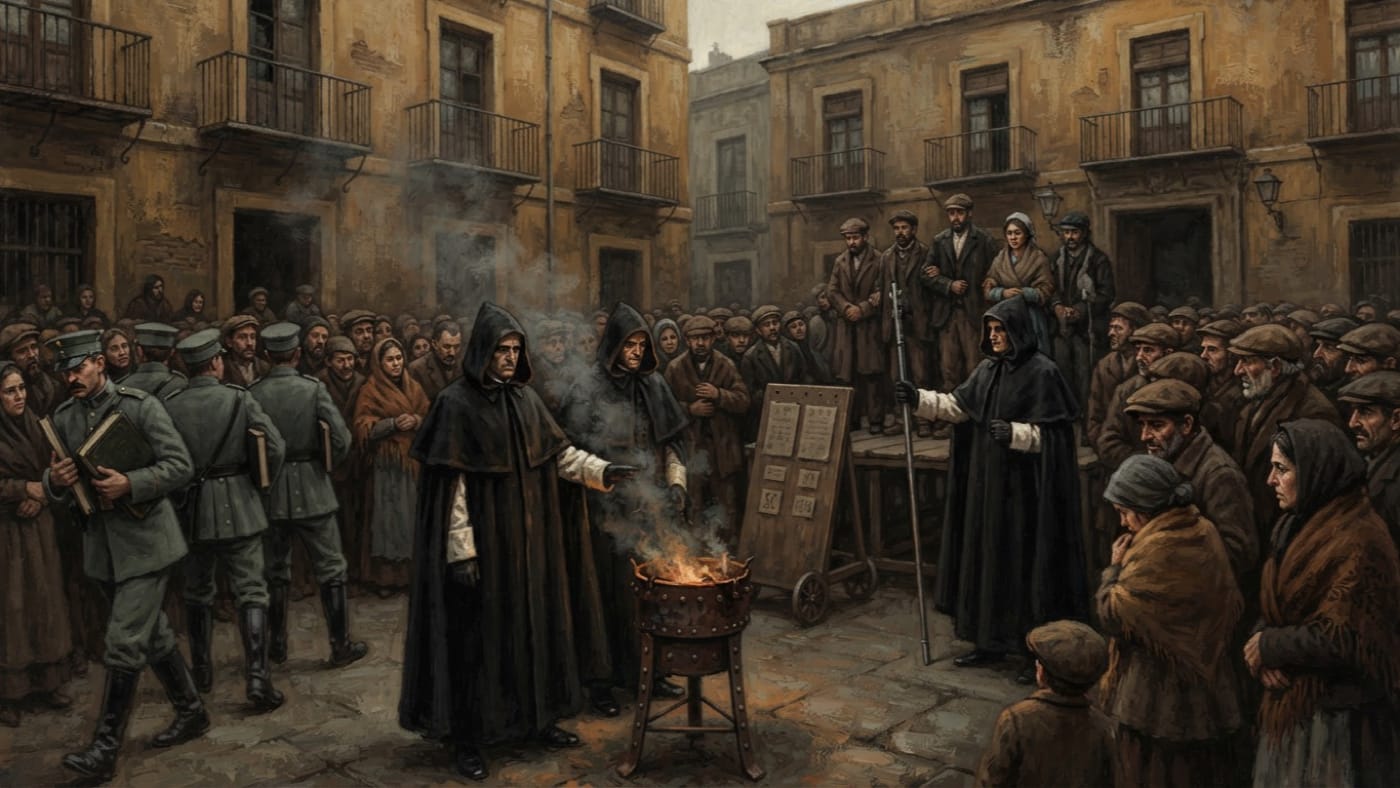
The Plaza de San Telmo enters the Ledger on foot. The file before me says nothing of its founding, its builders, its patron, the cut of its paving or the age of its walls. I will not fill the gap with invention, which is the trade of the Bureau of Festivals. It is a square in Seville, in Iberia. At dawn in A.S. 153 / 1863 CE, during the Laugh Riots, the first detachments of the Lictors of Purity entered it. Everything the Codex can certify about the place comes from that hour.
That is enough. A square is a machine for making witnesses. A tavern holds its drinkers, a guildhall its members, a kitchen court its cooks and their grievances. A plaza holds whoever happens to be standing in it, and the Synod has always valued a congregation it did not have to summon. Festival officers measure such open ground by how many throats it holds. Purity measures it by sightline. The citizens of Seville were never consulted or surveyed, and they used their squares the way people use squares everywhere: to buy, to loiter, to gossip, and to watch what the authorities were doing to someone else.
On the morning in question, the authorities obliged them.
#On Licensed Assembly
Before Purity came to San Telmo, Festivals governed the air above it. After the Heresy of Siena in A.S. 141, the Bureau of Festivals tightened the Iberian calendar until laughter had a volume, song needed clearance and every crowd waited for its cue. Festival Form 19-M, the Application for Civic Mirth Above Licensed Volume, let a citizen request in writing what a grandfather had once done freely with an open mouth. Chorus-Masters carried the batons that told a gathering when to begin and, more to the point, when to stop. Attendance Auditors wrote down who had obeyed.
The breach came at three taverns in Triana during the Feast of the Cracked Bell. On that feast citizens gather to hear old broken bells toll their uneven notes, an emblem of "the flawed but faithful spirit of mankind." The taverns overdid the flawed part. A junior Auditor reported it. The public file spares posterity the Auditor's name, and spares me too. The provincial office replied with a quota notice: ninety days of half-volume mirth, every public song cleared in advance, tavern doors held open through the evening hours, and a Chorus-Master posted to each licensed square.
The file does not say whether San Telmo was a licensed square, or whose baton stood in it. I will not appoint a ghost to the post.
The quota notice and Form 19-M are separate instruments, though Seville treated them with equal contempt. The city answered with organised excess. The Bellfounders' Hall laughed for seven minutes, and the Fishmongers' Court had joined by dawn. The dye-yards ran mock silences with batons of stolen blue. Markets chanted the clauses as street cries. Guildhalls took turns at the offence so the runners always arrived late. None of this is recorded at San Telmo. The square's part came afterward, and it was Purity's part: San Telmo is where the answer arrived.
The disturbances at Seville constituted "spontaneous civic disorder."
Withdrawn. Taverns that laugh in rotation, guildhalls that time their offences to a runner's legs and dye-women who match a baton's blue exactly are hardly spontaneous. Seville kept better time than its Chorus-Masters. The charge is amended to the truth, which is worse for everyone.
#On the Dawn Entry
The Bureau of Purity received the Seville file on the fourth day. The Codex does not number the day its Lictors reached San Telmo. It records only the hour, which was dawn. Purity likes to begin when the light is honest and the crowd is fresh.
They came in bone-white mantles worn beneath black travel-cloaks, the white showing at the hem like a verdict glimpsed through a confessional screen. They brought their instruments: braziers, knives, tongs, glyph-presses, and the portable tablets on which a taken tongue is shown to the public it used to address. Every piece arrived on a back or a cart and could leave the same way. The record mentions no permanent scaffold. They needed none. An open square, a lit brazier and enough eyes complete the liturgy.
The Festival auditors withdrew behind them, ledgers clasped to their chests. They gave the ground to a Bureau that has no need to count laughter, because it removes the organ that makes it.
The first tongue-taking was ceremonial, which in Purity's grammar means it was meant to be seen. Six citizens were brought forward: three tavern-keepers, one bellfounder, one fishwife, and a sixth recorded under initials taken to be those of the widow Mar Ortega. I give that identification as the deposition gives it, on condition. Purity's initials have been wrong before, and a knife does not check spelling.
Their crimes were read aloud and their quotas cited. The sentence rested on Clause 14 of the Index addendum on "Contumacious Speech, Rhythmic or Derisive." Then the Lictors did what the clause permitted, in front of the square, one by one.
The crowd watched. That was both its function and its sentence. Nobody in San Telmo that morning could later claim they had not been told.
Then a boy of twelve laughed once.
The file records the laugh. It does not give his name, what was done to him, whether he lived or what he became. I have looked for him in the public abstract with an eagerness I would not confess to my superiors. I found one sound and nothing after it. He remains a single entry in a column nobody ever totalled.
#On the Administration of Silence
By sunset, Purity had laid the Fast of Silence across five wards. The Bureaus have spent half a century blurring the next distinction, so the Ledger states it plainly. The Fast is a festival: a district is forbidden speech for a day, and its silence is proclaimed as proof that the tongue can be tamed for the Creator. It ends. A tongue taken at San Telmo does not grow back at the next bell. The Fast is laid on a ward. The knife is an edit made to a body, and no change to the calendar undoes it.
By the second day, the Lictors had processed three hundred and nine citizens in the wider operation across the city. The public file gives no separate count for the square. The figure counts people handled, which is a different ledger from the dead. "Processed" is Purity's word, chosen for its admirable refusal to mean anything. By the fourth day the total was classified. The Bureau of Records entered "mass corrective muting." Festivals entered "calendar interruption." Each Bureau wrote down the injury it could bear to own.
Festival supervision had already given way before the Lictors came. Chorus-Master Pell, styled "of Cordoba" in the report, had filed the account of a licensed mourning procession decaying into "unmeasured hilarity with hostile undertone." Pell then sent a memorandum stating that the form had become musical. Purity received it without comment. Pell's office was the baton. The file gives Pell no command over Lictors and no post in San Telmo.
Strasbourg read the silence that followed as a threat held in reserve. The Bureau of War opened Iberian contingency files. In A.S. 155, two years after the dawn at San Telmo, came the Subjugation of Seville. That was a campaign against a city, and it needs no stage in this square. Famine followed in A.S. 157. The Bureau of Agriculture was dissolved in A.S. 158, a bill presented to a corpse.
#On the Continuing Jurisdiction
In A.S. 201, Seville remains Synod territory. Auditors remain stationed in the city. Its taverns kept their shutters. Its guildhalls learned to do business on slate boards. Its citizens tap their cups twice before drinking and raise two fingers to their mouths when a Festival baton passes. The Codex records these habits for the city. I cannot certify that any of them is practised in San Telmo in particular, and I will not plant a memorial or a custom there to flatter the page. The square has done its share of witnessing without my help.
Disposition: the Plaza de San Telmo is entered as the place where Festival supervision of Seville ended and Purity's enforcement began. The jurisdiction continues. Witnesses were present, and they are not required to sign.