
#On the Winter's Name
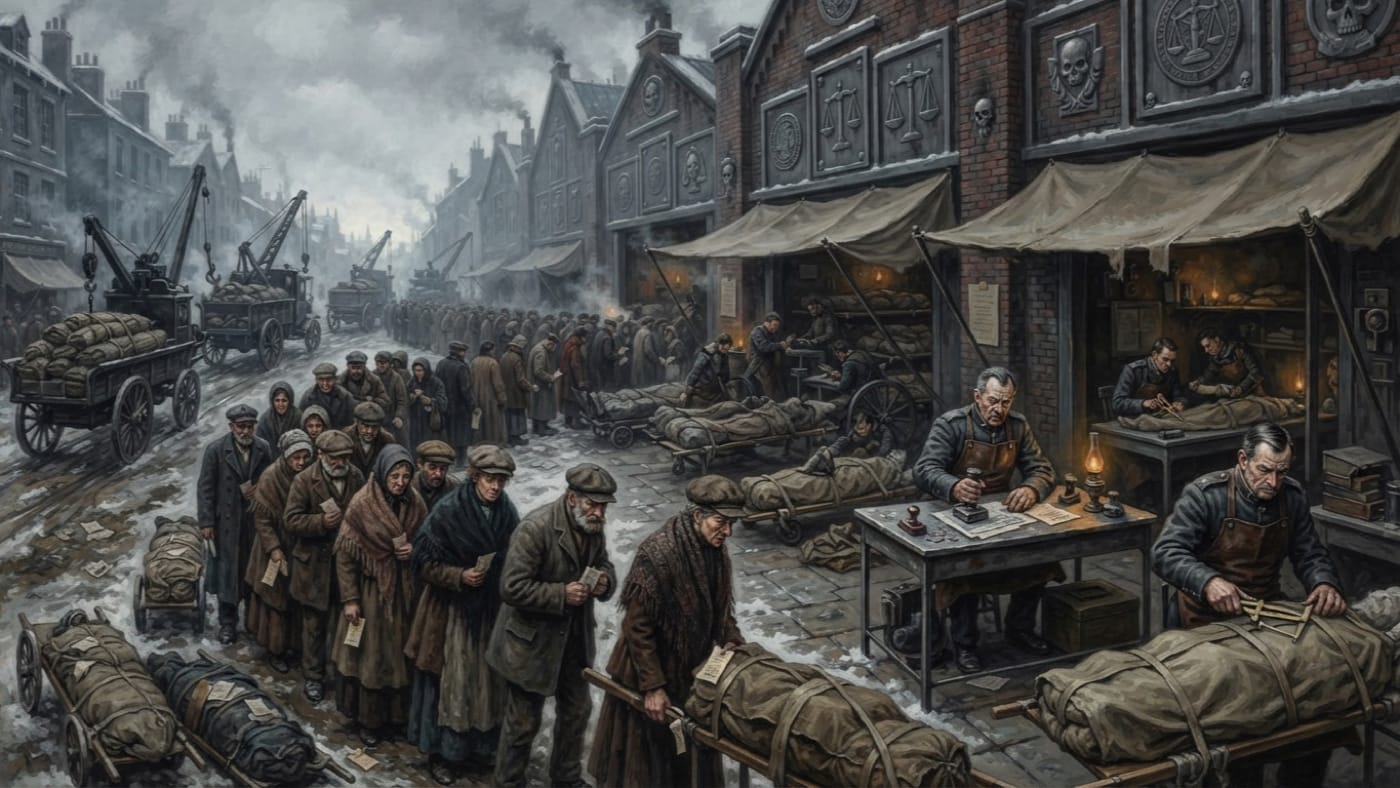
The Plague Winter belongs to A.S. 157, the famine year, and to no particular month. The Ledger records when the offices panicked. It doesn't record when the sickness arrived, because sicknesses file no application. What survives is the shape of the problem: the dead outnumbered the clerks licensed to classify them, the families of the dead would not go home without a stamp, and for one season the two populations shared the same pavements, the same chapel awnings and the same cold air.
The reader must keep apart two things that the Synod's own retrospectives like to fuse. The winter was the emergency: hunger on the roads, fever in the wards, bodies in the bays. Gray Clearance was the response, the procedure that moved remains faster than their names could follow. Fuse the two and the Bureau's answer becomes the whole history. That is why the Bureau fuses them.
#On the Hungry Roads
A.S. 157 had made itself vulgar before anyone coughed. The Iberian campaigns had stripped the western stores, and the western granaries were redirected toward the southern theatre on orders written by men who still dined in Strasbourg. The Bureau of Tithes met the shortfall in its native dialect, which is the emergency levy, and revived the Widow's Pennies. In a year without bread it is a fine thing to be reminded that a widow still has coins.
Relief existed. Relief always exists. It was dispensed the way the Synod dispenses everything, against paper: a ration class, a confession receipt, a permit to be where one was standing. Hungry people without papers did what hungry people do and walked toward places rumoured to have them. The Bureau of Pilgrimage was overwhelmed. That is the approved phrase for roads carrying more bodies than its hostels, passes and route schedules could absorb, some walking and some carried, with the ratio shifting by the week.
The Synod has no registered cause for the sickness that followed those roads. Doctrine had interpretations, and so did the Bureau of Rites. They were offered from pulpits and stamped in chapel circulars, and they disagreed in the courteous way of two offices that each wanted the other to pay for the funerals. I won't adjudicate. The Ledger names no pathogen and no first patient, and I am not paid for etiology. The roads were full, the people on them were starving, and starving people standing close together in the cold do not need a theologian to help them die.
#On the Bays That Filled
In ordinary years a body entering a tariff-chapel became one of five things: Burial, Transport, Salvage, Ornamental or Contaminated. Each designation had its tests. Kin had to be verified and documents matched to tags. The purity lamp had to be read and the bones measured with calipers against the standard tables. Oversight sat jointly with Tithes, Rites and the Bureau of Records, so each test also had a jurisdiction, and each jurisdiction had a clerk who could hold a body until the question was settled. That is the system working as intended. Classification decides whether a man is buried under his name or set into a wall without it, and a decision of that weight is supposed to be slow.
In the Plague Winter the slowness compounded. One unverified claimant held up one slip, and the slip held up a bay. A full bay closed the intake lane, and a closed lane left the wagons standing in the street. Within a fortnight of the backlogs taking hold, the queues at Marrowgate, at Strasbourg, at the Rhine corridor establishments and at the bastion intake chapels had passed what their staff could process. Bodies lay in the intake bays, then in the chapel corridors, then outside under canvas, waiting for clearance in the open air.
Marrowgate shows the arrangement most plainly, because Marrowgate was built for the dead to arrive in quantity. Its Wagon Quays are intake lanes, with no sea anywhere near them, and that winter they smelled of wet canvas and horse sweat. Behind them stood the White Ward, all vinegar smoke and boiled linen, where the living were losing the argument. Beyond both lay the Lime Yards, chalk dust and hot stone, where the dead stop being people and become material. The Sanitation Chapter policed the cordons. The Dead-Goods Tariffers sat at their cold desks with their lamps and calipers, doing correct work at a speed that had become lethal.
The families stayed. They had to. A body left unattended in a winter queue could be misrouted, mislaid or claimed by someone else, and a family that walked away to eat might come back to an empty space on the stones. So they stood holding the tags, and sat down beside the canvas, and slept where they sat.
#On Emergency Clearance
The answer, when it came, was two words. CLEARED meant the remains could move. HELD meant they could not, yet.
No single office admits to having designed Gray Clearance. Three or more admit to having been present when it was used. Under its emergency practice the five categories were suspended, and the cleared dead went straight toward the Lime Yards without lamp, caliper or kin verification. Carts that had stood idle for days began to move. Bays emptied. The canvas came off the pavements.
The reader should be exact about what the stamp said. CLEARED permitted the remains to travel. It did not identify them, and it certified nothing about their spiritual condition. It promised no family a grave. A cleared body could be anyone's, and once lime had taken it, it was nobody's. The five categories were not destroyed. They waited behind the two words, and where back-classification was attempted later it usually came after the material had been used. A wall does not surrender its contents for better paperwork.
HELD covered everything that would not go. It could mean a suspicious flicker in the lamp, a missing document, two families claiming one body, or a clerk waiting to be paid. The held dead stayed behind rope, and their families stayed with them.
The Ledger has to carry both columns at full value. The streets were cleared of rot, the wards stopped receiving fresh contagion from the bays, and the living were protected by dead who moved faster. In the same carts, unidentified remains went into material use, bodies were misrouted, and families lost their claims to their own dead without being told. The Bureau cannot cancel one column against the other, and I have stopped letting junior archivists try.
#On the Price of Speed
Gray Clearance was an emergency procedure. Selling it was something else, and the difference lasted less than a fortnight.
During the Clearance's second week, families whose dead were held began to form a line outside the Tariff-Chapel of Saint Morin in Marrowgate. Its name began as mockery. The Mercy Line stood along a rope. Some of the people in it held only slips and tags. Others held things that could be quietly handed across, and clerks accepted them. Certain held bodies cleared, and others stayed put. Grieving people are not stupid, and before long everyone on the rope understood the rate.
No protocol authorised the payments. The emergency procedure let a clerk move the dead without the full tests. It never let him charge for the favour. That distinction matters in law. It mattered very little to a mother on the rope, who saw two bodies held for the same reason and one of them leave before noon.
Saint Morin's cult grew thick in that chapel. His icon is a skull with its teeth sealed in wax, and the wax touched clerks' lips before each shift and was pressed onto tags that had been held. That much is local ritual and should be filed as such. The record holds no intercession by the saint, no first corrupt clerk to hang the custom on, and no miracle at the rope. It holds only wax, which is cheap, and silence, which the chapel had in quantity.
#On Revocation and Survival
Gray Clearance was revoked in A.S. 158. The five categories were restored in public law, along with the lamp, the calipers and kin verification. Unauthorised acceleration was prohibited, the queues lengthened again, and the slowness that had nearly drowned Marrowgate became virtue once more.
Revoking a procedure is not the same as ending a winter. The Ledger has no closing date for the sickness, and the revocation is no substitute for one. The disease ended at some point when nobody was keeping minutes, and the bays went quiet sooner in some cities than in others. Famine-year clean-up went on into A.S. 158, when the Bureau of Agriculture was dissolved. That was a reckoning with granaries and recommendations. It did not cure the plague, and Gray Clearance did not cause it, whatever the more imaginative chapel histories suggest.
Synodal retrospectives state that the Plague Winter and its mortuary irregularities ended with the A.S. 158 revocation.
CORRECTED. The revocation ended the emergency protocol in public law. The date the sickness ended was never entered. The irregularities outlived both.
The irregularities survived as the mercy stamp, off-ledger and for sale, a speed that families had learned could be bought. The plague did not survive, and nothing in the record says it did. The habit survived, and that was enough. By A.S. 201 the tariff-chapels are split between Pure Chain clerks, who hold to the full procedure and let the queue grow, and Mercy Stamp clerks, who hold to throughput and let the procedure shrink. Each faction cites the Plague Winter, and neither cites the families on the rope.