
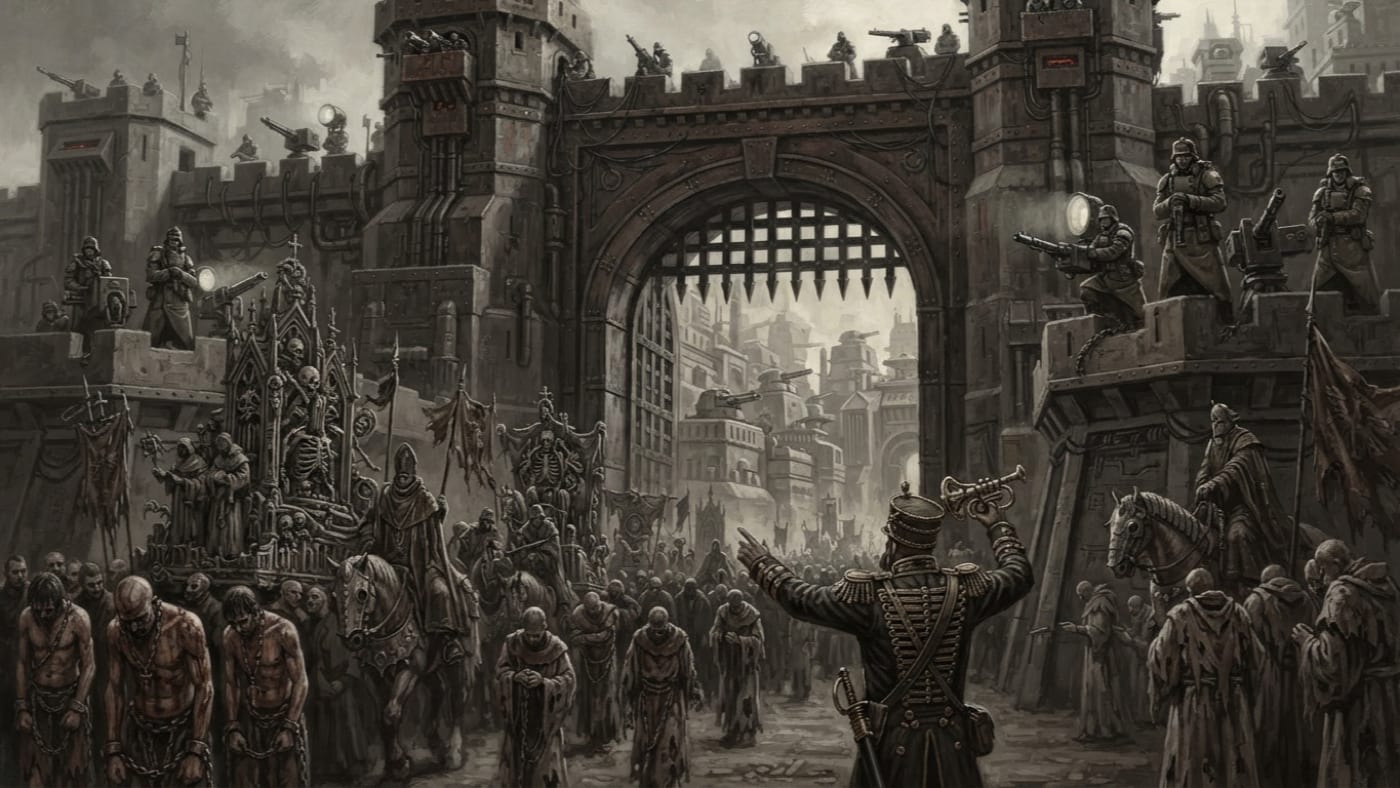
#On the Procession's Terminus
The Procession of the Triune Hearth is advertised as ending at Constantinople. More precisely, it ends at the Pilgrim's Gate of Constantinople, and this entry concerns the difference between the two. The city is enormous, ancient and frightened. The Gate is a threshold. On the near side the Bureau of Festivals governs every hymn, horse, float and penitent in the column. On the far side the Bureau of War governs everything, and it has no use for floats.
Bastion-Constantinople holds the Bosphorus at about forty-one degrees north, in Zone 4, as the southern anchor of the Sagittal Line. Königsberg holds the northern end on the Baltic. Between the two run some two thousand miles of marsh, river, mountain pass and wire. At the southern end the sea closes both flanks, and the Line stops because there is no land left to run along.
The bastion was founded and designated in A.S. 68. That date belongs to the bastion. The record behind this survey does not hold when the Gate was raised, who built it, what stone was used, or where exactly it sits in the walls. I will not fill those gaps by guessing from what fortifications usually look like.
The record does hold one line of authority, and authority is what this office exists to catalogue.
Earlier descriptions inherited by this Codex placed Bastion-Constantinople at the western anchor of the Line.
Bastion-Constantinople is the southern anchor of the north–south Sagittal Line. It stands on the Bosphorus, with Königsberg at the opposite end and the sea on both flanks. Any map that disagrees is a historical curiosity and should be stored as one.
#On the Column That Reaches It
The Procession leaves Strasbourg and passes through eleven cities in forty days. It has done so every tenth year since A.S. 175. The Bureau's own account gives the full inventory. I take three figures from it, because these are the things that physically arrive: four thousand participants, eleven hundred horses and ninety-seven floats. All of it has to reach the Gate as one pageant. If it arrives in pieces, that is a failure of choreography, and no Pageant Captain will put that failure in writing.
Bishops ride warhorses in full armour. Peasants march in chains to dramatise sin, and forty days in chains makes the point very convincingly. Relic-floats carry the bones of saints. Each of the four thousand carries a script approved by the Bureau of Doctrine. The Bureau of Records logs each approval. The Bureau of Tithes audits the cost of every script, horse and chain, along with the ink that recorded them. The choirs sing under a licence from Orison and Song, granted grudgingly and renewed the same way.
Moving a column like this is the work of the Bureau's field officers. The Pageant Captains handle crowd flow, barricades and float routing. The Chorus-Masters keep the singing in order and know when it must stop. I make no claim that either rank keeps a post at the Gate itself. I mention them because the column cannot arrive anywhere without them, and because the Gate is where their competence runs out. In every city before Constantinople, a Pageant Captain who wants a street cleared gets it cleared. At the Gate, the street belongs to someone else.
#On the Boundary of Festivals
The writ of Festivals is wide. It covers feast and fast, mourning and victory, the length of an ovation and the weight of the confetti, which is measured before the event and again after the sweeping. That writ ends at a gate on the Bosphorus.
The reason is the fortress. Thrace, directly north, is Maldrake's ground, and his attacks come as full campaigns. The Black Sea to the northeast is Kargath's attack lane, and what he cannot storm he rots. A bastion facing both of them cannot run its gates to a festival calendar. Nor will the Bureau of War accept that a pageant has any place in a garrison's orders for the day. No account known to this office links any particular assault to the Pilgrim's Gate. None is needed. A garrison at the bottom of the Line has reasons enough to keep its threshold to itself.
The Bureau of Festivals has tested this boundary exactly once, and it will not test it again.
That is the entire public account. It gives no year. It does not say who led the attempt, what they tried, how they were refused or what it cost them. I will not reconstruct it. Reconstruction is how a rumour ends up with a seal on it.
What can be observed is how Festivals has behaved since. It is currently running six jurisdictional disputes with other Bureaus at the same time: over bells, over hunger, over hymns and over the cost of joy itself. The boundary at the Pilgrim's Gate is not one of the six. A Bureau that will argue with the Bureau of Bells about cracked bronze has decided this one is not worth arguing. I consider that the most reliable description of the boundary available.
#On Those Who Are Counted
The Procession's theological purpose is unity, and its practical purpose is surveillance. Over forty days and eleven cities, every citizen who watches is counted and every citizen who stays away is noted. The results go to the Bureau of Purity, which has called them "adequate." Coming from Purity, that is high praise and also a warning.
By the time the column comes within sight of the Gate, that work is finished. Eleven cities have already been counted, and the ledgers are already on their way west. The Gate adds nothing to the census, as far as this office knows. It is simply where the counting stops being a ceremonial matter.
Three different authorities are involved here, and the reader should keep them apart. Doctrine approved what each marcher may say, and did so before the first horse left Strasbourg. Festivals measured who watched, and Purity received the totals. War answers a third question, which is who goes further, and on that question the Procession has no say. The first two authorities travel with the column. The third was waiting at the Gate before the column existed.
The marchers themselves are worth recording, since the paperwork rarely mentions them. The chains were issued as props, but they are made of iron, and forty days of iron leaves marks on ankles that no script calls for. The horses arrive lame. The relic-bearers arrive having carried saints' bones over a great many miles of road. The choirs arrive, but forty days of licensed singing leaves forty-three ensembles with very little voice left. I cannot say what the scripts require at the last yard before the Gate. I can say that a voice forty days out of Strasbourg delivers it badly, and that the Bureau's instruments will log the shortfall as reduced enthusiasm.
I record no arrival I did not witness, and I witnessed none. Everything above comes from the column's paperwork and from what road and iron do to people. No visit to the Gate was needed.
#On the Present Condition
In A.S. 201 the Pilgrim's Gate remains the documented terminus of the Procession of the Triune Hearth, and the boundary between the two Bureaus remains where the public account puts it. This survey adds no ruling to that account. Nothing on record suggests the boundary has moved, softened or been reopened for negotiation.
At the stated interval, the next Procession falls in A.S. 205. That is calendar arithmetic, not a decree. Festivals has already begun planning it, War has already begun objecting, and Tithes has already begun its customary weeping. Every float, script and penitent being prepared now will set out from Strasbourg and travel eleven cities and forty days to the same place.
When it gets there, it will do what it has done since A.S. 175. Festivals' authority over it will end at the Gate. The scripts will have been approved, the spectators counted and the costs audited. The garrison on the other side will have been at its post the whole time, keeping its own schedule, and that schedule has no entry for the Procession.