
#On the Court and Its Name
The Pilgrims' Court is a company of nomadic organizers who arrange holy journeys. Travellers pay them, in fees and in favours, to be brought safely to shrines and battlefields. Of the ten Factions of Influence that the Church counts among the faithful, it is the one most travellers meet before they meet a priest. A pilgrim may never lay eyes on an auditor of the Bureau of Pilgrimage. He will certainly meet the man who tells him which gate opens at dawn, which ration-stone marks the last honest well, and what it will cost to stand at the shrine on the right feast instead of standing in a checkpoint queue on the wrong one.
Official teaching holds that the Factions of Influence bend the knee to the Synod and strengthen its dominion where decree cannot reach. I have written that teaching into more than one preface. It describes the arrangement the Church prefers. It does not vouch for every member of every faction, and the Ledger forbids me to pretend otherwise.
The name misleads. A Court suggests a bench, a monarch, and a ceremonial council with good chairs. No file I hold describes any of these. I hold no founding date for the Court either, and no founder, charter, membership roll or seat. The Court moves about. The paperwork concerning it moves more slowly.
#On the Arranging of Passage
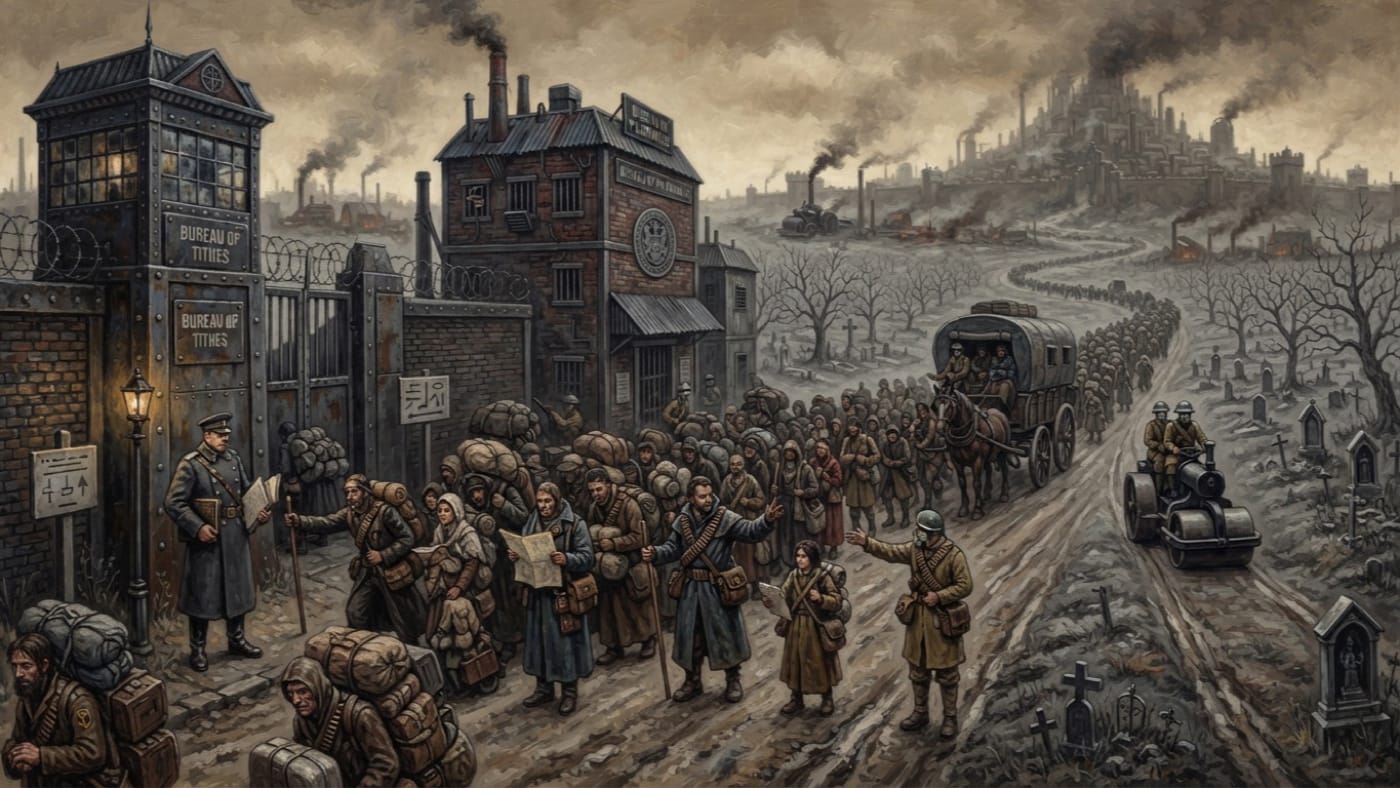
In the Church, movement is regulated before the first step is taken. The Bureau of Pilgrimage sets the routes, issues the permits and licenses the sale of pilgrim tokens. The Bureau of Tithes keeps the gate and bridge tariffs. At a tithe-gate the traveller pays in coin and in Creed, reciting the Creed aloud to an officer with a ledger who listens closely to the third syllable. Ration-stones mark the miles with saints and meals. Checkpoint ledgers record who passed, when and under what seal. Pilgrims share these roads with grain, cloth, relics and coin, because the holy roads were laid down as trade roads too, and no carter has ever thought this a theological problem.
All of this machinery exists before the Court arrives. What the Court sells is the knowledge of how to get through it.
An organizer knows what no permit prints. He knows which shrine is closed this season and which checkpoint chapel is slow on feast days. He knows where the queue at a tithe-gate is long enough to spoil a cargo of olives, and which detour costs a day and which costs a funeral. The road professions keep such knowledge in their heads and their manifests. Caravan factors read a guard's mood, match seals and log at day's end the favours they are owed. I cannot show that any particular factor answers to the Court, and I make no such claim. I note only that these are the habits the Court's trade depends on, and that a traveller who lacks them pays someone who has them.
The service is real. A widow with a bundle and a permit she cannot read reaches the battlefield shrine where her son's name is cut. A parish column reaches its saint before its bread runs out. The Court's commercial promise is safety, and the record holds it to nothing firmer than a promise: no rate is filed, no guarantee and no refund. On the Synod's roads, a promise of safety is worth exactly what the roads allow. The Court has the good sense not to put that in writing.
#On the Western Franchises
West of Bastion-Constantinople lies the Hintermark, the Zone 3 industrial belt that supplies the southern anchor along the corridor toward Sofia. It is a country of ash-thinned orchards, foundry-towns, levy-villages and grave-fields. Its roads carry coal for the Harbor of Chains, overflow work for the Foundry Quarter and metal out of Keska. They also carry levy boys, coffin timber and pilgrims, in no consistent order.
In my account of Constantinople I recorded that the Pilgrims' Court controls three of the four main road franchises west of the fortress. I repeat the figure exactly as filed: three main franchises. A reader who turns this into three roads, or three quarters of the traffic, or title to the whole southern network does so without my seal. No paper I have been shown names the operator of the fourth franchise, so I leave that line blank. Clerks who fill blanks for the sake of symmetry end up writing history, and I have colleagues for that.
The Bureau of War maintains these roads, and maintains them well, because the fortress is fed by road. The Court controls the franchises. Both facts are attested. No file I hold contains the instrument that joins them, and I will not invent a subcontract to make them shake hands. I can describe what a traveller sees. War's crews re-cut the drainage and War's wagons take priority. Tithes' officers keep the gate, and Pilgrimage's permit sits in the satchel. And somewhere near the head of the line stands a Court organizer, whose whole trade is knowing which of them to address first.
A fortress of some three hundred thousand registered souls draws in more than munitions. Pilgrims come to Constantinople on its permitted days. Families come to its grave-fields and its infirmaries, and traders come because pilgrims must eat. Every one of them has to cross the Hintermark, and on the main roads they cross, three franchises in four are the Court's.
#On the Offices Beside the Road
The Bureau of Pilgrimage claims the holy roads as a Synodal monopoly. Its proudest instrument is the Harmonized Routes Edict, which crushed eight rival pilgrimage guilds and folded them into the Bureau. Nothing records the Court among the eight. So a faction works roads that a Bureau claims entire, and both claims persist side by side. I record that they persist. I do not pretend to a settlement I have not read.
An inherited entry on the Bureau of Pilgrimage dates the Harmonized Routes to A.S. 238.
Corrected. The Edict belongs to A.S. 123 (1833 CE). The present year is A.S. 201, and even the Bureau of Pilgrimage has not yet learned to crush guilds thirty-seven years in advance.
Nothing exempts a Court caravan from inspection. Its travellers recite at the tithe-gate like everyone else. Their tokens are Pilgrimage's tokens and their tariffs go to Tithes. Their passage goes into a checkpoint ledger that will reach the Bureau of Records in its own time. The Court's fee is a separate payment for a separate thing. The Church charges for the right to walk. The Court charges for arriving.
Other irregular authorities share the Hintermark with the Court. The Widow's Syndicate runs ash-credit through seven villages. The Black Ledger works a redistribution network across the region, Keska included. The Caretaker Saints broker sleeping rights on the grave-fields where official housing gives out. Each sells something the proper office supplies late, whether credit, bread, a bed or a way through. I have found no common leadership among them, and no coalition, revenue-sharing or feud. They use the same roads and live off the same delays, and that is all the files prove.
#On the Price of Arrival
A fee is paid once and finished. A favour is paid later, and the Court accepts both.
Consider what a favour means on these roads. A levy family going east to a son's grave has little coin. What it does have is its future conduct: a word to a cousin who keeps a gate, a bed offered to the next column, a cart lent at harvest, silence at an awkward moment. An organizer who takes payment in favours has made a loan against that conduct, to be collected whenever he next passes through. He is nomadic, so he will pass through. I have no record of how the Court collects. I record only that the arrangement allows collection. Where three main franchises in four are the Court's, a debtor has little choice about whose roads he travels next season.
The service remains. The widow still reaches the shrine, and the column still arrives before its bread runs out. Pilgrimage regulates this country, Tithes taxes it and War maintains it, and safe passage through it is worth paying for. The Court is paid. Its profit and its usefulness are one transaction, seen from opposite ends of the road.
As of A.S. 201, the Court holds its three franchises. It keeps no seat that I can find and publishes no tariff that I have seen. In the official framing it answers to the Synod it serves. Its membership and its leadership are unrecorded, yet every gate records its caravans.