
#On the Seventh Berth
Bastion-Constantinople has seven ravelins, six ossuary rings and twenty-three bells. Its harbor has a seventh pier. The other sevens are celebrated. Nobody has written up Pier Seven, because no one had to account for it until something stayed there.
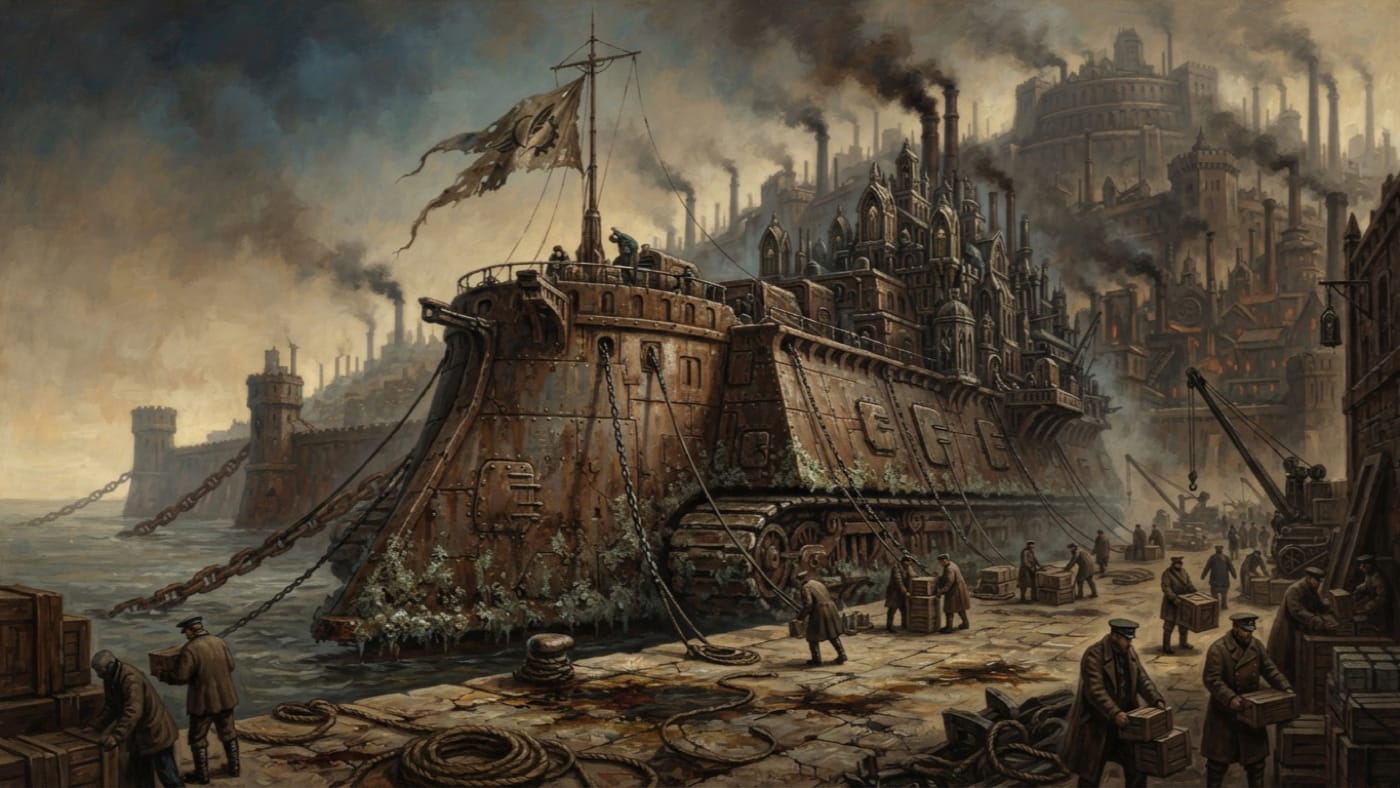
It is a berth of the Harbor of Chains, on the stretch of fortified quay where the waterfront meets the Foundry Quarter. The Catacomb-Carrier Threnody occupies it. That is the whole of its fame, and it is more fame than any pier needs.
I am Valerius Drax, Hieromnemon and Archivist of the Bureau of Doctrine. I have surveyed cathedrals, ossuaries and one vault that grows between audits. Now I have been asked to survey a mooring. I went through the deeds, the dedications and the registers of construction. Pier Seven appears in none of them. I found no founding charter, no name of a consecrating bishop, no architect's plate and no recorded first berthing. The Ledger knows the pier only as an address, in the way a parish knows a house by the trouble that comes out of it.
This entry is a survey of the pier's present condition in A.S. 201. It does not pretend to be a history.
#On the Quay and Its Neighbours
The harbor runs along the Bosphorus as a mile of walled quay. It is stone and iron, worn black in some places and green in others, and bells and lanterns mark off its hours. At night the great reliquary chains close the strait. Their condition has its own entry and its own officer, Harbormaster Joram Clee, whose daily inspections are of the chains and nothing else. I name him here so that nobody assumes the harbormaster has views on Pier Seven. If he has, he keeps them out of the logs.
Behind the seventh berth the Foundry Quarter climbs inland in sheds, chimneys, proof-ranges and furnace roofs. The Carrier Yard occupies the Quarter's southern strip, between the Ossuary Rings and the water. The workshops of the Order of the Shackled Flame lie under all of it, at a depth the civic maps prefer not to show. Pier Seven is where the Quarter's most famous product meets the harbor's most ordinary function. The two have not come to terms.
Everywhere else on the quay, work carries on. Ropes creak against bollards. Wax smoke from the seal-houses mixes with brine and coal. Porters count crates aloud, and clerks tag the crates with paper that has gone soft by noon. The bells divide the day. The berths take ships, empty them and let them go. Arrival, unloading and departure are the only liturgy a harbor knows.
At Pier Seven the third part of that liturgy has stopped happening.
The Three-Night Bombard of A.S. 177 tore through the Foundry Quarter, and reconstruction was certified in A.S. 179. The records I consulted do not say whether Pier Seven was damaged, rebuilt or left alone. I am recording that silence. I will not decorate it.
#On What Stands at the Berth
Threnody is the oldest surviving engine of her class. She was commissioned in A.S. 145 under the programme the Bureau of War later chartered to the Order. The Catacomb-Carrier is a land-fortress, sixty tons by the class figure. It has iron treads, bone-resonance speakers that carry hymns, blessed artillery and compartments for shield-saints in full panoply. Its hull is built on ossuary principles, with relics laid into the structure so that it keens when struck. In the field it is described as a cathedral that crawls.
At Pier Seven it is described as moored.
I record both descriptions. Reconciling them is not my office. A treaded reliquary-engine stands at a harbor berth, the registers call that mooring, and the Bureau of Engineering has not asked the Bureau of Doctrine to adjust the vocabulary. Until it does, the word stands.
Descriptive summaries of the Catacomb-Carrier class, written for recruitment and procession, present Threnody as a moving sepulchre now in service along the Sagittal Line.
Corrected for the present survey. Threnody is at Pier Seven, Harbor of Chains, Bastion-Constantinople, under maintenance. Any account of her present travels refers to an earlier condition or to a different engine. Recruitment literature is advised to use the past tense.
What can be seen from the quay is armour plate, much of it rusted at the seams. Barnacles have colonised the tread guards, which is the plainest proof I have that the sea has opinions about land machinery. The hatches are sealed. A pennant of the Bureau of Records hangs from her upper works, which tells you who keeps her paperwork. It does not tell you who keeps her. A Records survey woodcut of A.S. 197 shows the same face: rust, barnacles, sealed hatches and the pennant. Whatever I say below about the interior comes from documents. None of it comes from looking.
#On Maintenance, as a Doctrine
Maintenance is a Synodic sacrament without a sanctioned rite. It has no fixed end, and no outsider can judge how far along it is. It does not need to be finished to be in progress. Threnody has been under maintenance at Pier Seven for a long time. I have seen several durations quoted. They do not agree with each other, I have not been asked to make them agree, and I refuse to pick one to make the paragraph read better.
The arrangement of responsibility is clear on paper. The Bureau of War holds the charter. The Bureau of Engineering draws the plate and advises on the machinery. The Order of the Shackled Flame prepares and keeps the bound housing that the Order's own literature calls the engine's motive element. Under the War charter the Order receives "residual demonic essences" and restrains them in iron. The Order insists that it does not summon. Doctrine decides which explanations can be printed. The Bureau of Purity stands at the top of the stair in white gloves and notes the explanations for later. Arch-Artificer Lute Brann oversees the Workshops below.
Four offices share responsibility, and the pier sits outside all four. No document I could find assigns Pier Seven its own commanding officer, warden, deed of ownership or roster. As far as I can establish, the berth is governed by everyone who governs the engine and by nobody who governs the berth.
The maintenance logs are sealed. They run to six hundred and fourteen pages, and I have read them. The word "voice" appears forty-two times. Each time it is in quotation marks, and each time it comes with an explanation: thermal noise, hull resonance, hymn residue in the speaker housings, or a fatigued listener. Every entry is qualified. The logs do not name a speaker. They do not establish possession, and they do not say why the hatches stay sealed. I record what the logs contain, and I say plainly that the logs contain nothing more.
Engineering keeps the logs in the language of tolerances. The Order keeps its own observations in the language of restraint, which is what one would expect from a body whose badge is a flame inside three broken iron bands. Doctrine has not ruled on whether the quotation marks are a devotional practice or a technical one. Its ruling, when it comes, will be correct.
#On the Registered Crew
The register gives Threnody's crew complement in four words and a dash:
Intact — see supplemental.
I have spent more time on those four words than on some sieges. "Intact" is a statement about the register, and the register is in good order. It does not describe any living body, any posting, any rotation of crews or where the crew sleeps. A crew can be intact in the Ledger in the same way a regiment can be at full strength on a muster roll whose clerk has not been told otherwise.
"See supplemental" sends the reader to a document. That document was not with the register when I consulted it. I am not alleging that it was removed, or concealed, or that it never existed. The Bureau of Records cross-references a great many things, and a cross-reference is a promise that may be kept in another building. I am recording that the promise is outstanding.
What is aboard, I do not know. Why the maintenance continues, I do not know. The quay workers say things, as quay workers always have. I have not entered their sayings as evidence, because evidence needs a signature and gossip only needs an audience.
My findings are these. Pier Seven exists. It is the seventh berth of the Harbor of Chains, adjacent to the Foundry Quarter of Bastion-Constantinople. A Catacomb-Carrier commissioned in A.S. 145 occupies it under a maintenance designation with no recorded end. The quay is in working order, and so is the harbor around it. The engine is described as moored. Its crew is described as intact. Neither description is false as written.
I certify the occupation. I do not certify the reasons for it.