
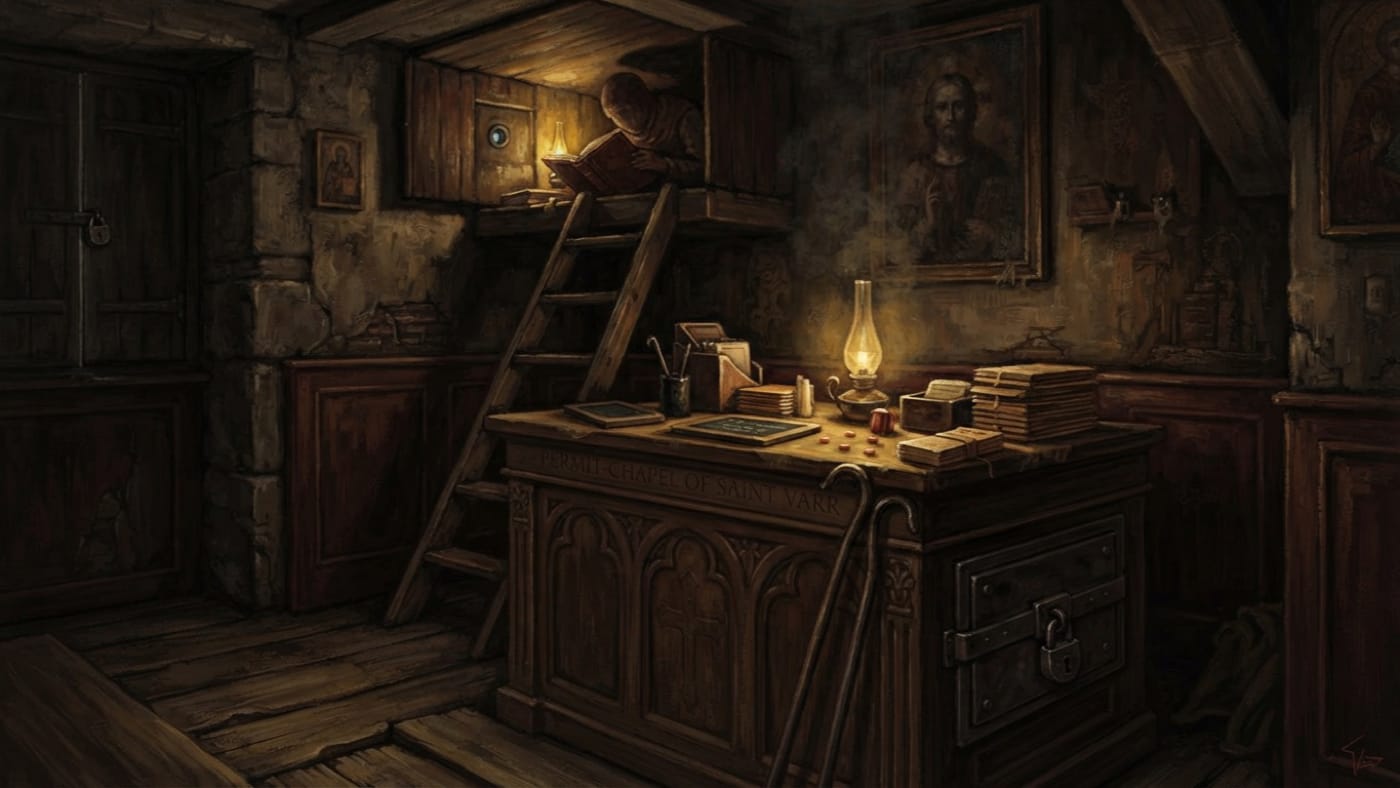
#On the Shrine Between Hall and Court
The Circle of Nine Wicks keeps its house in a building barely larger than a vestry. The Permit-Chapel of Saint Varr is a shuttered side-shrine wedged between a ration hall and a market court. It sits close enough to both that the bread queue leans its damp shoulders on the chapel wall, and the bargaining from the court comes in through the shutter-slats for free. The shutters stay closed and the chapel stays occupied. Anyone who takes a closed shutter for an empty room has never worked a night in a Bureau.
I can still list the smells in order of rank: lamp oil, old bread, wet wool, and under them the sour residue of hungry people made to wait. A queue leaves its fear in masonry the way a censer keeps its resin. Sweeping does not remove it, and the Circle has never tried.
The shrine is dedicated to Saint Varr, whose official recognition is disputed. I record the dispute and leave it unsettled. Nothing establishes when the building was raised, when it was first dedicated, or on what night its altar stopped serving the Creator's offices and began serving the Circle's. As of this survey, in A.S. 201, I have found no instrument that would establish any of them. The Lantern Brotherhood arrived and the saint remained. Nobody consulted the saint.
#On the Altar and the Permit
The altar is a desk. My inspection note on the chapel opens with that sentence, and I have seen nothing since that would make me revise it. The Circle's working instruments cross that slab on their way out into the lanes: citation slates, wax permit dots, and the short shepherd's crooks the Brothers call crowd-hooks. The slab was consecrated to receive the elements. It now receives receipts, which I consider a lateral transfer of function.
The permit dot is the chapel's sacrament, and its theology is simple. A stallholder pays. In return his window is classified as "properly lit" and his stall as "unselected." Those two words decide whether his sacks are opened at the dawn rush or after trade has closed, and whether the Blade's polite questions come to his counter or to his neighbour's. The Circle's own published account says plainly that the dot has no Bureau standing. The coin has standing, and it has it at once. No fee schedule has ever been written down where I could find it, and no permit states how long it lasts. Price is a conversation, and the conversation is held with a crook in one hand.
Once a stall is under lantern, its post is marked with nine small chalk wick-strokes. A stall that refuses the arrangement, or offends after paying, may "lose light" for seven nights under Permit Revocation. In a market court, seven nights unlit is a funeral without the expense of a coffin.
#On the Loft and Its Witness
A narrow loft runs above the altar-desk. It holds the Echo's ledgers, and a peephole looks down on the queue lanes. Of all the chapel's fittings, this one has been least corrupted from its first purpose. A shrine-loft was always built so that someone could watch the faithful without being watched himself.
The Circle patrols by the Triangle of Witness. The Anchor stands at the choke-point with his lantern hood half open, so that the queue can see it is being watched. The Blade moves through the line as a searching pair. The Echo never intervenes. He records, and he identifies the seizures to come. These are three positions, which need not mean three men, and an Echo may just as well work from an awning, a shutter crack or a stall vent as from upstairs. The loft is useful because it is fixed, dry and above the crowd, and because the ledgers already sit beside the peephole, so the first report can be written there before the person it accuses has understood the accusation.
The peephole sees a hand near a sack. The ledger records a theft. Between the two stands the Echo with a pen, and the pen has the quotas in mind.
#On the Night's Account
The chapel keeps an order of hours as strict as any choir's, and more consistently observed.
Read the order from the altar's side. Oil leaves the chapel at dusk, as measured as any tithe. Coin comes back through the early night. At midnight a seizure is staged for the queue's instruction while a second transaction goes unrecorded. Names come in late. Before dawn the scrap notes go into the same lamp that lit the night, and the totals go upstairs to be made to agree with each other. What the Circle offers in return for being tolerated is a weekly seizure theatre and monthly riot-prevention figures in which curfew compliance "improves" on paper. Both are produced at this desk.
The Circle teaches its Ember-Pages restraint by the Bread-Wick. The initiate holds a flame over a ration loaf until the crust blackens, and the loaf must not catch. The lesson is pressure without fire: singe the edge and keep the commodity. I do not know where the rite is performed, and I will not pretend it happens in this chapel. It is enough that its graduates run the chapel. A market that burns yields no fees, and Nine Wicks is never short of fees.
#On the Chapel's Toleration
The chapel has no standing of its own. It borrows the Circle's. Nine Wicks operates under a writ of toleration from the nearest Warden-Captain of the Wardens. The writ can be revoked without notice or appeal. Its precedent is the Curfew Ordinance of Quiet Hours of A.S. 94, in which Vicar-General Anselm Rihn allowed "auxiliary vigil personnel, locally licensed." The ordinance says nothing of Saint Varr and nothing of this building. It dates the clause. It does not date the chapel, and anyone who tells you the shrine was converted in A.S. 94 has confused a licence with a lintel.
A Brother sworn here may detain a citizen. He may not arrest one, because arrest belongs to the Bureau of Purity. The chapel is therefore neither cell nor court. Queue Penance is carried out at the front of the line, in the open air. The offender recites a scripted confession until the crowd accepts it, and the chapel supplies the script.
Brotherhood chalk-sign glossaries gloss the Crossed Wicks mark, "proof required here," as an instruction to "make an arrest, find contraband, or fabricate a reason."
Corrected to "effect a detention." The Brotherhood holds no arrest authority. The rest of that gloss is left as printed. It is accurate.
The Bureaus tolerate the arrangement for reasons of their own. The Bureau of Tithes likes stable markets, because stable markets can be counted. Purity watches and keeps a file. The Bureau of Records receives the classifications and reported figures that come down the loft ladder each morning, and it has a strong preference against learning where they came from. The Bureau of Shadows watches the watchers, which is its devotion. None of them owns the chapel or appears in its deeds, if it has any deeds. Purity counts a quiet queue as a benefit, since a quiet queue is a poor congregation for Mercy Preachers. The Brotherhood's wider dealings with those preachers are filed elsewhere, under a more embarrassing heading.
Standing Order 14-V, revised A.S. 199, limits a licensed Circle to thirty operatives. That limit describes the Circle, not the room. The room is too small to seat thirty, which may explain the shutters.
Saint Varr endures through all of this the way disputed saints usually endure: kept for the name over the door. Whatever image hangs above the desk is dim with lamp-soot, and I will not invent a face for it.
#On the Locked Drawer
The saint's reliquary is a locked drawer. It holds three kinds of paper, and the Codex must keep them apart even when the Circle does not.
The first two are the chapel's ordinary sins. Permit dots wait there for a buyer. Confiscation tags wait there for the goods they will turn into evidence. The third is the pre-written confession, made ready for Queue Penance, which spares the penitent the labour of composing his own guilt. That is the chapel's daily traffic, tolerated in the same way the light permit is tolerated.
The Confession Closet is something else. The name refers to the cache, not to a separate room, and the cache holds blank confessions and pre-signed citations. They are used on nights when the quotas want proof and the city has provided none. A blank confession needs only a name. A citation signed before its offence exists needs only an offence. With both in hand, the Circle can produce a culprit to order before dawn.
If Wardens or Synod auditors open that drawer, Nine Wicks will be a criminal gang by morning. Purity would call it a heretical apparatus. Records would first check the forms for procedural adequacy. The chapel would stay standing, of course. Buildings are rarely charged.
No such opening has happened. The audit is threatened and has not been scheduled.