
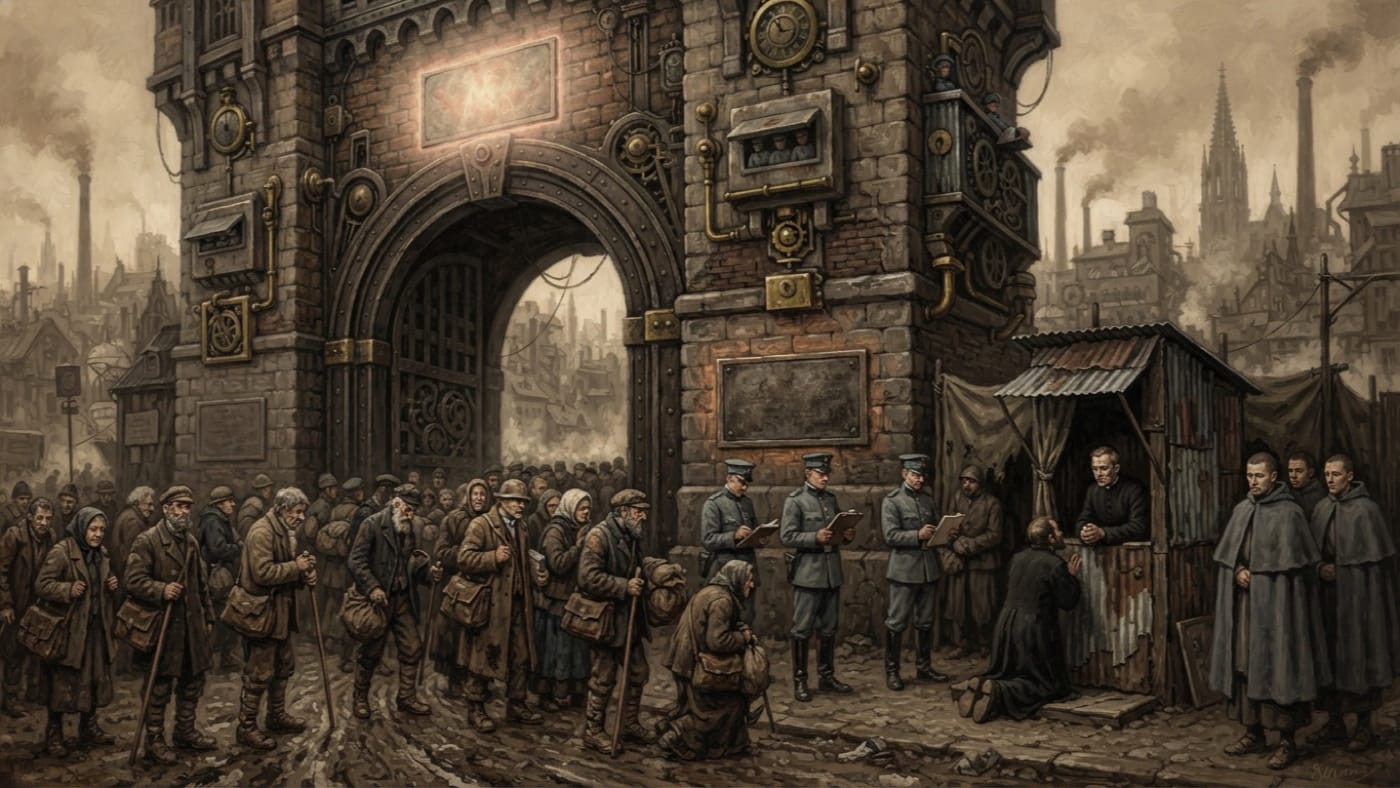
#On the Separation
The Gates of Regensburg carry two sentences. One hangs above the traveller's head and the other sits under his hand, and every theologian who has stood between them has wanted to choose one. The Pastoral Separatists choose the traveller. Their position is that the benediction and the curse fall according to the interior disposition of the person who passes. The penitent receives what the upper stone promises, the guilty incurs what the lower stone threatens, and the masonry sends each verdict to its proper address.
Above: Benedictus qui transit sub pondere veritatis. Blessed is he who passes beneath the weight of Truth.
Below: Maledictus qui pacem emit sanguine altaris. Cursed is he who buys peace with altar-blood.
The upper words were cut after the Reichssaal was reconsecrated in A.S. 92, when the Bureau of Doctrine annulled the Treaty retroactively. The lower words were taken from a graffito scratched into a cellar beneath the former episcopal palace. The Bureau would dearly like to name the hand that scratched it and cannot, and nobody has established the year the lower stone went into the wall. The Separatists cut neither plaque. Like everyone else in Regensburg, they inherited both and set about deciding whom the plaques meant.
By interior disposition the school means the state of the soul at the moment of passage. That includes repentance or its absence, obedience or a good imitation of it, and whatever intention a man carries through the arch along with his papers.
#On the Traveller's Disposition
Grant the Separatist premise and the gatehouse apparatus loses its footing. The ninth-bell procession files a Cellar Saint descendant and the grandson of a prefectural clerk under the same lintel, in an order fixed by ancestry. If disposition decides, the order of the queue is courtesy and nothing more. The grandson may carry no share in the purchase the lower plaque condemns. The descendant of martyrs, shriven last week, permit stamped, may carry the curse's whole object through the arch in a purse of private bargains. Under this reasoning appearance, ancestry, paperwork and the touch of a palm all lose their standing as sufficient witnesses. A token from the Bureau of Pilgrimage proves that a fee was paid and a clerk was awake.
That is the attraction of the premise, and it is also the trouble, because every category the curse invites now needs a soul examined.
Take the bishops who signed under duress in A.S. 30. Did they buy peace with altar-blood, or was it sold over their heads while their own hands held the pen? Take the merchant who sold candles to the banquet, which was a different room and a different crime from the signing in the Reichssaal, though pilgrims merge them freely. Take the banker who lends today against property that changed hands during the Atheist Wars. The pamphlet curses "those who knowingly profit from the wounds of the Church." Knowingly is a Separatist's word smuggled into a Bureau document, because it asks what the man knew, and knowledge is kept where no clerk can inspect it. Then there is the traveller who came to buy iron hinges. He has bought no peace and sold no altar, but he lies to his confessor every Lent about his brother's debts.
The position does not decide these cases, and I will not decide them on its behalf. It only says where the answer is kept. Remorse, fear and compliance look alike at a gate. A man weeping beneath the lower plaque may be sorry, or frightened, or performing for the people behind him, and his tears read the same in all three cases. The Separatists put the verdict in the one place the Church has never audited without the sinner's help.
#On Confession Before Passage
For ambiguous cases the pamphlet says to consult a confessor before passage. That reads like a concession to the Separatists. It is closer to a requisition. If the outcome depends on the state of the soul, the Church wants that state on paper, signed and taken down before the traveller reaches the gate.
The pilgrim reaches the confessional screen afraid, and fear is the gatehouse's chief industry. Rationalist descendants linger under the lower plaque, and the local confessors are kept well employed. Whatever those confessors privately think of the plaques, the record does not enlist them in this school, and neither will I.
Here the Separatist position looks to confession as its ally and finds a turnkey. Confession is the only instrument the Church has for knowing a disposition, and it answers to two offices: it absolves and it reports. Every licensed confessor has heard the second purpose rustling behind the screen. A frightened man who knows his words may travel from the grille to a file will produce the disposition he thinks the file wants. All the confessor learns is that the man can recite. An honest penitent who confesses to a profit taken from the Church's wounds supplies the curse with its object and the Bureau with its evidence in one breath.
Followed honestly, the Separatist claim makes the confessor indispensable and his record unreliable. Doctrine has always welcomed the first half.
#On the Other Interpretations
Send one pilgrim through the western gate and ask the three schools what happened to him.
The Threshold Maximalist says he received both inscriptions in full, without distinction, as every traveller does. The blessing settled on his skull and the curse on his palm, and he walks into the city forgiven and accused at once, which is the ordinary condition of any child of the Church. The Maximalist never asks who the pilgrim was, and that is why I admire the school in private. It describes what the gate does and humiliates everyone equally.
The Pastoral Separatist says the pilgrim received what his soul had earned, and that the gate can see his soul even though the queue cannot.
The Administrative Harmonist says the pilgrim received the blessing because a pamphlet issued under Bureau authority assigns it to the shriven and the obedient: the instruction creates the distinction it describes. I favour this school in public. It is orderly, and it pays salaries, including mine.
The Separatists sit awkwardly between the other two. They agree with the Harmonists that the plaques sort people, and with the Maximalists that no clerk can do the sorting. That leaves them the Harmonist's sorting with no Harmonist to do it. Their answer is that the Creator reads the soul at the arch. As theology this is excellent. At a gatehouse with a queue it is useless, because the Creator files no returns.
#On the Evidence and the Present Dispute
The gates have not cooperated with any school. Pilgrims report warmth beneath the upper plaque and a bell whose tower nobody can find. The Bureau of Relics has not authenticated the gates as relics, and the Bureau of Doctrine has not ratified them as a miracle-site. Reported effects, institutional classification and explanation belong in three separate drawers. I keep them separate, and I lock all three.
The gatehouse report from A.S. 184 is the document every school quotes and none can digest. A man of thirty-seven, descended from a Rationalist prefectural clerk, passed under the western gate at second bell. He sobbed and laughed at the same time, and his palms blackened where they had touched the lower plaque. He said: "It forgave me before it accused me."
A Separatist reading takes the order of that sentence as a sign that forgiveness came first because his disposition earned it first. The Maximalist answers that the man said he was forgiven and accused, and that his palms are black. The Harmonist points out that the pamphlet was amended afterward. The report's line for the man's disposition is redacted, and I have not seen it. It is the one fact the Separatist argument needs, and the Church has kept it.
A.S. 126 commentary by Sub-Deacon Hermault held that a traveller who avoids touching the lower plaque is exempt from its curse.
Withdrawn, as recorded in the gates' own entry: Hermault tripped while demonstrating the exemption, struck his chin on the stone, and confessed to falsifying three ordination certificates. Separatist reasoning rejects the exemption on better grounds than a bruised chin. If disposition decides, a hand kept in a pocket decides nothing.
The question therefore stays where the Synod least likes questions to stay, which is open and in daily use. The Bureau of Pilgrimage still prints its ambiguous-case instruction, and the confessors still take the fearful before the arch. The Separatists still hold that the decisive document cannot be issued by any office in the Church. Every pilgrim who walks under the western gate tests their claim, and none of them is permitted to see the result.