
#On the Direction Prescribed
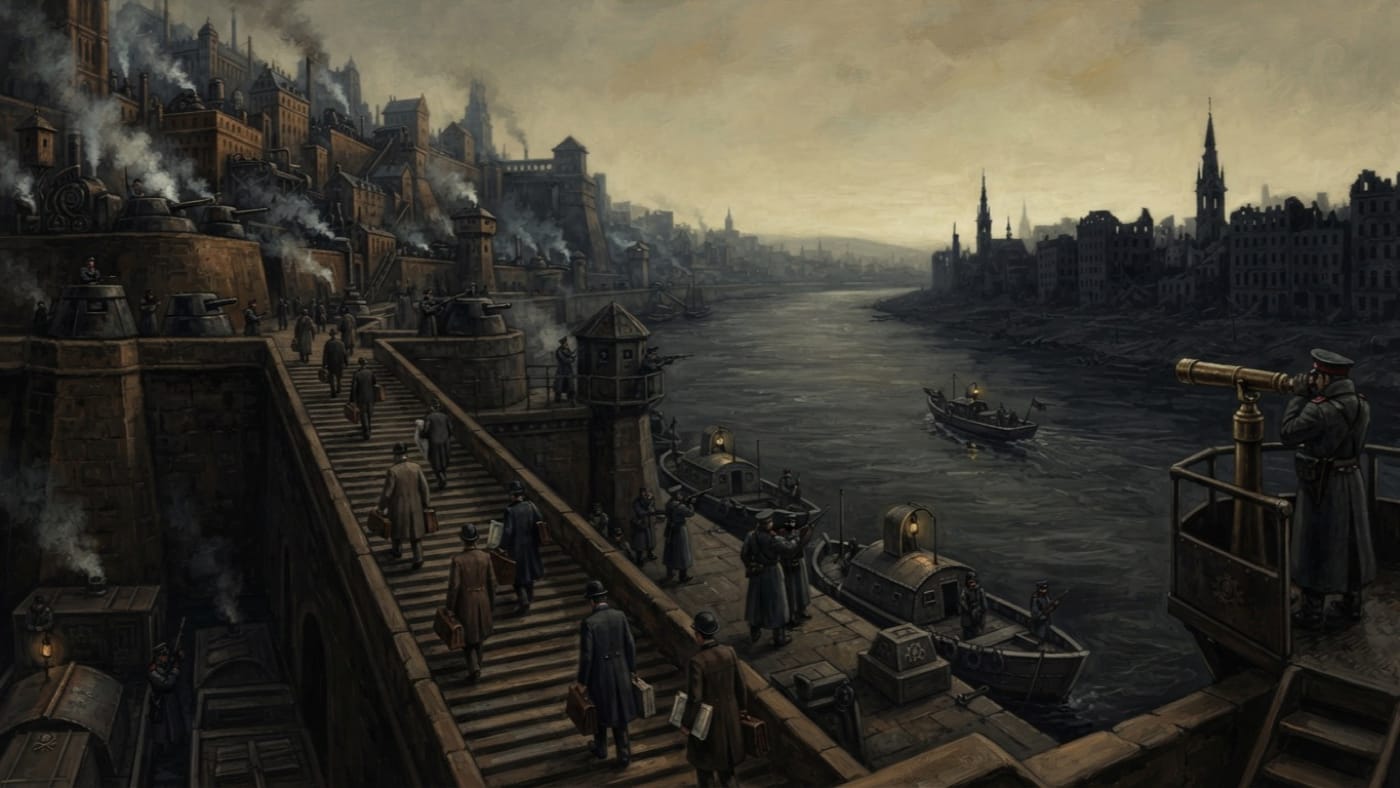
Clerks crossing the western quay of Budapest carry manifests up from the river landings toward Command, and they carry them facing west. This is the visible working of Pastoral Directive 88-E/BUDAPEST, which the Central Corridor survey shortens to Directive 88-E. Every runner who has been scolded on those steps shortens it the same way. The instrument advises facing west. The material before me gives no more of its text than that. I will not write the missing clauses myself. Inventing scripture is a privilege I keep for sermons, where the congregation expects it.
The two witnesses do not use the same verb. The Corridor survey says the directive advises. The record of Pest says the clerks are told. I record both verbs and rule on neither. The clerks, who do the turning, report no difference in the neck.
Two neighbouring customs keep the directive company. Children are told not to wave at the eastern windows. Soldiers are told not to count lit rooms. No surviving portion of the directive contains either instruction. Both belong to the same city's long habit of managing its own eyes, and I list them beside the directive the way a chancery lists the servants beside the bishop: to be complete, and to show who does the work.
#On the Bank Within Sight
Four hundred metres of brown water separate the Synod-held western districts from Pest. The western city is the Corridor's Zone 3 command and staging hub. It has guns on the shore, pins on Hofer's maps, and coffee black enough to confess into. The eastern bank is contested and kept under observation. On clear mornings its rooflines are sharp and three church spires still rise above them. The windows are dark, mostly. The directive exists because of that word mostly.
The background can be told briefly, because the directive does not need it at length. In A.S. 117 the perfume fogs of the Shattered Courts reached both banks while Pest was still inhabited. The withdrawal and the bridge demolitions ran from A.S. 118 to A.S. 122. In A.S. 120 the evacuation was declared complete, and the Bureau of Settlement designated Pest Vacated. The Mothers of Plenty processed evacuees through western warehouses from A.S. 118 to A.S. 125 and could not make the names agree with the people. The Chain Bridge fell last, in A.S. 122.
Between sixty and ninety thousand residents remain unaccounted for. Their names sit in the Great Ledger of Souls under administrative review. Records will not enter them as dead, and it will not enter them as living. The Codex follows Records in this, because I value my seal.
That is why the view matters. Western Budapest is full of people whose names were once written beside names now under review. A rooftop seen across water tells a stranger nothing. To a man whose family's entry in the Ledger has stayed open for eighty years, the same rooftop says a great deal.
#On the Eleven Attempts
According to the record, prolonged observation of the eastern bank has been linked to melancholy, to doctrinal questioning, and to eleven documented attempts to cross by improvised means. Linked is the file's word. I will not promote it to a diagnosis, and I will not dress it up as a mechanism. The file gives no means for the crossings either. It says improvised and stops there, like a confessor who has heard enough.
Eleven is the number of documented cases. Nobody should take it as the number of attempts. A man who slips into the Danube at night without a witness leaves no file behind him, and a man with no file cannot be counted, however much he drowns.
The two offices classify the same act in two ways. The Bureau of Mercy files these attempts as despair. The Bureau of War files them as unauthorised movement into contested territory. Each office calls its own reading accurate. Both punish the rescued, when anyone is rescued. The material before me does not say what the punishment is, which procedure imposes it, or what authority lies behind it. I leave those columns blank. Better a blank column than a lie that a later clerk copies faithfully for a century.
BUREAU OF WAR / SHADOWS CROSSING INCIDENT FILE Case count: eleven documented western-to-eastern attempts under Directive 88-E. Recovered alive: █. Recovered speaking: █. Common statement among recovered: "I saw my own kitchen lit." Common correction issued by Doctrine: kitchens across the river are not yours.
The statement is all the file preserves. It names no witness, no household and no street. A Codex reader who wants a mother at the stove, or a lamp left burning for a son, must find one in a cheaper book. The file does not establish that any kitchen in Pest is lit, or that it is anyone's. It establishes only what several recovered people said.
The literature on the Mirror and Perfume Arts holds that Velkara's method works on attachment. It teaches the mind to take the wrong room for home and the wrong face for the beloved. The Codex permits this observation as context. It convicts no kitchen, and it does not tell us who or what keeps house across the river.
#On the Necessary Observers
A Church that advises its clerks to face west must pay other men to face east. Gun emplacements line the western shore. Patrol boats sweep the water between dusk and dawn. They are flat-bottomed and reliquary-shielded, and they keep their lamps hooded. Their crews rotate every forty-five days under the authority of Quartermaster-General Hofer, because longer service produces reports, and reports produce categories. Shadows gathers the restricted observations. Doctrine maintains the official reading of whatever Shadows will release.
The material does not say how the directive treats these men, or whether it bothers to. The crews face east as a matter of profession. The clerks face west as a matter of pastoral advice. Both arrangements are paid for out of the same ledger.
Once a year the observation becomes a rite. The Annual Confirmation of Vacuity sends a patrol boat across the midline after midnight. A reliquary lamp is uncovered at the bow, and a Litany-Engineer sits astern, listening for an answer from stone, glass and water. The boat does not land. Dawn returns it west, and the classification is confirmed for another year.
Public summaries state that the Annual Confirmation of Vacuity establishes Pest to be empty.
Corrected. The confirmation establishes that Pest remains classifiable as Vacated. Emptiness is a physical claim. Vacated is a status at law, and the law has never been required to look out of a window.
#On Present Application
The western city has made its own arrangements. Some coffee houses draw curtains over their east-facing windows. Others face whichever way earns trade. A proprietor who sells pastry and a view across the river to a colonel on leave is not defying the Church. He is pricing it. Both habits sit comfortably on the same quay, and neither proves that the city's architecture has obeyed the directive.
Children dare one another to look across at noon, which is how children have always obeyed. Patrol crews avoid reflective buttons. Clerks keep their faces to the western heights and their thoughts wherever thoughts go once the satchel is delivered. Steam rises from the western baths. The eastern rooflines stay dry, sharp and patient.
In A.S. 199 the Bureau of Shadows assessed the eastern bank. It reported coordinated movement. It confirmed Velmora assets in three commercial structures. That finding does not mean Greed holds the bank alone, and the assessment does not say so. It revised the estimate of the unaccounted population upward. Then it recommended that Pest remain classified as Vacated. Doctrine concurred.
The directive sits inside that finding like a candle in a confessional: small, sanctioned, and lit for whoever happens to be kneeling. Shadows looks east and writes coordinated. Settlement looks at the register and writes Vacated. The clerk on the quay is advised to look at neither.