
#On the Watch and Its Ground
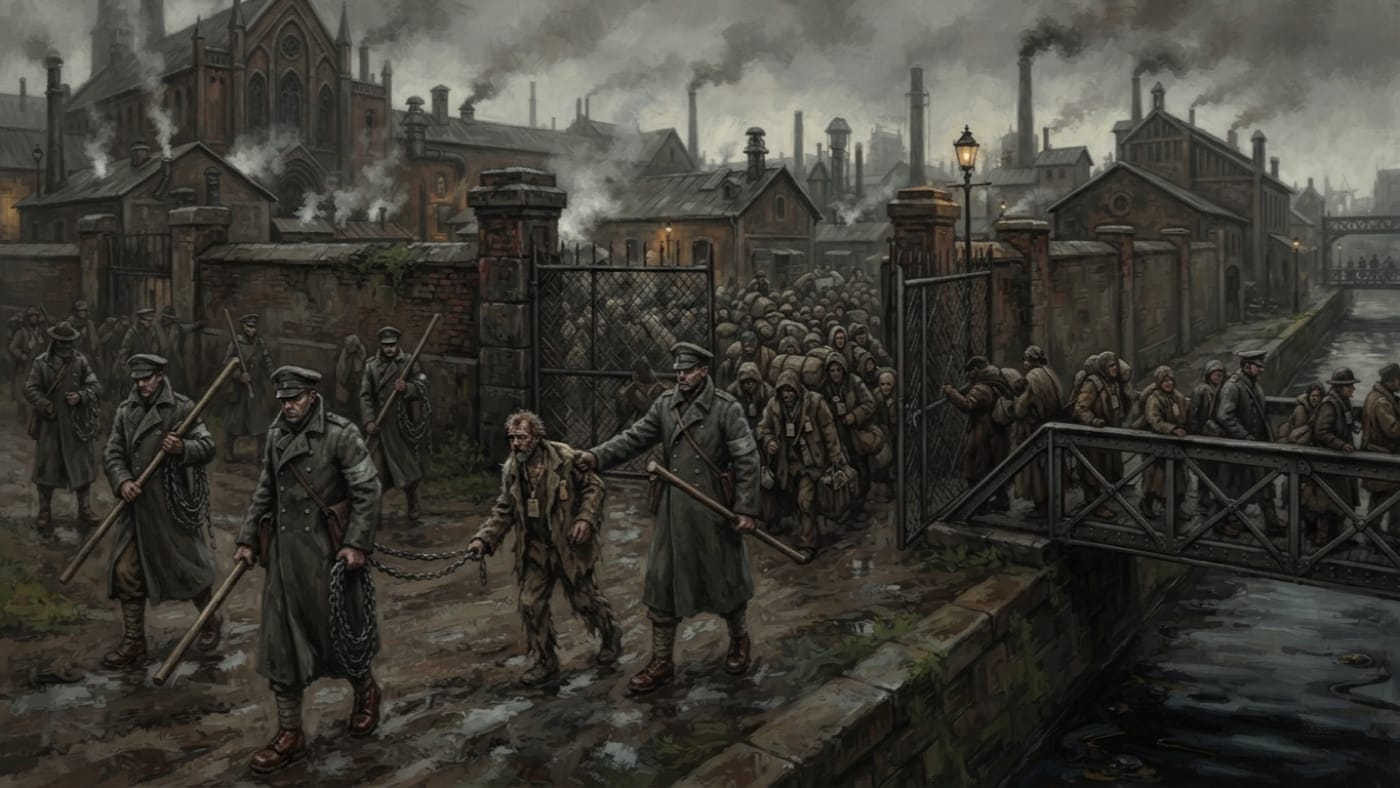
The Outer-Watch of the Ash Canal is the municipal militia that keeps order around the Cloister of Miscounted Beads on Strasbourg's western pilgrim outskirts. That is its public description. Like most public descriptions, it gets the verb right and leaves out the price. The Watch arrests and intimidates, and it takes a cut from expulsions and from the allocation of berths. It does all of this in an ash armband tied over wet wool.
Its ground is the gates and the yard. A low wall rings the Cloister and chain gates close it. Entry and exit both go through sanctioned gates. The Ash Canal runs along the southern edge, and it gives the force its name and, in warm weather, its smell. The garrison is a small platoon. I decline to give it a number because the Watch declines to give one to me. In a borough built entirely for counting, a militia that cannot be counted would be a scandal anywhere else. The Cloister treats it as a joke.
The force is not the same thing as its house. The Outer Watch Post is a building that smells of tar and metal, where the Watch keeps its chains and its temper. The Watch is the people who walk out of it. The Cloister itself grew out of the A.S. 94 overflow at the western gates, four years after the Concordat of Strasbourg gave the Synod its formal shape. No ledger I have consulted records the day the first ash went onto a municipal sleeve. The armband was apparently thought too humble to date. It has never been thought too humble to obey.
#On Intake and Arrest
A pilgrim reaches the Cloister in one of three ways. They are redirected from the city gate, they come in with the pilgrim lines, or a Watch hand closes on their collar for a count discrepancy. The third is the fastest, and the least devotional.
In the Lost Procession Yard, Outer-Watch runners work inside intake itself. A clerk on the Porch shouts a name and nobody claims it. A runner then grips a pilgrim by the collar and finds a man who has been carrying a different identity under his tongue since the last waystation. That case goes to the red lane. The runner does not decide this. The runner supplies the grip, and the classification belongs to someone with a slate.
Arrest begins custody and ends there. A discrepancy can only be reconciled at the desks of the Counting Hall, and a name can only be rewritten by the clerks who own the ink. Jossa Rill rules on disposition from the Porch: Supplementary, Awaiting, Chapel, Dorm, Expel, Hold, Red. The Watch then walks each ruling to its destination. A white tag means a muddy shuffle toward the berths. A red tag means Purity review and an escort with a firm grip on the elbow. A man suspected of falsifying his string goes toward the oath-collar, which is the falsifier's ornament. Repeat miscounts go toward inquisitorial review. The Watch brings them to the threshold of each of these offices. It does not go further, because what lies beyond the threshold is reasoning, and reasoning is not in its remit.
#On Clearance and Expulsion
People leave the Cloister in two conditions: cleared or expelled. The Watch profits more from the second.
Clearance belongs to Prior-Scribe Erem Vale, whose seals give a second string its legal force. At the sanctioned gate the guard asks for the lawful string, and the detainee holds it out the correct way. The guard cannot read a bead count. What he can read is a seal, a tag and a face that has learned not to argue. That is enough for the gate.
Expulsion is Rill's decision and the Watch's business. She chooses who is housed and who is thrown back toward the city, and the Watch does the throwing. The dossier says the Watch takes its cut from expulsions and from dorm control, and I see no reason to doubt a document that flatters nobody. The cut comes in coin where coin exists. Where it does not, it comes as a cloak, a reliquary pin, or a tacit understanding about the next arrest. In the Dorm Rows the same arithmetic decides who gets a berth by the wall and who sleeps in the damp rot-rows, and whether a family stays together or is counted out in separate rows. The Watch does not run the dorms. It runs the corridor outside them, which is where the money changes hands.
The city magistrates complain that the Cloister dumps cleared vagrants back onto the streets. The vagrants are dumped by a municipal militia. The magistrates have so far not found this ironic enough to look into.
The Cloister's own records describe Watch custody as part of a system of compassionate reconciliation.
Corrected. The records are compassionate. The custody consists of a collar grip, an escort, a fee and a gate. People who have been through it call the place a time-prison, and they do not mean it as a figure of speech.
The sponsor-broker stall under the Yard's south awning survives because the runners tolerate it. It reduces violence. A mother who can buy a yellow tag with her winter cloak does not start a riot, and a riot is one of the two things that obliges the Watch to stop collecting and start working. Rill values the stall because it moves bodies. Vale tolerates it as part of the wider arrangement. The Watch values it most of all, because its customers stay calm.
#On the Chapter and Its Officers
The Watch is municipal. The Cloister Chapter is Synodal and works under the joint mandate of the Bureau of Records and the Bureau of Pilgrimage, with rotating tribunal appointees making the administrative rulings. On paper these are two authorities sharing one wall. In the Yard they share one pilgrim, and they tend to pull him in different directions.
Each officer holds a different key. Vale holds the clearance seals. Rill holds disposition: house or expel, Chapel or Dorm. Archivist Keth holds the Bead Vault, and she gives up its evidence only on her own terms. During anomaly weeks the inquisitorial cells arrive with their own keys and their own manners. The Watch holds chains. A chain is a fine instrument of government, but it cannot interpret a basin, seal a clearance or classify a child, and the Chapter takes care to remind the Watch of this whenever the Watch starts to look as if it is thinking.
Which of these authorities may give orders to which is settled anew at every gate, by whoever arrives with the better paper. I have not found the instrument that fixes it, and I have looked in all the places where such instruments are usually lost.
#On Closed Gates
During sealed anomaly weeks the Cloister turns inward and the Watch earns its armbands. The chain gates lock. A quarantine cordon is drawn along the wall and across the lanes. Curfew tightens. The order for all this comes from wherever such orders come from, and the Watch receives it the way a lock receives a key: completely, without curiosity, and with a loud metallic noise.
Inside the Yard, people move by slate, by pointing and by escort. Spoken names are held back during the sealed hours. Anyone who answers to a name that is not written on their tag is struck quiet and taken to the Chapel of the Second String. The Chapel records that the Outer Watch sends no one gently. I have seen these transfers. "Rough" was the Chapel's word, and it is accurate. The Cloister's defence doctrine is to lock the gates, control the ink stores, isolate the Vault and burn suspect strings. The Watch handles the locking and the hauling, and it puts detainees to work forming the cordons and scrubbing the quarantine lanes. Nobody is better at holding a line than a person who has been told the line is the only thing keeping their name.
That last line is the one fixed point in the Cloister's market. A fee can move a berth. A fee can buy a glance toward the right desk. Once an anomaly has been declared active, nobody in the Watch can sell its removal at any price, and the experienced ones have stopped pretending they can.
The Watch was built to hold bodies, and an anomaly is not a body. In my entry on the Chapel I recorded a child holding a second string. Her first string counted a mother she said was waiting outside the gate. The Outer Watch record said no such woman stood there. The water in the basin in front of the child rose while I watched. I leave that account exactly as I filed it. I do not certify the woman, and I do not interpret the water. I note only that the Watch was quite sure, in writing, about the far side of a wall that it guards with a small platoon.
Crowd sickness is the Watch's other enemy, and it fears the rumour more than the fever. A plague rumour is one of its two triggers. A cough repeated three times in the lantern lanes will bring more armbands than a stabbing.
#On the Present Watch
As of A.S. 201, the Watch is the same small platoon it has always been, policing a Cloister that is not what it was. Since A.S. 198 the traffic redirected through the western gates has kept the Yard beyond its design capacity. The Yard recorded fourteen thousand two hundred arrivals in A.S. 200. That is the Yard's figure and nobody else's, and certainly not a tally of Watch arrests, since the Watch does not offer such a tally. The pilgrim lines are longer than they were. The berths are wetter. The Watch has not grown.
It has, however, become better paid. Crowding turns every berth into a commodity and every expulsion into revenue, and both currents run through the Watch's corridor. The Synod wants more detentions so it can harvest more confession data. The magistrates want fewer vagrants on the streets. The Watch detains for the one and expels for the other, takes a fee in both directions, and reports that order has been kept. On the evidence of its own reports, order has never once failed to be kept.
At dusk the lantern patrols go out along the wall. Runners wait on the Porch for the shouted name nobody answers. Behind the chain gate, the ash on a dozen sleeves is the only thing in the Cloister that has never been miscounted.