
#On Office Seven
Ossuary Office Seven is a stone chamber inside the ossuary ring of Bastion-Constantinople, among the Ossuary Rings at the southern end of the Line. The Circle of Ashen Steps keeps it as home base. Everyone with sense calls it the Counting Room. The Circle's published account records one clerk who calls it "Auxiliary Vigil Substation, Bone-Lane East." I preserve his title as an attributed variant. I do not preserve his dignity.
The Rings number six. The office is numbered Seven. Petitioners have written to propose a hidden seventh Ring, a seventh sacrament of counting, and a staircase to a place they decline to name over a signature, and I have returned each petition with the same instruction: read the door. Seven is an office designation. The Church numbers its rooms the way a sacristan numbers his keys, which is well enough to lose them in sequence.
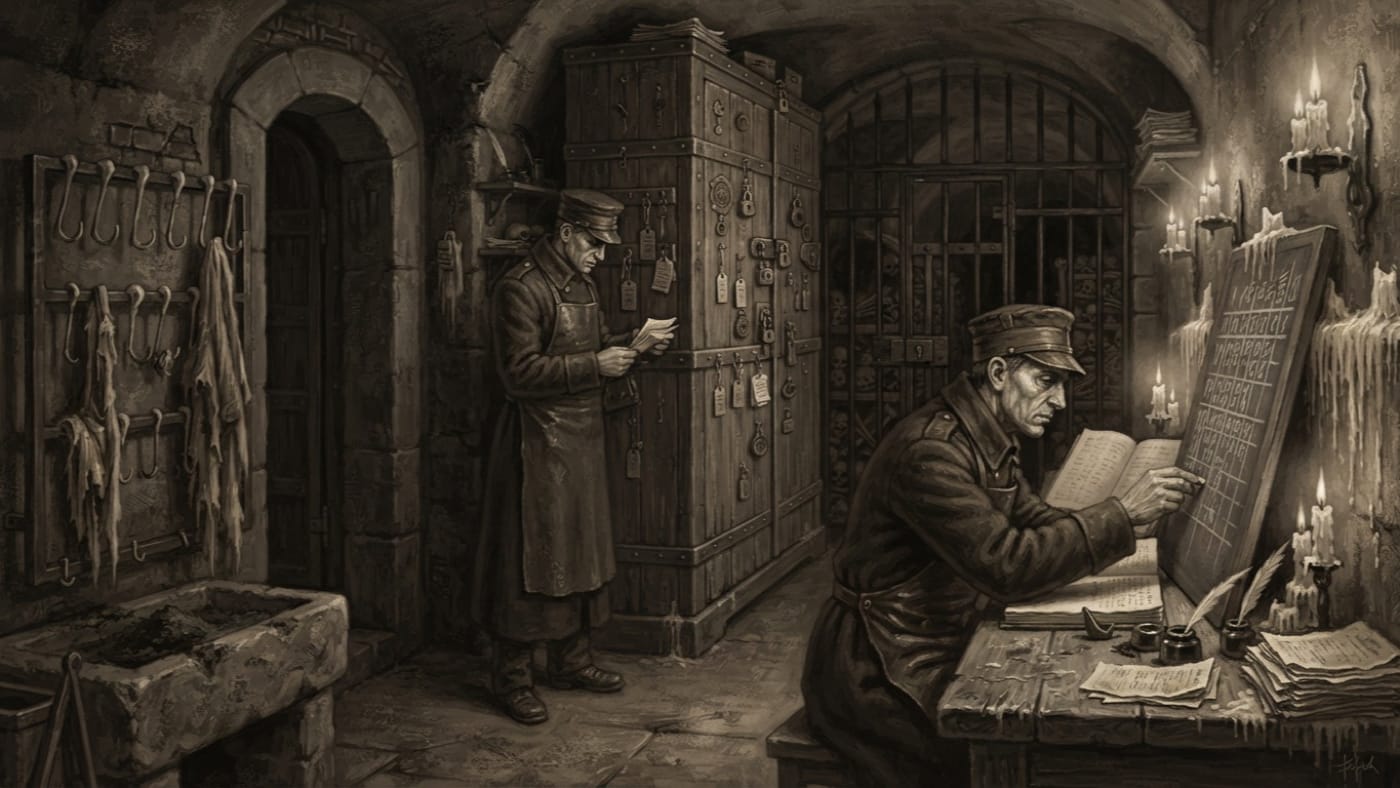
The furnishings attested in the Lantern Brotherhood's own charter are few and unlovely. There is slate, scratched with candle tallies. Pale wax runs down the stone in ridges as thick as a thumb, dripped from candles nobody has troubled to scrape. There is a rack of bone hooks, a trough of ash paste and a locked cabinet of body-tags. The list is the charter's, and charters are brief. There may be a stool. I would not swear to the stool before a tribunal.
The Ledger does not say when the chamber was cut, when it received its number or when Ashen Steps took possession. I decline to lay a cornerstone for the convenience of pilgrims.
#On the Slate and the Cabinet
The room keeps two kinds of record, and the Circle's whole profession lives in the distance between them.
The slate belongs to the living. On the ring-walk each household flame receives a mark and each dark window receives a separate one, and the slate comes back to Office Seven bearing both. A missing flame may mean a family too poor for approved wax, or a house emptied by death or departure. It may mean a body kept one more night under a blanket while the mourners pretend it sleeps. It may mean a household that has stopped praying. The slate records the dark window. It does not record the reason. Reasons are collected later, by hook.
The cabinet belongs to the dead, and to those the Circle has provisionally assigned to them. The charter distinguishes three conditions of tag: stamped, blank, and already filled with names. The published account adds that some of the named are still walking about, eating rations and lighting candles in apparent ignorance of their filing status. Readers who ought to know better ask me how a name reaches a tag before its body does. The charter records that it happens and records no method. I shall supply none.
Office Seven is a working station, kept by a bone-lane Circle for its own nights. The rolls of the dead belong to the Bureau of Records. Housing permits for the ossuaries belong to offices with other stamps and other smells. Chalk, slate and tag are local instruments, and they become a Records number only at the dawn handoff, once reconciliation has made them agree.
Above the slate the Circle recites its doctrine: Names are weight. We do not allow weight to float. Also: A candle uncounted is a body unclaimed. These are slogans. They state what the Circle intends to do about an uncounted candle. The candle itself has no opinion.
#On the Night's Reconciliation
The office empties and fills again by a fixed order of six offices. The charter's daily order is the nearest thing the Counting Room has to a breviary.
At dusk the Brothers wash in ash from the trough and count what leaves the room. Hooks come off the rack and are tallied. Tags come out of the cabinet and are tallied. Approved wax is counted against issue. Everything that goes out must come back as something: a hook, a blank tag, a filled tag or an explanation.
At the Curfew Seal kept under the Curfew Ordinance of Quiet Hours, the patrol sets out on its ring-walk. It walks clockwise only, because counterclockwise is held to invite return. Each lantern is strapped at the sternum. The charter forbids searchlight behaviour as disrespectful and liable to cause panic. A lamp at the breastbone lights a threshold, a face and a hand on a latch, and nothing above them. The arrangement is courteous and watchful at once.
Early night is for counting only. Missing flames go onto the slate and the Brothers walk on. The thresholds of watched homes already bear the Circle's split-candle glyph in chalk, which tells the walker where to slow. The glyph is Ashen Steps' own mark under its own charter. Other Circles chalk other things.
At midnight the patrol checks the body routes and meets the corpse-thieves who use them. The charter allows two responses, interception or negotiation, and leaves the choice to the Brothers on the night. I commend its frankness.
Late night brings corrections, which the charter defines as making tallies true by warning, by fining or by taking someone. A Marrow Fine removes a family's approved-wax ration. Ash-Tongue dusts an offender's lips with ash until speech hurts for days. The initiate's Candle-Tally belongs to this hour as well. The new Brother keeps a household candle ledger through a full night, and where the ledger is wrong, the Circle alters the household until the ledger is right. A miscount need not end in a corpse. The slate is patient. It will accept a fine.
Before dawn the hooks go back on the rack, the tags go back into the cabinet, and reconciliation begins. Tags are matched to bodies, the bodies are handed to the sanctioned ash crews, and the chalk is wiped from the thresholds so the morning finds nothing it could quote.
#On Approved Wax and the Second Book
Approved wax enters the Counting Room through the dusk inventory. Marrow-wax is made with marrow-fat rendered from sanctioned remains and worked into vigil candles, and it is supposed to pass under Tithes measure and Records receipt. The charter puts no rendering in this room, and neither do I. The patrol lanterns burn ash-oil, which is a separate supply under a separate issue.
The tolerated sin is skimming. The Circle trims what it handles and sells the difference to households desperate to keep a vigil burning one more night. The arithmetic is cruel and needs no imagination. A Marrow Fine leaves a family short of approved wax. A family short of approved wax becomes a dark window, and the dark window goes onto the slate. The records I hold do not establish whether any particular confiscated ration came back to the same street for sale. I do not decorate a column with guesses.
Diverted wax is a trouble for one ledger. Diverted bodies are a trouble for another. The Two-Book Dead is the Circle's second ledger. It records bodies quietly turned aside for patrons, for corpse-sale, for marrow extraction and for funerals that were lost. It also records the wealthy houses that purchased discretion after disgrace. The charter and the Circle's published account both establish that the ledger exists. The Bureau of Records publicly refuses to acknowledge it. Both positions are on file, and I find them compatible.
The danger lives in the gap between a tag and its body. A tag reconciled at dawn closes a line in the column, and the transfer receipt satisfies a clerk who has never smelled the Rings. Closure is a property of paper. Custody is a property of the corpse. None of my sources records where Office Seven keeps the second book, and I have not gone looking for it with a lantern.
The Circle's published account corrected "route attrition" by stating that several bodies were "reassigned without the courtesy of a verb."
Corrected. The verbs exist. They are entered in the other book.
Wick-Sergeant Rulik "Sootmouth" knows the ossuary tunnels and coughs wax-sweet phlegm. The Brotherhood roster ties his wax sales to a daughter's ration debt. His defenders repeat this, and his enemies say the daughter is dead. I leave her where the record leaves her. Lanternman Vey Strahl, once a gravedigger, works with a blade so calm that it unsettles men who have seen blades. He is rumoured to have buried someone alive "to balance the ledger." It remains a rumour.
If the bereaved learn that a father was sold rather than sanctified, the ossuary riots will burn Ashen Steps alive. Every Brother who turns the cabinet key knows what a riot in the Rings would cost him.
#On Provisional Toleration
Ashen Steps keeps the Counting Room because corpse scandals frighten the authorities more than corpse corruption does. Its charter states plainly what the Circle trades for its toleration: clean handoffs of bodies to sanctioned crews and quiet suppression of corpse-theft scandals. The Circle buries the scandal before the corpse. Funeral lanes keep moving, the dawn crews receive what they were promised, and the public goes on believing its dead are counted.
The precedent dates to A.S. 94, which is 1804 CE, when the auxiliary toleration clauses attached to the curfew ordinance gave Brotherhood Circles their conditional standing. A.S. 94 dates the clause. It does not date the office.
The Wardens despise the Circle. The Bureau of Purity watches it. I am confident the Bureau of Shadows has measured the cabinet, although it will deny that cabinets exist. That is my opinion. No inspection is on file.
As of A.S. 201, which is 1911 CE, the Circle's standing in the Counting Room is still provisional.