
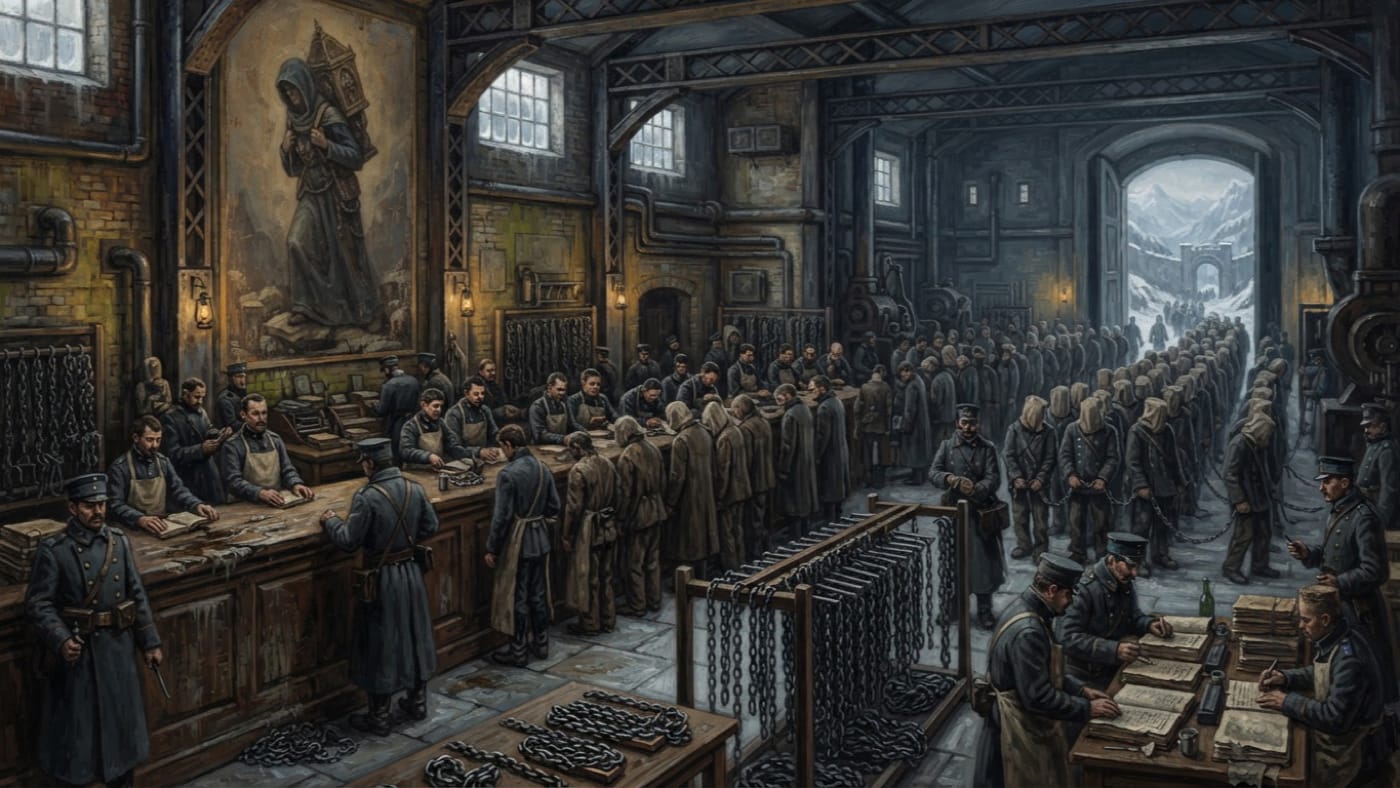
#On the Intake Hall
"Count the living. Count the dead. Deliver the relic." — Standard dispatch catechism
The condemned come in at one end of the Office and relics go out at the other, and between them the Synod requires a counter. The Ossuary Convoy Office at Bastion-Przemyśl, our western Carpathian bastion in Zone 4, keeps its counter in the intake hall. It is a long board scarred by seal-wax and shackle-iron. Clerks receive the writs behind it, and the prisoners stand in front of it and are not permitted to lean. The writs come from trench courts, Purity holding cells, debt sessions, deserter pens and confessor-booth referrals. Each prisoner arrives attached to one.
I inspected the hall in A.S. 197. Registrar Aldous Krenk received me. He was Chief Handler and had forty-one years in service at that date. Wax had burned his palms to a gloss, his apron hung on him like a sacristan's cope, and his keys rode his belt in numbered order. He pointed with the stem of his seal press and never with a finger. "Everything in order, Hieromnemon," he said. "Everything accounted for."
The titles can wait until the work has been described. The Office belongs to the trade of the Ossuary-Draft Handler, which holds its licence under joint writ of the Bureau of Rites and the Bureau of War. Rites sets the ritual conditions and War demands the deliveries. The Bureau of Relics keeps custody of the cargo and authenticates it, and Purity keeps the supply of bodies flowing. At Przemyśl the house answers to Logistics-Penance jurisdiction. That makes four bureaus at one counter, and none of them answers for what happens across it. The Synod calls the arrangement penance logistics, and I signed the visitation report under that heading.
#On Quarantine and Chain Issue
The clerks read the writ before they look at the body. They check crime, sentence, issuing office and transfer authority. They match the name to the docket and the docket to the route requirement, and only then is the prisoner passed back into the quarantine sheds.
The sheds belong to brine. Buckets of it stand along whitewashed walls, and the whitewash has been laid on so often that it shines without hiding the handprints near the floor. Prisoners stand naked under lanterns while inspectors work combs through their seams and press two fingers into the hollow behind the collarbone, where fever hides. The coughing never stops for long. A Handler of Krenk's seniority is said to grade a man by his cough, and I heard enough coughs that morning to believe it.
Grade A is the strong back, free of disease and fit for forty pounds over twenty miles. Grade B takes lighter cargo or shorter routes. Grade C is unfit to march and is held for depot labour, for quarantine without end, or for dispositions the ledger describes with words like "delayed." The pen can go against the body in either direction. A discretionary upgrade puts a weak prisoner on the road. A mercy downgrade keeps a march-fit prisoner behind on the strength of a medical note that would embarrass a horse-leech. Neither is a rescue. One spends the body in the mountains and the other spends it in the depot.
Earlier handling manuals described the discretionary upgrade as "a mercy classification available at the Registrar's pastoral judgment."
Corrected. The discretionary upgrade is a throughput tool, used when convoy numbers, cargo weight, escort morale and route hazard allow a weak body to be spent outside the depot. Mercy may occur incidentally. The Bureau does not reimburse incidental mercy.
From quarantine the graded go to the chain yards, which smell of cold iron and nothing else. Restraints hang sorted by ankle, wrist and throat, and again by convoy spacing, because the interval between carriers is set by the manifest. Every shackle key is numbered, and every number goes into the chain manifest beside the name it secures. The sentence came in as a writ, and here it becomes a position in a column.
#On the Seal Rooms and Departure
The seal rooms are kept colder than the yards. Wax wafers wait in shallow trays, and the press comes down with a short dry knock that a junior clerk learns to hear in his sleep. Here the Office weighs, packs and stamps its cargo: reliquaries, ossuary crates, bell-caskets trailing ward-chain, and warded bone loads. Rites revises the sealing prayer quarterly. The Handlers have kept seven obsolete versions in memory because nobody ordered them to forget the old ones. If a seal is struck while screaming can be heard in the room, it counts as provisional, and the Office keeps the hours of floggings and the hours of sealing apart.
Carrier order is doctrine before it is logistics. A blasphemer may not carry a saint's femur, and a debtor may not walk ahead of a sealed bell-casket. The deserter goes at the rear, where his back faces only the road already travelled. Hymn cadence moves the column. A licensed caller sets the beat and the chains keep time with it.
The seal clerks claim their work comes first, the chain clerks claim theirs does, and the Office's own lists side with each in turn. The column leaves only when both jobs are finished and checked. At the route desk the clerks mark gate closures, deserter sightings and demon weather. The Gatewarden-Notary authorizes passage and enters the column in his custody log. The escorts sign. After that the column goes to the departure chapel.
The hoods are issued in the chapel. The bastion network has hooded its carriers since the aftermath of the Cart-Saint, Josek of Düren, who died in A.S. 138 after carrying a sealed crate to Bastion-Irongate. His march did not begin at Przemyśl. Its consequences reached every chapel like this one. Doctrine annulled his acclamation in A.S. 140, and War ordered faces covered so the public would have nothing to remember. The trade's first rule is spoken in that chapel: don't make saints.
#On the Cold Ledger Annex
Every departure has to come back to the Office as a reconciliation, and that work is done in the cold ledger annex. The annex is quiet, and that makes it worse than the sheds. All a visitor hears is pens scratching and keys being counted onto green baize. Completion certificates come back from the forward positions carrying the escort signatures. Each shackle key returns or is reported missing. Each seal is declared intact or broken, and a single broken seal can bring a tribunal down on a convoy no matter how few carriers it lost. The losses are entered under five categories: death in march, escape, medical withdrawal, doctrinal removal and administrative correction.
The twelve and twenty per cent figures in Standing Order 14-C are thresholds for escalation. Nobody issued them as quotas. I write that down because I have heard clerks in other houses use them as quotas.
A hooded Marrow-Saint Elen is painted above the annex desks with a reliquary on her back. Anxious juniors have retouched her so often that her hands look newer than her burden. Whether she lived Doctrine has answered with the word "canonically," and that word has closed many files.
The ghost slot belongs here as well. It begins as a blank line on a roster, with no name, no crime and no grade. Later the line receives a name, a Grade C notation and the words "expired in transit," and at about the same time a person leaves custody at a waystation where the escort has been told not to count too closely. On paper the Office records that person as dead. Some of them are debtors whose families paid, and some are innocents whose release would embarrass the wrong bureau. Others are bodies sold on to employers who prefer not to stamp anything. The roster records none of these differences. Krenk did not invent the ghost slot, but at Przemyśl he made it tidy.
The Convoy Audit Office is a separate office, with cold rooms of its own and no affection for this one. Its auditors read the annex's ledgers and found them clean, and that was exactly what worried them.
#On What Remains Accounted For
When I left, the next column was already forming in the chain yard. The hymn-caller was warming his voice against the cold, and the seal press was knocking in its room. A clerk at the route desk was blotting a gate permission while the escort captain waited for it with his hand out.
Above the yard gate hangs a second Elen, hooded and carrying her reliquary. Krenk keeps her paint fresh by ordering ladders for other men to climb. A candle is lit beneath her at first bell on every departure day, and if it gutters before the column clears the outer gate, it is replaced. Krenk tapped the ledger spine three times before he signed the column out, and every clerk in the hall heard the taps without looking up.
On a rack by the yard door, shackles were drying, and they were sized for wrists thinner than mine.
I did not ask about them. My visitation report gives the Office's throughput, the condition of its seals, the cleanliness of its annex and the state of its wax requisitions. I left the rack out of it.