
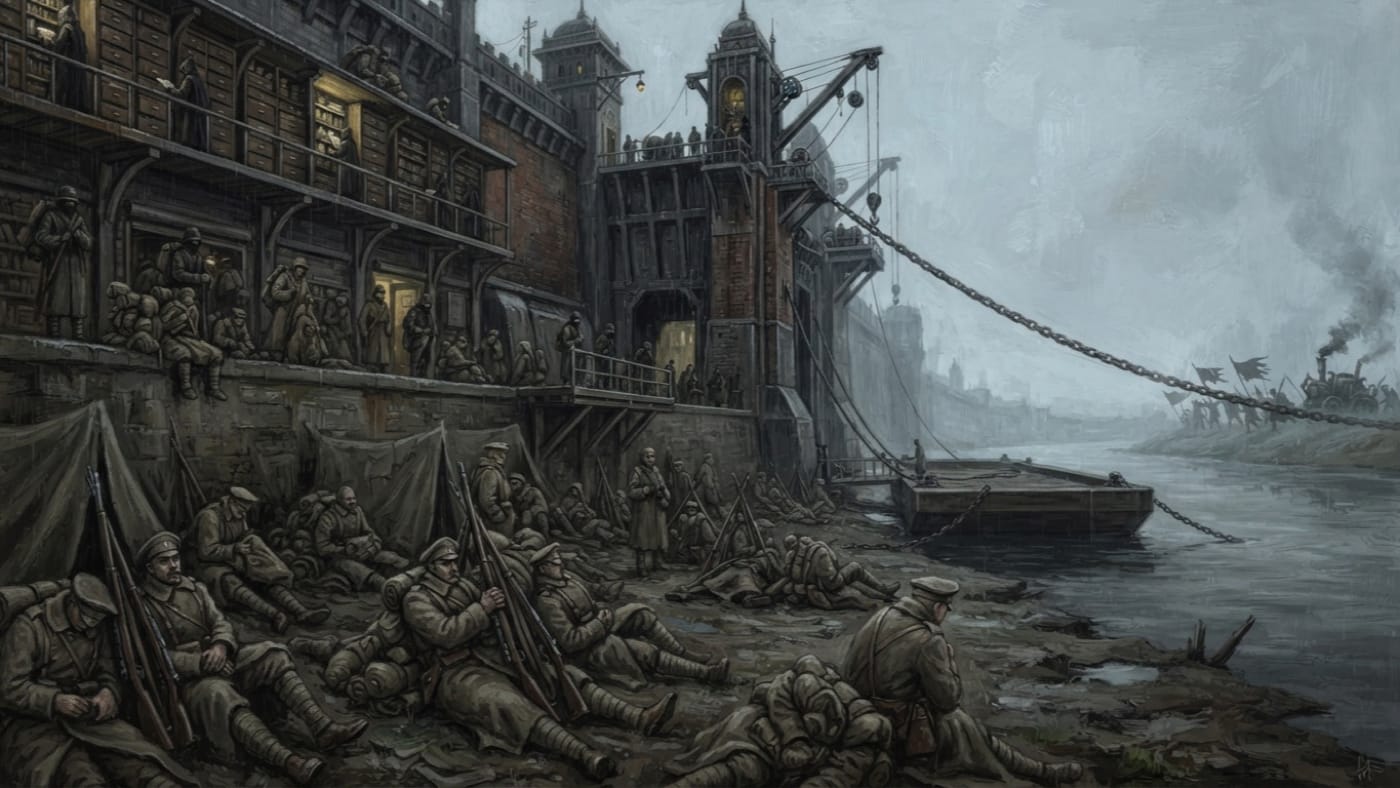
#On the Regiment Refused
In c. A.S. 138, which the Codex renders as c. 1848 CE and will not render more exactly, an entire regiment came down to Nominalist's Gate and asked to cross. It carried orders, a commission and a manifest. Each document named the colonel. Each named him differently.
The Gate refused passage. The dispute went up through proper channels while the regiment waited on the trench-bank, and while it waited it starved. At dawn Wrath's raiders came and slaughtered it. The Bureau audited the crossing afterward, found the ledgers immaculate, and recorded no procedural breach. The Codex keeps both findings side by side, the way a reliquary keeps two bones that the sacristan swears came from the same saint.
The accounts available to me do not give the regiment's designation, its strength, where it came from or where it was going. The colonel's name survives in none of its three forms. I will not supply one. A man who has already been spelled to death three times may at least be spared a fourth.
The Orthography Siege (A.S. 238).
Corrected to c. A.S. 138. The older entry dated the regiment's destruction thirty-seven years after the present year, which shows a confidence in the future that even the Bureau of War reserves for its procurement estimates. The approximation stands. I will not round a dead regiment to make it neater.
#On the Three Documents
Orders tell a soldier where to go. A commission tells the world by what right a man gives orders. A manifest tells the ferry what it is being asked to carry. The three are separate instruments. Separate hands draft them, separate seals close them, and separate drawers of the Bureau of Records keep them. In a sane world they agree because they describe one man. In the Church they agree only if the letters agree, because there the written name does more than describe a man. It is his lawful existence.
The Manifest Litigants exist for this. They are licensed advocates under the Bureau of Commerce who dispute spellings, provenance, lineage marks and seals, since a thing wrongly named may not lawfully move. Their ordinary tools are the objection, the attestation, the comparison of precedent, the hold and the recorded ruling. Which of these were used at the Gate in 138, and in what order, the accounts do not say. What they say is simpler and worse: the Litigants on duty could not clear one document without condemning another.
The mechanism is easy to follow. Accept the spelling on the orders, and the commission names some other man, so the authority behind those orders goes with him. Accept the commission, and the manifest lists a regiment headed by a stranger, which in law is a column of armed men with no officer and no right to a barge. Accept the manifest, and the orders were addressed to nobody. Every ruling in the colonel's favour was also a ruling against him.
Doctrine teaches that a misnamed thing is an unguarded thing, a gap in the wall where the Great Deceiver may come in under borrowed letters. I teach this myself, and I teach it well. Nothing in the record suggests the Deceiver had any hand in what happened at the Gate. The clerks managed it alone.
#On the Trench-Bank
The Gate is built so that refusal can be seen from every angle. Petitioners stand in the Mud Court on the lower bank. Above it runs the Ferry Rail, a roofed plankway where guards hear what they are paid to hear. Behind the rail is the Archive Porch, narrow and wet, its cabinets swollen so tight in rain that a clerk may need a mallet to open the drawer holding your life. The ledgers cross the river in oilskin chests, which keep them drier than the passengers.
The regiment waited below all of this. It could see the cable stretched across the water, the iron pulleys sweating, the flat barge at its mooring, close enough to touch and forbidden. It could smell tar from the kettles and wet hemp from the rope. It could watch its case climb the archive ladder one rung at a time, each rung a properly constituted step toward a ruling, each step recorded.
The accounts say the soldiers starved. They do not say for how long, how many fell before the end, or what rations ran out first, and I will not invent a diary to make the starving easier to read. Starved is the record's word. It needs no help from me.
A regiment in the field expects to die of something. It drills against cavalry, it digs against shot, and it prays against plague. Nobody drills it against a consonant. The men on that bank were armed, fed by the Church until the Gate stopped feeding them, and within sight of their crossing. They had everything a regiment needs except a colonel spelled the same way three times.
#On the Dawn Assault
The accounts call the raiders Wrath's, meaning they answered, at whatever remove, to Maldrake, whose dominion is Thrace and whose hosts include both corrupted men and worse. The accounts do not say how many came, who led them, what they carried, or how they reached a Rhine crossing. I have seen too many Codex entries put a Sin-General at a slaughter he never attended, so I will put Maldrake nowhere near this one. His banner is enough.
They came at dawn. Dawn is the only part of the timing the record keeps. The day, the month and the season are lost.
What the raiders found was a regiment worn down by hunger on an open bank, with a river at its back that it had no permission to cross. The record keeps no tally of that morning. It says the soldiers were slaughtered, and when a military record allows itself a word like that, the reader should take it at full strength.
#On the Audit
The Bureau audited the Gate afterward. It examined what audits examine: entries, holds, signatures, seals, the order of filings and the custody of instruments. It found the ledgers immaculate and no procedural breach.
That is true, and I put it in the record as true. Every objection was entered in its proper column. Every hold was authorised. Every document stayed in the drawer where it belonged and came out only when properly called for. As far as anyone has shown, the case was still moving through proper channels when the raiders reached the bank. The audit found no error because none was made. The procedure did everything its authors asked of it.
The audit had nothing to say about the regiment. The regiment fell outside its scope. A ledger can show that a hold was lawfully placed. It cannot show that the men under the hold were fed, and it does not pretend to. The clean result does not mean the soldiers were processed, that the refusal did no harm, or that the right answer arrived in time. Readers who take it that way should have their reading licences reviewed.
On my reading the Bureau blamed the colonel, which was convenient. He was the one man in the affair whose identity was officially in doubt, so he could hardly appeal. Whether he died on the bank or survived it, the accounts do not say. They also do not say whether any ruling on his name was ever issued, or what became of the three documents. Presumably they were filed. At the Gate, everything ends up filed.
#On the Siege in Subsequent Use
Afterward the siege passed into the vocabulary of the people it embarrassed. Officers cursed the Gate in their dispatches, and the curse became something said in the field when any order hesitated at a desk. Records clerks studied the case in training, which is to say they learned it as a lesson, though nobody can say which lesson they took from it. The Manifest Litigants remember it as their profession's most quoted incident and the one they least like to quote. They mention it in whispers and never cite it in court.
It should not be confused with the Mass Denial, the Gate's other famous refusal, though that confusion is common. The Mass Denial came earlier and is undated. It involved three hundred travellers with valid papers, one mispronounced password, and the Ferry Chokepoint Brokers with their phonetic cards. The regiment had no problem with passwords and no Broker to coach it. Its fault was in writing, three times over, on documents the Church had issued itself.
The crossing still works under the same arrangements across the Rope-Ferry Chain: rail, porch, court, and cabinets that swell in the rain. The case is closed, the ledgers are in order, and no procedural breach was found.