
#On the Tool beneath Glass
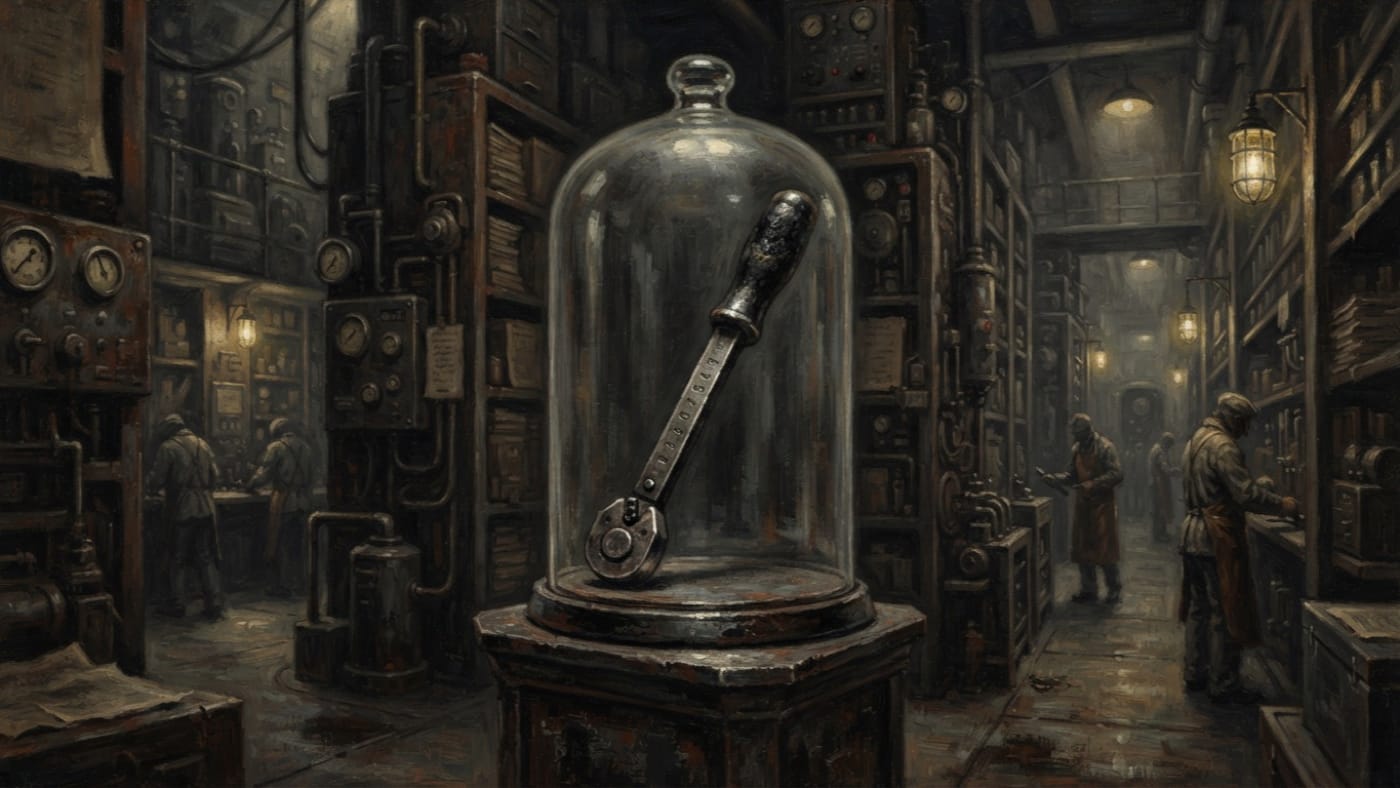
The object lies in the Metz Ash Vault under a glass bell. More Bureaus have dusted that bell than have ever agreed on a dusting schedule. The Bureau of Relics files it as the torque key of Saint Orla of the Seventh Line. It is said to be hers. The vault says so, the cult says so, and two of three examinations said so. In relic custody that counts as a landslide.
Before it became a relic it was standard issue. Every Gasket-Hymn Mechanic draws a torque key along with the seal irons, purity wax, alignment pins and pressure chalk, signs for it, and is docked for losing it. The tool has one job. It turns a bolt by a governed amount at a governed pace, so the ring seats evenly and the flange closes without warping. Because the turn is timed to the verse, the hand cannot hurry it. The verse paces the wrist. The wrist leaves a witness mark. Later, the witness mark tells the inspector whether anyone lied.
Two features of the vaulted key are worth a clerk's ink. Eight numbers are etched along it. There is also a blackened patch on the handle where, according to the description the Vault accepted, palm flesh fused to the metal. No document I have been permitted to read says anything else about the object. It names no maker, no stamping house, no calibration and no verse. Mechanics' keys often carry verses. This one is not recorded as carrying any. I will not engrave holiness onto it just because the pious would enjoy the lettering.
#On Seal Seven
The key's sanctity rests on a single night in old Bastion-Metz. The year in the official Life has rotted in a damp file. I assign the flood to A.S. 132, and the Bureau of Records has not yet found the stomach to dispute me.
The arrangement was plain engineering. Seal Seven sat on an old conduit, and that conduit fed pressure to the western pressure door. The door kept the river out of a low ward full of families, condemned labourers, and children asleep in bunks bought on ration debt. Then the old gasket swelled and the seal slipped. From that moment the door would survive only if someone replaced the ring while the water came up the stair.
Orla stayed. The repair meant tightening eight bolts in a star pattern. Each pass was timed to the Boundary Litany, so the hand would not rush and the ring would seat flat. The torque key is the instrument of exactly that discipline. Without it there is only a wrench and a prayer, and the old conduit had heard plenty of both.
The earliest named witness is Wax-Hand Jerun Pell. He was twelve that night. He later became a Torque Technician, and later still he was immured for altering a sequence without registering it, which shows how the Church rewards those who remember its saints too precisely. Pell says her hand was still on Bolt Eight when they pulled the door afterward. Pell says the key had fused to her palm. Pell says a chalk witness line crossed her thumb and the flange in one unbroken stroke. He also says the pipe knocked once and the water stopped climbing for a time.
I record each of those claims as Pell's. A child standing in cold water is a witness, and a witness is no mechanism. The chalk line proves that a hand and a flange were touching when the chalk was drawn. It proves nothing about the preferences of Heaven.
The record can bear something smaller and harder. The seal held. The pressure door stayed shut. The ward lived, and Orla died. The rescue ledger names seven hundred and twelve survivors of that ward. Records later cut the figure to six hundred and eighty-nine, after some of the living turned out to lack bunk permits. Both numbers count the saved, and both cover one ward only. Nobody in that engine chapel stopped a river.
Popular chapbooks claim Orla held back the flood by prayer alone.
Retracted. The prayer governed the pace of the key. The key seated the ring, the ring held the seal, and the seal kept one door closed. Anyone selling the shorter version to apprentices shall recite the longer one standing in a sump.
#On Authentication and Custody
Relics authenticated the key twice and questioned it once. It then declined a fourth inspection. According to the report filed, the key had turned one-eighth of an inch inside its case while a hymn-gasket novice was being examined in front of it.
The dates of those inspections are as follows: none. The names of the examiners: none. Their methods are not recorded in anything that has reached my desk. A Relic Authenticator is trained to tell a writ from a provenance chain, and a provenance chain from the object itself. In this case the writs have survived more cheerfully than the chain. The Authenticity Writ is paper. The key is dark metal under glass. Between them runs a custody record whose gaps are the width of a Bureau reorganisation.
Such gaps have been filled before by theft, by substitution, by careless clerks, and by nothing at all. The record does not tell me which applies here, so I do not tell you.
The reported movement gets the same treatment. An eighth of an inch is a measurement taken by somebody frightened. It records how far the key moved and nothing about why: no agent, no will, no verdict from a saint on a nervous novice, no draught from a badly hung vault door. Doctrine has not ruled on the cause. The only thing Relics has ruled on is its own attendance, which it withdrew.
#On Torque and Patronage
Recognition came thirty years late. The Bureau of Doctrine canonised Orla in A.S. 162. The Bureau of Engineering had spent three decades calling her an instructive incident. It promptly attached her name to a tightening specification. Orla-Seven torque calls for three light passes, one listening pause, two opposing seats, and a final quarter-turn on the closing syllable.
Keep the numbers apart, because the faithful will not. Seal Seven was the seal. The Seventh Line is the closing phrase, spoken with the last turn. Eight bolts made up the star. Eight numbers are etched on the vaulted key, and no document I hold says which number belongs to which bolt, or whether they belong to bolts at all. The Orla-Seven pattern is a later standard that carries her name. Engineering wrote it. It proves the relic genuine no more than a street named for a bishop proves his bones genuine.
In A.S. 164 came the Split-Ring Disaster at Bastion-Przemyśl. A cleansing verse was cut short, forty-three men died, and the craft was given formal licensing. From then on the key was an argument. The Line-Purists hold it up as proof of obedience: she finished every line and every bolt, and the seal held. The Field Pragmatists answer that a key is a tool. In their account she understood which turns would seat the ring, and she died because nobody came down the stair to relieve her. Orla belonged to neither faction. Both keep her picture.
Wax slips bearing her thumb-line circulate through engine chapels from Przemyśl to Bastion-Irongate, and so does pressure chalk said to come from Seal Seven. These are secondary goods, and there are a great many of them, which proves only that wax and chalk are plentiful. No second key holds a writ. Any key offered for sale in a Metz tavern is stamped tin and useless on a live flange.
#On Present Keeping
The vaulted key does no work, and it cannot, because nobody may lift the bell. Its use to the living lies in the thousands of issued keys that apprentices touch to their ribs before their first live seal, whispering Seat the ring. Speak the line. Those keys turn real bolts and leave real witness marks. They are counted at the end of each shift, and lost ones are docked from wages. The mechanics who carry them into flooded pits ask the saint for steady hands. That is a smaller request than Relics has ever made of her.
Apprentices do not visit the original. Masters do not lend it out. The glass bell stays down and the custody schedule stays violated. The eighth of an inch stays on file, unexplained, between two affirmations and one doubt.