
#On the Name and the Evidence
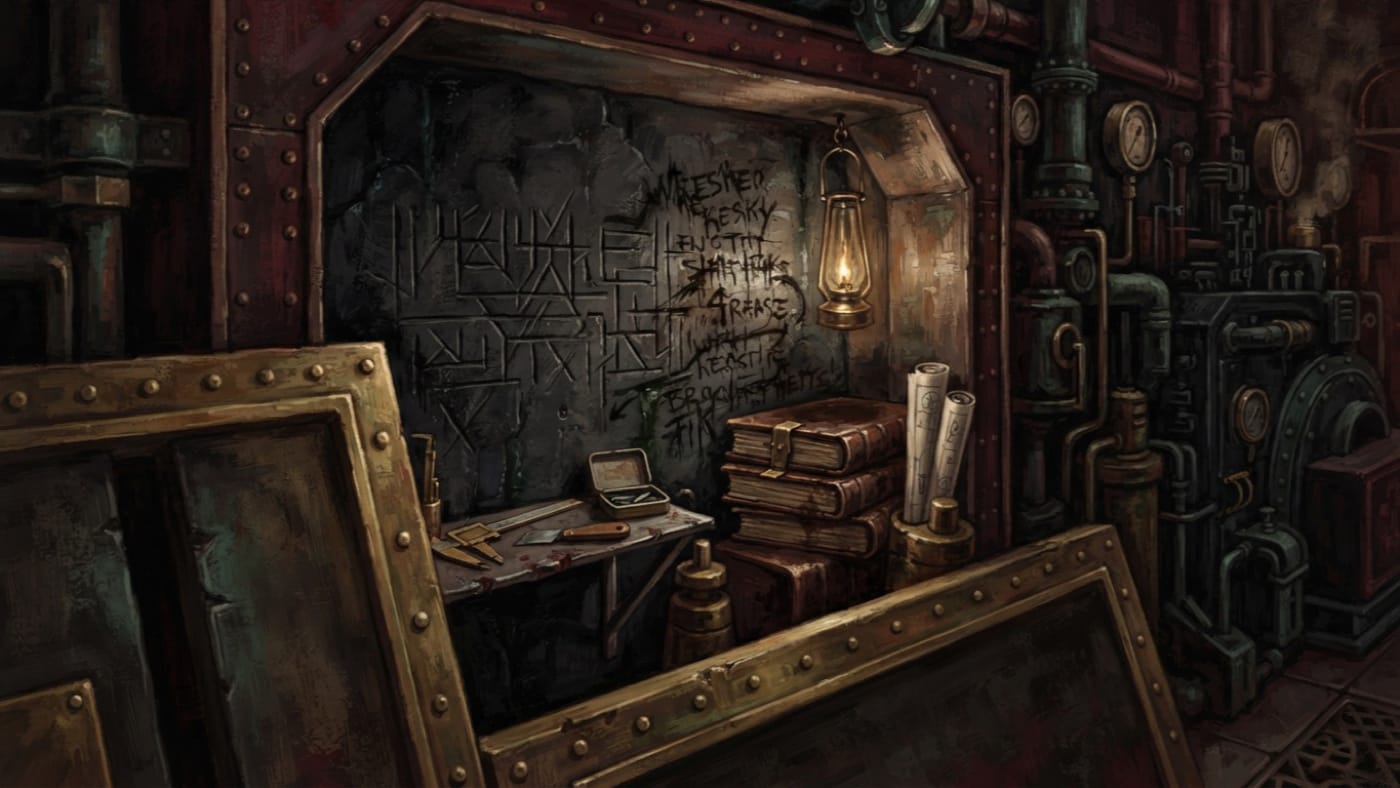
The Original Key is the Counterkey Circle's name for a set of acoustic incisions cut into the basalt behind baffle bank four, on the eastern wall of the Choir Nave at Bastion-Irongate. The name belongs to the Circle. The stone belonged to the Church until part of it went west in crates and part of it went into a sweeper's pan. I set this distinction down first because every later quarrel depends on it. Heretics like to name a thing and then behave as though the name were a finding.
The Choir Magistracy found the cavity in A.S. 200, during an inspection of the brass baffles. The full narrative belongs to The Hidden Alcove. Here it is enough to say that the concealing panel, and the tool marks beneath its brackets, belong to an earlier phase of work than the present fittings. Nobody has certified how much earlier. Behind the panel were two layers: older scoring cut into the rock, and fresh notation laid beside it in gasket grease.
So there is an inscription, and there are the things said about it. The Circle says it is old, that it came first, that it worked, and that it was buried because it worked. The inscription is evidence. The claims are doctrine, and heretical doctrine at that, until the Bench rules otherwise.
#On the Two Hands
The older marks were cut into black basalt with a narrow tool, and damp has worn their edges. The newer marks were drawn in grease, which does not wear. It smears, it collects grit, and it stays tacky long enough to prove that somebody stood in that hole recently. Purity analysts judged the grease to be probably the hand of Alen Rill, the Circle's writer of keys. Probably. The word is in their report and I have left it there. A Purity analyst who writes "probably" has already been overruled once that week and is in no hurry to be overruled again.
That attribution covers the grease and nothing else. Nobody has assigned the incisions to Rill or to any named hand. Irongate forbids anyone to speak the name of whoever set its first chant, and this office does not intend to break that prohibition on the evidence of chisel wear. The record does not know who cut the basalt. The Circle prefers it that way, since an anonymous ancestor can be made to agree with anyone.
Bells analysts recognised the old cuts as a precursor to Magistracy calibration notation. This is a comparative judgement: certain forms in the stone stand in a recognisable relation to forms now used in the licensed hymnals. Rill's grease answers those forms. Beside the cuts the analysts recorded adjustments for temperature and pressure, and a lower progression set against an upper incision. The newer hand therefore reads as reply and extension rather than vandalism, which offends the Magistracy far more than vandalism would.
What survives is fragmentary. No complete composition has been recovered. Anyone in the Dead Gallery who offers you one is selling a page he wrote himself by tallow light.
#On an Earlier Hymnal
The parent account gives the Circle's claim in the Circle's own words: the old scoring records the frequency the mountain accepted before the Magistracy fixed its present hymnals. Take away the poetry and three propositions are left. The scoring is earlier than the authorised system. It represents a working practice. That practice was sound. Bells has given partial support to the first. The second is plausible. The third is a sermon.
The first proposition is the dangerous one. Since the Great Hush, the Magistracy has governed Irongate on the premise that its hymnals are a settled instrument, numbered, guarded, recalled and reissued under seal, with every deviation treated as a crime. An ancestor complicates that premise. If the authorised notation descends from something older, someone adapted it. Adaptation means choices were made, and choices mean someone might have chosen otherwise. The Magistracy has advertised an oracle and cannot afford to be caught holding an edition.
Its answer is operational, and it is a strong answer. The present stanzas are sung. The Third Lung stays sealed. The gauges read within tolerance. A system that keeps holding has a claim on obedience that no carving in a wall can match.
The answer settles less than the Magistracy pretends. Continued operation proves that the current hymnals are sufficient. It says nothing about what was discarded, or why. Age proves nothing about merit either. The oldest error in a chapter house is still an error, merely better upholstered.
Then there is the correspondence. Bells reported that portions of the old scoring resemble current emergency reinforcement harmonics. Note the word portions. The Circle repeats the finding as though the mountain had sworn an affidavit. What it shows is a relationship that needs explaining. It does not show that the older system worked as a whole, that it was safer, or that burying it caused any later collapse. Perhaps emergency practice inherited something from the old scoring. Perhaps both answered the same physical necessity by different roads. The slabs now in Strasbourg do not say which.
#On the Price of a Voice
None of this would trouble a cathedral chapter. At Irongate, notation is bread. A voice-license fixes a tier, and the tier fixes heat, food, work and the right to walk a corridor after second bell. Whoever controls the hymnals decides which throats are useful, and so which bodies stay warm. Cantor Ys Varr administers that arithmetic with a razor's calm and a ledger's memory.
As far as Purity has reconstructed it, the Circle's programme is to break the licensing monopoly by teaching harmonics the Magistracy forbids. It works through coded taps, humming in the silent corridors, and hymn pages stolen from licensed stock. To the Circle the Original Key is chiefly a warrant. If the mountain's first music was cut by an unlicensed hand into a wall that nobody now owns, then the license is a toll laid on top of an older right. Reed, whose voice was burned, serves that argument as its martyr and Rill as its scribe. They are two separate people, whatever the provost's sketches suggest.
The Underchords give the Circle routes, and hollows to meet in. The Underchord Cartel keeps those routes and sells quiet passes and counterfeit stamps to anyone with grease or coin. Its interest in the Original Key is a merchant's interest in a rumour that raises prices. Anyone who mistakes the Cartel's ledger for the Circle's catechism will arrest the wrong people, and will usually be paid to.
The licensed singer in the chant pit meets the dispute as a question nobody asks aloud: if the stanzas she was taught are a revision, was the revision made for the mountain or for the Bench? The warden meets it as an order to scrape. The magistrate meets it as a matter of precedent, because the Magistracy and the Hush Court already blame certain minor collapses on Circle harmonics. That attribution is theirs. This entry records it and adds no verdict.
#On Custody and Unanswered Claims
The grease was scraped into sample tins. The incisions were cut out in slabs where the basalt allowed. Where extraction threatened the baffle seat, they were planed away. Part of the Original Key therefore no longer exists anywhere. It became shavings on a nave floor and went wherever the Gasket Choir's sweepings go. The remainder passed into Doctrine custody and travelled west to a sealed acoustic vault in Strasbourg, under a manifest describing damaged hymn stands. The record I am permitted to cite stops at that manifest. I have no accession to quote and no custodian to name, and nobody has tested the slabs since in any way I can certify.
The public maintenance report for baffle bank four records the alcove as empty.
Corrected. The alcove held fresh grease notation and older incised scoring, both recorded in the Magistracy's own account of the find. Empty describes only the condition the Magistracy produced afterwards. The report's authors are commended for having described their own handiwork so accurately.
The parent account gives the position as of A.S. 201. The alcove is resealed and its baffles pass inspection. Rill has not been taken. The Circle circulates the alcove's significance among its lower cells, where the phrase "bank four" is tapped before meetings. Varr has the Nave's furniture checked twice a week for counterkey scratches, which is the kind of sensible procedure an absurd discovery tends to produce.
Five questions remain open. I list them so that nobody can later claim the Bureau answered them.
First, age. The panel is earlier than its fittings, and no construction year has been established. Second, authorship of the incisions. That hand is unknown, and its name could not be printed here even if it were known. Third, completeness. The scoring is fragmentary, and the removal destroyed part of what remained. Fourth, its relation to emergency harmonics. Portions resemble them, and no one has explained why. Fifth, capability. No one has shown that the Original Key can do anything except embarrass the people who were supposed to have filed it.