
#On the Attested Provision
This survey, conducted in A.S. 201, covers a single provision as it stands in present use by the Order of Ash. I give the scope at the door so that no reader mistakes the size of the room. The instrument is named the Ordo Ignis. Its forty-third revision is recorded as the occasion on which the Bureau of Doctrine approved an accelerant treatment for the binding of the Ashman's breviary. The approval has not been revoked.
That is the whole of the attestation. No record this survey can cite gives the rest of the Ordo's text, the hand that first compiled it, the dates of its revisions or the composition of the treatment. I decline to furnish the Ledger with anything I did not find in it. A clerk who invents the remainder of a code to make his entry heavier should be bound in calfskin and shelved with it.
The numeral needs one further word, since the Bureau has met clerks who cannot count. Forty-third numbers a revision. It is not a year. Whoever files it under A.S. 43 may apply to the Bureau for remedial arithmetic.
#On the Binding
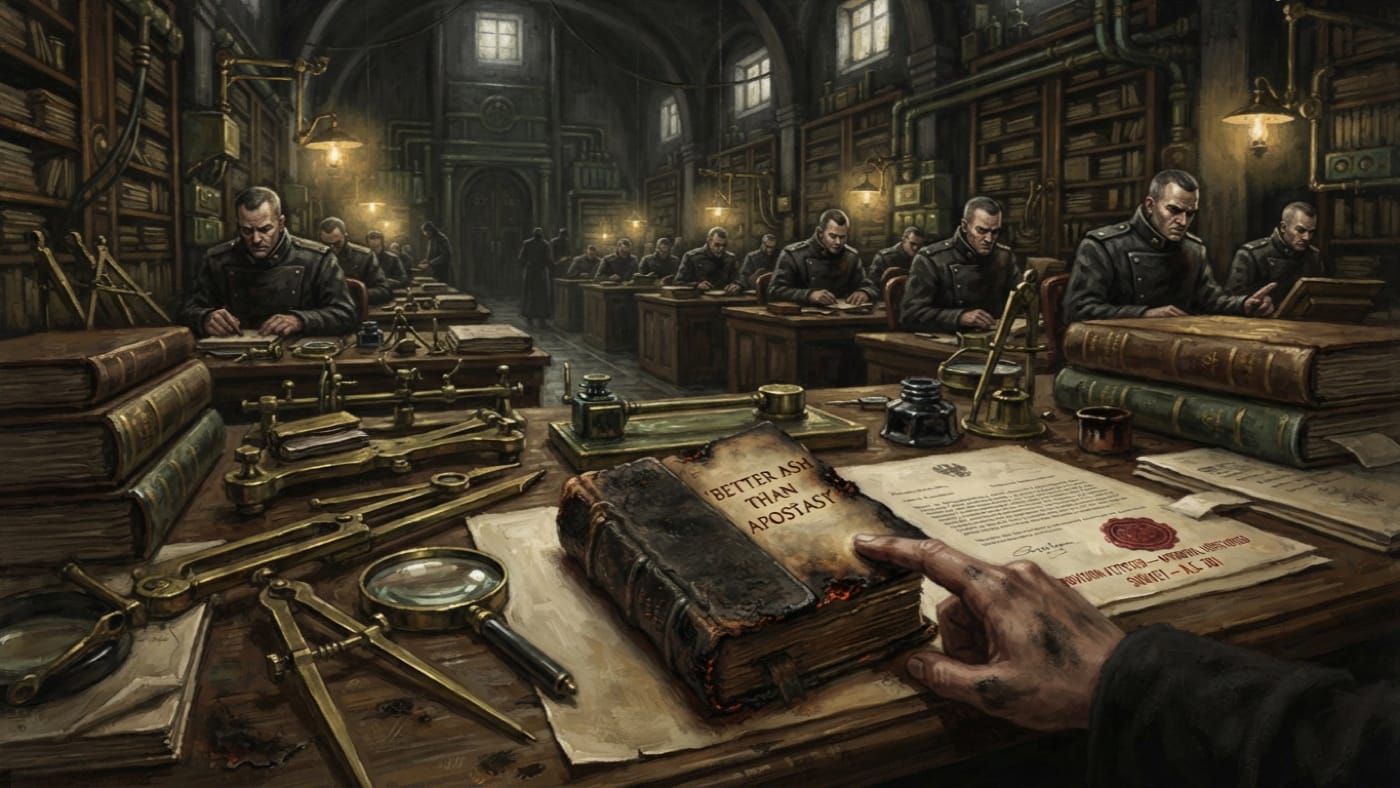
The breviary is small, which is the first thing to grasp about it and the last thing anyone remembers. An Ashman carries his office-book as any cleric carries his: against the body, worn at the corners, opened at the hours. Printed inside the cover is the Order's motto, Better ash than apostasy. The Codex's entry on the Order records that these letters char slightly whenever the book is closed.
I report that as it was recorded and attempt no explanation. A description is no mechanism, and Doctrine approved a binding. It issued no treatise on combustion.
What I will offer is a reading, and the reading is mine. Every other Order's devotional book may be lost, stolen, left in a ditch or carried off to some cellar where a heretic reads it aloud in a mocking voice. The Ashman's book has been prepared, at the level of its boards and stitching, to share the one end his Order prefers to all others. His prayers are sewn into a cover that agrees with him. Every evening he closes the office, and every evening the motto takes a little more scorch. There is a liturgical word for an act repeated until the body knows it without the mind. The Ashmen do not need the word. They have the book.
The rest of the Church carries breviaries that would burn if thrown on a fire. The Ashman carries one that has been helped toward it.
#On Doctrine's Approval
The division of labour is old and serviceable. Doctrine defines and the Bureau of Purity enforces. Between definition and enforcement sits the whole apparatus of permission, and that apparatus is where this provision lives. Its approval is less a sacrament than a licence.
Consider what the approval actually accomplishes. A binder may treat the boards. A quartermaster may issue the finished book. An Ashman may carry it into a chapter house, onto a road or across a parish boundary, and no inspector of the Inquisition may call the object irregular, because the Bureau of Doctrine has already called it regular. Approval turns a dangerous habit into a compliant one. I have seen the same alchemy performed on taxes, on silences and on the burial of the inconvenient. It never loses its charm.
The approval goes no further than that. It gives the Order no general law of fire and does not make the provision safe from later amendment. What the Bureau sanctioned is an accelerant in a binding, nothing more, and anyone who reads a broader mandate into it is reading his own appetite.
The present status is not revoked. That is a status, and reporting statuses is a survey's business. Whether the Bureau has had cause to revoke it, and has chosen not to, is a question for Doctrine's minutes. Those minutes were not opened for me, and I did not ask.
#On the Ashmen's Practice
The provision governs a book. The book belongs to men whose trade is the burning of settlements, from the village to the city, and the Order's own entry sets out what that trade involves. Their motto is printed in the breviary as operational guidance. I quote it here as the Order's watchword. I do not quote it as the opening clause of the Ordo Ignis, because nothing places it there, and a motto stamped into a cover is not thereby a line of the statute that approved the cover.
A few other things are recorded of their practice. The Order anoints brows with soot and recites what is called the litany of accelerants. Precise operational manuals for Ashmen are held in the Bureau of Purity's archive. The Bureau of Records keeps planning tables that the Order consults before it moves. Each of these belongs to the Order's method. None of them is attested as a clause of the Ordo, and I will not have them dragged into this dossier to make it look complete. A survey that fattens itself on neighbouring rooms is no longer a survey. It is burglary.
Earlier editions of this Codex described the Order's methods as "crude but effective."
The withdrawal entered in the Codex's entry on the Order of Ash stands, and is repeated here only because the binding supports it so well. An Order that has its devotional books treated, under doctrinal approval, down to the boards is not improvising anything.
I once walked through what that method leaves behind. My earlier inspection in the Ardennes is already on record: a parish reduced to a grey pan, its well-stones glassed smooth, and children's slates lifted from the kiln-hard earth with their lessons baked into blistered oblongs. I add nothing to that account and need not. The breviary's binding and that grey pan are the same instruction written at two scales. One sits in a hand. The other was a parish.
#On Its Present Standing
So stands the provision as of this survey. The Ordo Ignis, in its forty-third revision, carries Doctrine's approval of an accelerant-treated binding for the Ashman's breviary. The approval has not been revoked. The breviaries are carried. Their mottoes are printed inside the cover, and the Order of Ash, by its own record, closes them each night upon letters that darken slightly at the touch.
I have checked the approval and found it adequate to its object. A cover was proposed, a cover was sanctioned, and the sanction holds. What the Ashmen do afterward with the hands that hold those books comes before other desks, under other seals, and I have never been asked to countersign it. The Creator will audit as He sees fit. The Bureau has already done so, and it found the paperwork in order.