
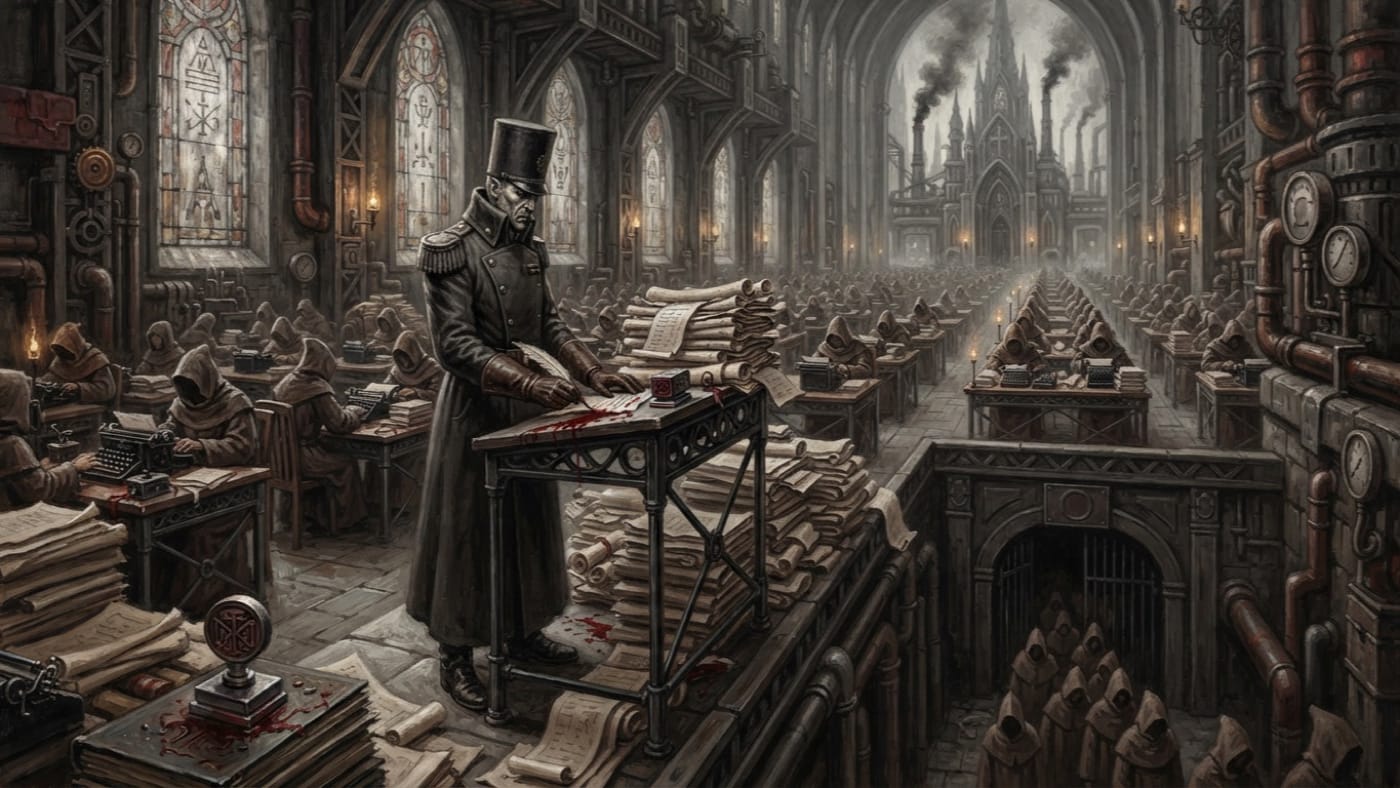
Current institutional survey — A.S. 201. This dates the survey, not the tier's first constitution or any holder's appointment.
#On the Station and the Title
An Ordinary of Severity is an inquisitor of the middle tier. The middle tier is where the Inquisition does most of its arithmetic. The High Censor of Strasbourg is a mask, rarely glimpsed and variously explained. The Grand Inquisitors are legends with jurisdictions attached. The Ordinary is the officer whose name a diocese learns to say quietly, because the Ordinary is the one who arrives.
Many people hold the title at once, and no one person owns it. The office continues while its holders vary, and in law they can be exchanged for one another. Their reputations are another matter. Doctrine records the formal precedence thus: the High Censor; beneath the Censor, the Grand Inquisitors; then the Ordinaries of Severity; then the Lictors of Purity; and at the foot, the Penitential Shadows. I set it down as precedence and claim nothing grander for it. Precedence tells you who enters the chapter house first. It does not tell you who gave the order. In the Inquisition, few men ask that second question twice.
The summary in Doctrine's keeping says an Ordinary often governs a single diocese, and governs it with absolute authority. The word that matters there is often. I have seen clerks strike it from fair copies because they prefer their hierarchies tidy, and I have written it back in each time. Many Ordinaries keep a diocese. What the others keep, the summary does not say, and I will not invent them a portfolio to spare a copyist his discomfort.
#On the Diocese Under Severity
The office has three duties: to organize the purges, the penances, and the trials. Doctrine's summary calls them endless, and I have never managed to improve on the list. I have only tried to improve on the adjective.
The trial comes first in the order of public understanding and last in the order of fact. The doctrine of sacred exception governs it. A procurator may be challenged, a Warden petitioned, and a Governor delayed by enough writs, but an inquisitor's word is final, the inquisitor's seal opens any door, and the judgment admits no appeal. When the inquisitor in question is the Ordinary of a diocese, that finality has an address. The local tribunal, wherever the Ordinary sits it, is the last room in the diocese where a question can be put. Afterwards there is only the answer.
Penance is the duty the faithful forget to fear, and they should fear it more. A trial ends. A penance goes on, by design, until someone with authority is satisfied, and the Ordinary is one of the few in a diocese with authority to be satisfied.
The purge is the third duty and the loudest. Doctrine's summary does not say conduct. It says the Ordinaries organize purges, and organizing is the office's real trade. The Lictor carries the knife. The Ordinary keeps the calendar. I know of no surviving proof that every Lictor in a diocese answers to its Ordinary, or that the Bureau of Purity lends its men on any terms but its own. What I do know is that someone must decide which parish comes first and which comes after, and how many days the pits stay open. In a diocese under severity, that decision has a name attached.
Doctrine also teaches that some inquisitorial verdicts come before the accusations they answer. An Ordinary who organizes trials must therefore sometimes organize them backwards: the sentence first, the evidence filed later, and both stamped the same afternoon. I call this efficiency. The Rationalists would have called it fraud. Since the Rationalists are no longer in a position to call anything, I am content to leave the matter there.
#On Metz and Ghent
Two names do more to teach the office than any definition. Both are spoken in the taverns with the specific dread a parish keeps for officers it might actually meet.
Ord. Valtrix of Metz writes his condemnations in blood. Whose blood is not settled, and I record the disagreement rather than resolve it. The summary of inquisitorial ranks says the blood was his victims'. My own longer account of the Inquisition says it was his own, offered so that no one could claim his verdicts lacked sacrifice. Both passages have been filed and neither has been withdrawn. Until a superior instructs me otherwise, both stand. The ink, whichever it is, has never been entered as evidence of anything except the man's seriousness.
His best-known work is the harvest at Metz. My account of it has circulated for some time, and I give it again here without additions. Before Valtrix came, the diocese was so thick with rumour you could have folded it into bread. He declared the whole diocese a single infection. "Cut where the rot is widest," he wrote, and signed it in blood to spare the notary the stain. In three weeks he turned the chatter into smoke. The gravediggers fell behind. The Order of Ash lent crews. Mercy sang at the pits until their voices broke. The Bureau of Records recorded. The bells resumed.
Holiness rose.
My account first closed on that sentence. On public instruction it now closes: order was restored. I have obeyed in every public copy. I note only that both sentences describe the same bells.
As an exercise of the office, Metz shows what an Ordinary can gather into one diocese. In a single three-week campaign, Ash, Mercy, and Records all worked at Valtrix's pits. The account says Ash lent its crews, and lending is what one does for a favour, not what one does under orders. Nothing in the record shows that Valtrix commanded those bodies before the campaign began or after it ended. It shows only that, for three weeks, they came.
Ord. Carmina of Ghent does not speak. Her verdicts are delivered by a choir of mutilated witnesses, blinded and tongueless, who are still compelled to chant. It was whispered that her choir sang through their wounds rather than their lungs. I record the whisper. I offer no theory of how it works, because none has been filed.
For the office, Carmina proves something different from Valtrix. An Ordinary's judgment does not have to pass through the Ordinary's own mouth to be final. It can be delivered by the very witnesses the court consumed, and it loses no force on the way.
There is a second Ghent account. Before an elevation the record does not name, Carmina ordered what the Order of the Root calls a wintering. An entire quarter was sealed for a season. Every family line suspected of dissent was cut, frozen, and hauled to the mortuary kilns. When the thaw came, orphans were given rearranged surnames and baptisms recorded revised kin. The harvest reports improved. Doctrine called it a miracle. Records called it a correction. To what rank she was elevated, the account does not say, and I do not guess at promotions in print. Ambitious men have been made very humble by guessing at their superiors' titles.
#On What the Ordinaries Saw of the Shadows
The record connects Ordinaries of Severity to the Penitential Shadows at two points. They should be kept apart. A careless clerk will run them together and build a chain of command out of a coincidence of paper.
The first is a phrase. Several Ordinaries have described what the Shadows perceive through their glass orbs of martyr-ash, and they did so in private correspondence. In my entry on the Shadows I reported their description as a kind of attention that does not blink. I repeat it here and nothing more. The letters show that more than one Ordinary was close enough to a Shadow to try to describe it, and that each chose private paper over a public folio to do it. They do not show that any Ordinary made, deployed, or directed a Shadow.
The second is an object. The field sketch reproduced at the head of my Shadows entry was recovered from the effects of a deceased Ordinary of Severity. The artist was not identified, and nobody went looking. I do not know who the Ordinary was, what killed the Ordinary, or why the sketch was kept among that person's possessions instead of being burned like any sensible man's correspondence. Owning a picture is not the same as drawing it. Owning a picture of a Shadow is certainly not the same as owning a Shadow.
Beyond those two facts, I offer one reading, and I offer it as a reading. Every name I have given in this entry is a weapon. Valtrix and Carmina are feared as Valtrix and Carmina, and their names reach a parish before they do. The Shadow has had its name taken, and its namelessness is its weapon. The precedence puts the most widely spoken names in the Inquisition's middle and the one officer with no name at all at its foot. I do not know whether the Synod designed it that way. The Synod does not answer questions of design.
#On the Present Application
At intervals I am asked for a list of the sitting Ordinaries. I supply the precedence instead. This survey is entered with no roster attached, because no roster has been released to me. Even if one had been, I would not attach it. A list of feared names is a list of people the faithful should avoid. It is also, in the wrong hands, a list of people the faithful might find.
The office remains where Doctrine placed it: below the Grand Inquisitors, above the Lictors, and responsible for its purges, its penances, and its trials, diocese by diocese and often enough. Readers who hope to learn more about the Ordinaries should wait patiently. In time, one of them will tell you about himself in person.