
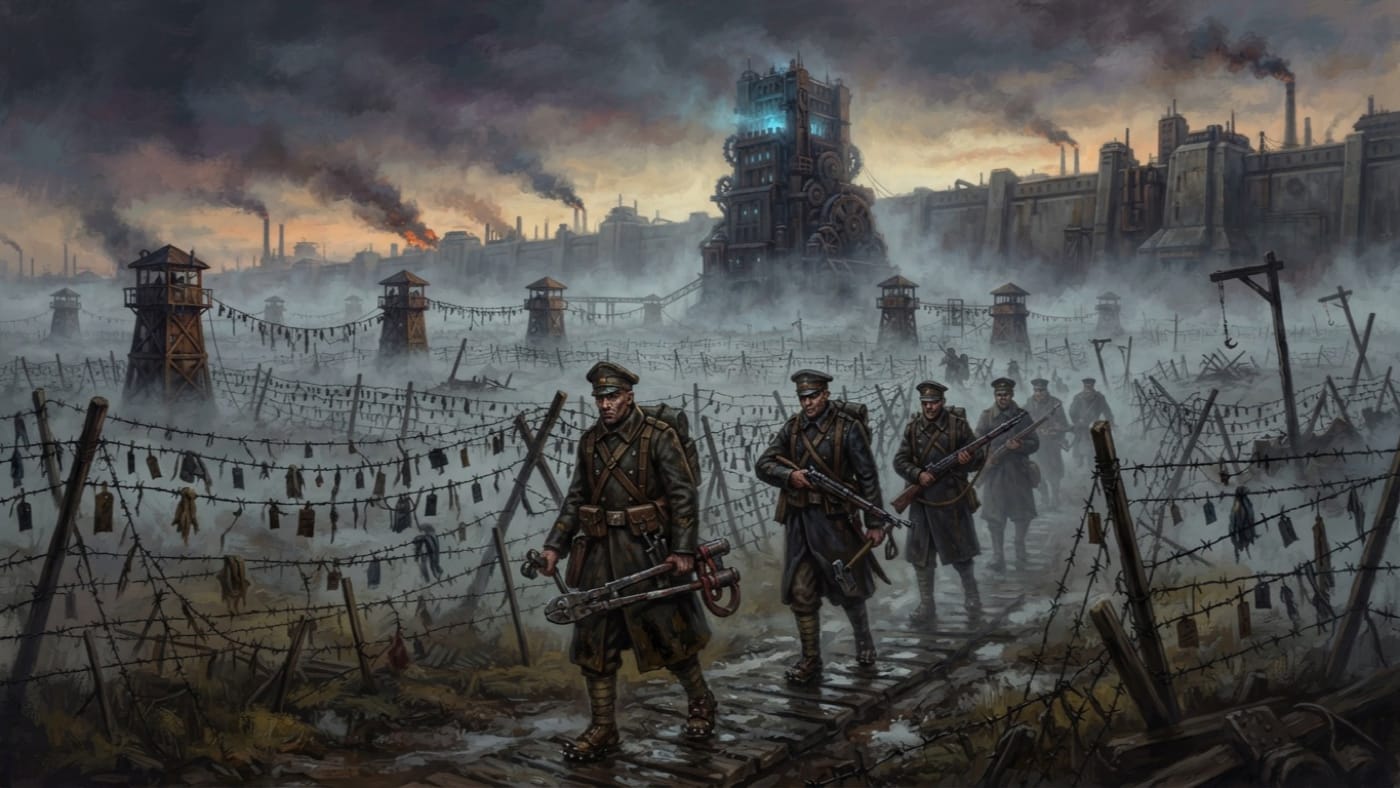
"Every strand is a sentence. The question is whose." — Orchard Warden graffito, Tower Nine stairwell
#On the Station and Its Jurisdiction
The Orchard Wardens are the militia charged with keeping the wire of Bastion-Przemyśl secure. That is their whole public commission. It would fit on a ration tag with room left over for the seal. They hold the Orchard Ring, the inner edge of the wire-zone where gallows posts stand among the groves of barb, and they hold the towers that rise from it. Tower Nine, the tallest, is called the Orchard Eye.
The Wardens are not the garrison. The roughly 2,400 provost troops and auxiliaries of Barrack-Ash eat first and sleep warm. The Bureau of Records has never told me how much of that number is theirs. What sets them apart is territory. A provost squad may arrest a man anywhere in the bastion. A Warden owns a lane.
The grid was strung to stop Atheron's host on the eastern approaches. It stops everyone else as well. The bastion rose around A.S. 67, as the Sagittal Line hardened under the frontier authorities now counted as the Synod's forerunners. Its wire reached two miles by A.S. 75 and three by A.S. 92. Each strand that lengthened the kill-zone also lengthened the fence around the bastion's own people. Men who keep a fence come in time to believe they keep whatever it encloses.
#On the Keeping of the Orchard
The wire does not keep itself. Strands sag under ice. Current fails along pylons salvaged from structures never meant to carry it. Shell splinters, deserters and the Carpathian wind all cut the grid, and every cut brings the Wardens, whoever made it.
They carry wire-cutters blessed by the Chapel of Counting, and the difference between a blessed cut and any other cut is the law of Przemyśl in miniature. A Warden who severs a strand in order to replace it is doing maintenance. Anyone else who severs a strand has committed an offence. Cutting the grid in daylight is one of the bastion's red lines, which have no tribunal attached to them, only a result. Cut wire is restrung promptly. The Wardens swear each replacement is identical. The Bureau of Engineering has observed that replacement wire "does not always agree."
The Wardens do not do all the labour. The bastion owes wire-maintenance duty as a tithe, alongside the ration percentage and the labour-hours, and in the season of Wire Renewal the grid becomes a work site for anyone who can be compelled onto it. Barbs bite through wool gloves. Cuts from the Orchard go bad so reliably that the soldiers have a word for them: wirekiss. Current runs in places where the ledger says it does not. Cutting wire with bare hands is taboo, and nobody needs a priest to enforce that taboo.
The Wardens' power to coerce grows out of this work. The lanes are the only routes through the grid, so whoever decides which lanes stay open decides who moves. Their methods are on record: patrol terror, the incident filed as an accident, the ambush in the wire-lane. The Orchard Ring's accident reports read as though their authors agreed on the weather first.
#On the Dawn Harvest
"Dawn is a knife with paperwork." — Proverb of the Orchard
Each morning before the first bell, Provost-Marshal Vanna Rook sends out the dawn harvest patrols. They collect what the wire caught overnight: bodies, and the tags on them. The tags go into the morning ledger. The bodies go to the ditch-pits unless a burial claim stands, in which case a wax seal goes on the tongue. If the tags do not match the morning's projected intake, the Logistics-Penance Tribunal adjusts.
The Wardens fit into this system less neatly than the system would like. The harvest is taken from ground they hold. The night's catch is watched from their lanes and towers. They buy bounties at the Gallows Market, where tags change hands in daylight. No command chart I possess says whether they act under the Provost-Marshal's warrant, beside it, or merely in its general direction. The Bureau of Records treats the question as unasked.
The Wardens must not be confused with the Dawn Harvesters. That provost clique works out of the Barrack-Ash staging pens and earns bounty money and terror's prestige through staged captures and planted tags. The two groups share a dawn, a quarry and a vocabulary, but they keep separate ledgers. I record the distinction because the Wardens insist on it, and men who insist on such distinctions usually know why.
The Wardens want harvest authority that reaches beyond deserters. No decree has granted it. Nothing in the morning ledger suggests the Wardens have waited for one.
Only deserters are harvested.
Corrected. This is the falsehood most often recited in Bastion-Przemyśl, and it was never true enough to be worth retracting. The harvest takes whoever the wire holds at dawn, and the wire holds whoever the lanes delivered to it. Deserters remain the official quarry. The street puts it differently: "They take whoever balances the week." The Bureau of Records declines to endorse the street. It also declines to count.
The Gleaners work against all of this. They are a heretic mutual-aid cell that shelters the Erased, swaps tags between the living and the recently dead, and runs escape routes through the Underwire. Every swapped tag is a lie entered into the Wardens' own harvest. Every Erased person who reaches the ditch-edge alive makes a cut in the grid that no new wire can mend. I have found no record that the Wardens' hunt for them has succeeded.
#On Patrol Through the Wire-Hymn
"If the wire hums, stay humble." — Proverb of the Orchard
Of all the bastion, the Wardens patrol the one part that talks back.
On humming nights the grid gives off a resonance the garrison calls the Wire-Hymn. Soldiers report hearing names in it, and some of those names appear in no ledger. Tags lift on their strings in still air. Ink on freshly stamped paper creeps into spirals. On the worst nights the patrol lanes are said to change, straight at dusk and bent by morning. A Warden whose lane has moved must still report it open or closed. The form has no third box.
Their protections are the garrison's, and modest. They lay a salt line across a tower threshold. They put wax in their ears. They carry blank sheets of silent paper inside the coat, so that whatever writes finds nothing to sign. Every Warden learns the superstition before walking a first lane: if the wire says your name, do not answer.
The Wardens do not ask what speaks through the wire, and this entry will not ask either. The Bureau of Doctrine holds that the hymn is wind. The Bureau of Bells disagrees. The Wardens sweep the salt back into its line each morning.
#On the Test of A.S. 195
In the autumn of A.S. 195, Atheron's Spire-Crusher crossed seven miles of broken saddle toward the eastern salient. Tower Nine first reported it at dawn, at three hundred and forty feet. By the time it reached the outer wire it stood nine hundred. The Nine-Hour Rubric belongs to the Bureau of War's account. The Wardens' part in it is shorter and stranger.
Before the tower touched the Orchard, the pylons bent outward to meet it. Salvaged iron sunk in Carpathian rock and hung with tags leaned toward the enemy like courtiers at a levée. The Orchard was bowing. The after-action material records that this disturbed the Wardens more than the casualties did, and I believe it. A Warden sees men die in the wire every dawn. No Warden is prepared to watch the wire kneel.
Provost-Marshal Rook ordered the eastern current doubled, and the strands burned blue. The ration tags on the barbs caught one by one, each small paper authority curling to ash. The forward pier entered the charged field and stopped. For twelve minutes nothing advanced.
Those twelve minutes were the best the Wardens' apparatus has ever done. Then the pier lengthened over the wire, rose clear of the charged strands, and carried its shadow across the ditch and onto the inner wall. The grid was never breached. The tower simply stepped over it. At the ninth hour the artillery concentrated its fire on the narrowing pier, and the tower fell. Its collapse left forty feet of rubble and three days in which the garrison could not stop looking at the sky.
Credit is shared among the guns, the bells, the smoke, the current and the enemy's own structural vanity, in proportions the Bureau of War is still litigating. The Wardens kept the wire. The wire bought twelve minutes and lost its fruit.
#On the Present Ambition
The bastion's present wound, documented through A.S. 201, is a missing stamp die. A forger who held it could print valid tags. Valid tags are valid lives, and a glut of valid lives is a famine with good paperwork. The Bureau of War has modelled the outcome if nothing changes: riots within three months and mass erasures within six. For now it remains a model.
A militia that answers any cut in the grid will treat a forged tag as one more cut. Provost-Marshal Rook is presenting the dawn harvest as a matter of security rather than supply, and she is understood to be reaching for the Tribunal's authority under cover of the audit emergency. That too is an aim and not yet an act. If she succeeds, the Wardens gain their old ambition by consequence, without a decree.
The other hazard lies to the east. Atheron works through comparison, through the grievance of the passed-over and the certainty of the deserving. Every muster in Przemyśl recites equality before the Creator, and the Wardens recite it from the towers, looking down. An institution that ranks people by which side of its wire they stand on has already granted the enemy half his argument. Nothing in the record shows that any Warden is possessed or has joined his cult. Nothing in the record needs to.
The Wardens keep the grid secure, and the grid surrounds everyone on the Line's Carpathian arc who cannot produce a tag on demand. Draw the inference at your own expense. I have filed mine.