
#On the Breath Before the Iron
A frightened body breathes badly. It gulps and catches and heaves against the strap, and in doing so it moves the very skin on which the Bureau of Purity means to write. A brand laid on heaving skin leaves a smear, and an inspector at a gate twenty years later cannot read a smear. The Opening Hymn exists to correct this. It is the second of six stages in the branding rite performed by the Iron Choir Brand-Singers, and breath is its whole office. It takes the condemned person's ragged intake and lays it, by sustained and patient pitch, into a pattern still enough for iron.
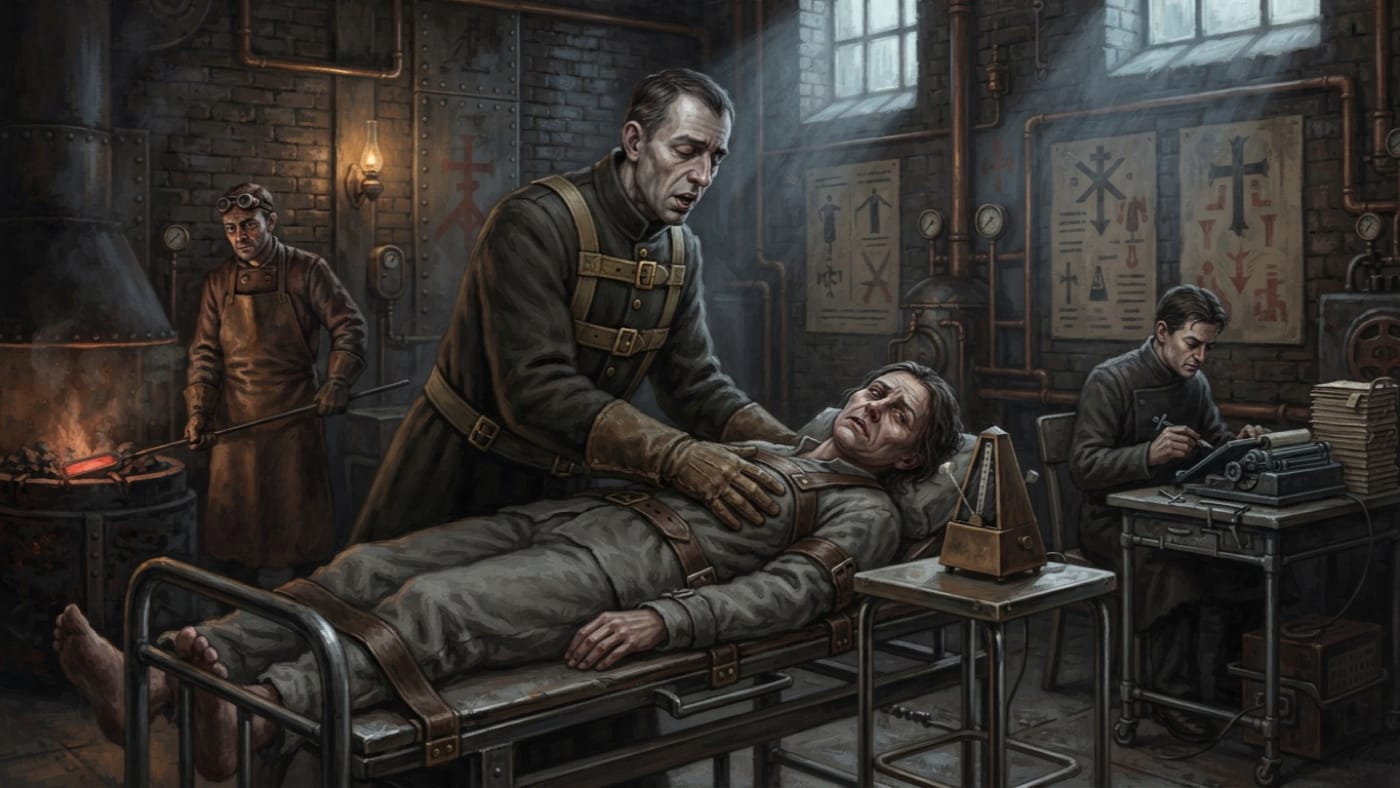
Four people occupy the chamber at that moment. The singer stands near the subject, one hand spread against the ribs. The condemned person lies restrained and breathing, which is the only thing presently asked of them. The Brand-Smith waits at the brazier with the iron heating and nothing yet to do. The scribe sits to one side with slate and form, watching for the moment the paperwork may begin. One of the four is being prepared.
The approved account calls this mercy, and it is mercy in exactly the sense the Bureau intends. The hymn prevents thrashing. Thrashing kills, and nobody can certify a dead subject. The Church has always preferred its confessions finished.
#On the Borrowed Choir
Between A.S. 94 and A.S. 104 (1804–1814 CE), Purity had no singers of its own, so it borrowed them. Trenchline psalmists of the Bureau of Orison and Song were lent into the iron chapels of Strasbourg and elsewhere to steady bodies under the brand, and every document of the period calls the arrangement provisional. Orison brought the older tradition: the drone, the breath discipline, the trench habit of keeping men in time while they did something they would rather not do. Purity brought the bodies.
The corps received its formal constitution under Writ 14-C around A.S. 104. From that settlement onward the practice belongs to Purity and its Directorate of Acoustic Enforcement, which trains, licenses, audits and punishes. Orison keeps its interest in the licensing of hymns generally, since Orison keeps an interest in anything that can be hummed. An interest is a lesser thing than a command. Both Bureaux know it, and only one of them says so in public.
Whether the Opening Hymn is older than the Writ, no document I have consulted will say. Nor do they record its composer, its first performance, or the year it got its name. They record that the stage exists and what it is for. A working liturgy needs nothing more.
Saint Orla of the Steady Note belongs to those borrowed years. She is patron of controlled breath and of the singers who supply it, and the Opening Hymn is where her patronage does its daily labour. Hagiographers who credit her with composing it are being generous to a woman who cannot correct them.
#On the Work of the Opening
The room begins the rite, and the hymn only follows it. Before anyone sings a note, the singer taps the tuning rod, sets the bell-hour metronome token and listens to what the chamber gives back. Stone repaired that week is distrusted on principle. A crack in the masonry changes how a room answers. The changed answer moves the pitch, and the moved pitch reaches the iron. The Opening Hymn assumes this inspection is already done. It cannot do the inspection itself. Singers who try to correct a bad room by singing harder are remembered chiefly by their replacements.
Once the baseline is set, the singer begins from the approved slate. The hymn's business is the condemned person's lungs. The singer sustains and paces, and the subject's breathing is drawn toward that pace by fear, by exhaustion, and by the plain animal habit of falling into whatever rhythm is offered in a frightening place. Singers call this keeping the bell in the ribs: holding tempo inside oneself against everything the room supplies. That means sobbing, the hiss of the quench bucket, and the subject whispering the names of officials the singer has never met. Somebody always tries to bargain. The hymn goes on.
When the breathing holds, the stage is complete. The rest belongs to later stages. First come the cue patterns that mark each segment of the confession, and then the iron, laid in time with the cadence so that each scar matches its text. The singer gives the timing, the smith gives the mark, and the scribe records that both were given correctly. Three crafts, each competent, and each able to say afterwards that it only did its part.
The certificate issued at stage six speaks of a stable subject and a clean confession. The stable subject is the Opening Hymn's contribution. Whether the confession was true is a separate question, and no stage of the rite is asked it.
#On the Throat Under Examination
Novices learn the Opening Hymn first, because nothing else can be taught to a throat that cannot hold it. Ash Choristers carry drones and learn breath pacing for years before they lead anything. Licensed Brand-Singers lead the rite and give the cues. Cantor-Marshals train, set protocol and audit. They correct wandering pitch in the manner preserved in Orla's own dossier, with a blow from the tuning rod to the ribs, where the bell should have been kept. The motto is recited along with the blow.
A clean note wards a dirty mouth.
Examination proceeds by Orla's Line, a low drone held while an auditor reads out false charges, family names, bribe offers and fragments of forbidden melody. The Line is an examination piece and the Opening Hymn is a working stage. Sharing a saint does not make them the same composition. Both ask the same thing of the throat, which is indifference to everything except tempo.
The throat pays for it. Fatigue brings drift, and drift brings audit. Audit brings demotion to drone work, a penance of silent weeks, or reassignment to the trenchline wards. Cords scar. Singers who have held too many openings hum in their sleep and count stairs in bell-time. The Bureau of Medicine calls this bell-sickness and the Bureau of Doctrine prefers to call it devotion. The difference between the two names is a matter of pension.
Singing with compassion in imitation of Saint Orla's tenderness.
Struck by Purity Circular 14-C/9. The approved wording is "singing with steadiness in imitation of Saint Orla's control." Compassion may occur privately, provided it does not affect tempo, inscription, subject survival beyond the authorised interval, or audit legibility.
#On Mercy, Judgment, and Reduced Sound
The schools agree on the stage and quarrel over its manner. Mercy Tone singers hold the opening slow and long, on the doctrine that preserved breath means preserved life, and preserved life may yet be appealed. Judgment Tone singers open sharper. They hold that a subject brought quickly to order is brought quickly to confession, and that delay is a cruelty the quota does not fund. The Silentists distrust sound altogether. They lean on the metronome token and on timing, and give the room as little voice as protocol will allow. All three schools cite Orla, and all three cite her selectively.
The trade sums it up as flat mercy, sharp judgment, and families know the phrase as well as singers do. They pay for the first in sugar, medicine and clean paper. Officials with quotas prefer the second and pay in other coin. Auditors ignore both kinds of payment as long as the tempo log agrees with the scar.
#On the Answer Nobody Licensed
Sometimes the room answers. Singers call it echo weather. The profession's own accounts describe the hymn coming back half a beat late, harmonised by something that is not human. The account of Orla's final rite in Strasbourg tells it differently. That rite was officially filed in winter A.S. 104, though some accounts date it to A.S. 103, and it describes a response that came half a breath early and sounded her note before her own throat had finished it. The two reports disagree about the timing. I have no instruction to reconcile them, and I will not do it for free.
In the warm-up corridors the saying is if the room sings back, stop breathing. Singers pass it to each other as a warning. Whether a singer who hears the answer during the opening must finish the stage or abandon it, I find settled nowhere, and the Directorate has not asked me.
Orla's last instruction, preserved in Purity transcript, ran to four words: Do not answer it. The whole corps now treats it as a creed. Her better-known legacy, the Closing Tone codified under Standing Order 22-S, governs the end of the rite and its silence. The Opening Hymn has no seal of that kind. It begins in a room nobody can promise is empty, and it asks a frightened person to breathe in time.