
#On the Condemned Lecture
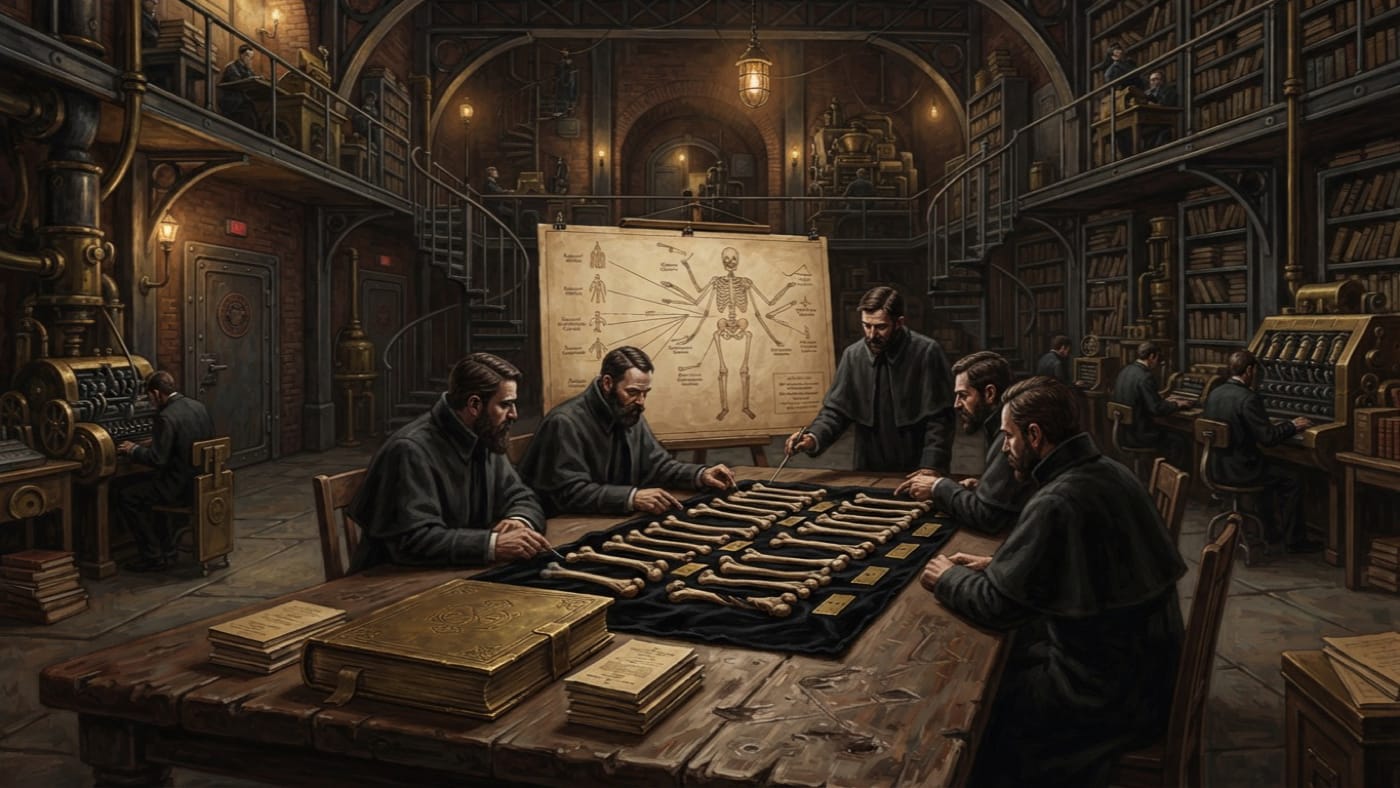
Dr. Matthias Voll delivered On the Statistical Distribution of Relics in Amsterdam in the year the Church now numbers A.S. 11, which the merchants of that city would have called 1721. No day survives, and no month. That suits me. A lecture of this kind has not earned an anniversary. He gave it in the hall where the Rationalists staged their Trial of Saint Aldebrand's Reliquary, and it was the reason the trial had a script.
Readers who want the gags, the jeering and the stenographers should consult that entry. This one is about the instrument. Voll brought one question into the room and dressed it as a lecture: if a saint was a single man, how many thighs may his shrines claim between them?
The question is older than Voll and cleverer than him, and that is why it has a shelf in the Forbidden Stacks. The lecture is kept there under suppression. Licensed readers may consult restricted Rationalist matter under the usual conditions. The unlicensed may consult this article and be grateful.
#On the Arithmetic Inherited
Forty-three years before Voll opened his mouth, three Amsterdam scholars had already done the tedious part. During the Year of Letters, A.S. −32 / 1678 CE, Van Hoorn, Lemstra, and de Waal set what one shrine claimed beside what another shrine claimed and posted the contradictions to anyone with a doorstep. Each certificate, read alone, was a sober little document with a seal and a pious signature. Set side by side, the certificates began to quarrel. The scholars never had to enter a crypt. All they needed were the letters, a table and a postal service indifferent to doctrine.
That was the method. No shrine is accused. The shrines accuse one another, and the scholar merely arranges the seating.
No record makes Voll their pupil, colleague or guest. He inherited them the way a parish inherits a leaking roof. Their method had lain in Amsterdam's print shops and correspondence for four decades, and Voll picked it up because it was lying there.
What Voll added was a room. The Year of Letters travelled by post and was read in private, at a desk, by a man free to put the pamphlet down. Nobody can put a lecture down. One must sit through it among neighbours, and the neighbours laugh.
#On Making a Count into a Verdict
As far as the record preserves it, the argument was anatomical and brief. A saint has the bones of one man. Shrine by shrine and certificate by certificate, Saint Aldebrand had been credited with more femurs than one man carries. If every claim were honoured at once, Voll said, the saint would need the skeleton of a centipede.
The arithmetic was correct. I have checked it, which took less time than I like to admit. A man has two femurs, the claims numbered more than two, and no Academy is needed to see the contradiction.
What the count proves is narrower than the crowd wanted. It proves that the claims cannot all be true of one body at once. Which claim is the honest one, it leaves unanswered. Whether a particular bone came from a pig, a sheep or a churchwarden's grandfather lies wholly outside its competence. A quarrel among many claimants still leaves room for one true one, so the sum convicts no relic in particular. Voll's sum was a sum about paperwork.
Then he pointed at a bone.
That gesture was the fraud. The lecture had shown a quarrel among certificates. The performance turned it into a verdict on the one femur on the table, and from there into a verdict on holiness itself. To finish the job the Rationalists needed testimony, and to get testimony they bound two priests. The two men signed beneath the phrase "pig fragment, common, undressed, of no liturgical significance." No anatomist examined the bone to produce that sentence. It was extorted, and the Codex records it as an extorted statement and as nothing more.
The confession reached forty cities. Its road and the lecture's road are separate. The confession was short, lurid and easy to copy: two frightened men signing their names. A numbered argument about bones was none of those things. A copy of the confession in some city proves nothing about whether Voll's lecture ever arrived there.
#On the Authorized Correction
The Synod later annulled the transcript as a forgery. Its stated grounds were scribal: the letter e in the confession leaned seventeen degrees away from the known hand of the priest who was supposed to have written it. No file I am licensed to cite gives a year for this ruling, and I will not supply one for elegance.
The annulment voided the testimony and left the count alone. Voll's femurs were exactly as numerous after the paleographers finished as before. The Church answered the confession with handwriting and left the arithmetic in the corridor, unescorted and unrebuked, like a petitioner whose case has been adjourned without a date.
Later, the Bureau of Relics settled the matter another way: a notarized femur is authentic. The cathedrals of Cologne keep seventeen femurs of Saint Aldebrand, all notarized and all equally holy. That is the policy of a later Bureau. The clergy of Amsterdam in A.S. 11 had no such instrument, and Voll never examined those seventeen. I record it because it is the only formal answer the Church has ever given to the arithmetic itself, and it answers by declining to subtract.
#On Vienna's Answer
An earlier compilation states that the same reliquary was seen aflame above the trenches at Vienna "centuries later."
Corrected. Vienna is A.S. 95 / 1805 CE, eighty-four years after the lecture. That is less than one century, never mind several. The compiler was carried away by the miracle, which is forgivable, and by his own cadence, which is not.
At Vienna in A.S. 95, Clemens Stahlhand carried the reliquary of Saint Aldebrand against Althazar of Pest, and Althazar's force was broken. The official account and its witnesses record that the reliquary burned in his hand and that the bells of Saint Rupert rang with no one at the ropes. The miracle bears Rupert's name. The bone belongs to Aldebrand. The Bureau ratified the miracle in A.S. 104 / 1814 CE, nine years after the breach and ninety-three years after Voll's evening.
The Church reads Vienna as Voll's true refutation, and so do I. A saint whose relic answers in battle has no need of a census. The Church also identifies the Vienna reliquary as the one mocked in Amsterdam. That identification is the Church's own. The file does not contain the chain of custody between the lecture hall and the breach. The femur disappeared from the hall the night of the trial, and nobody has since produced the hand that took it, the road it travelled or the cathedral that received it.
The careful reader will notice that the miracle ratifies one relic and audits nothing else. The femurs in Voll's count are still disputed, still more than two and now notarized. Vienna proved one bone holy. Voll had argued only that the bones were too many. The two findings do not collide, which is why the Church cites Vienna loudly and the count never.
#On the Work under Suppression
Why keep the lecture at all? Burning is cheaper.
The Bureau of Doctrine keeps it because a refutation without its target looks like a temper. Condemned scholarship is retained so that licensed instructors can bring it out, set Vienna beside it and let the student watch the arithmetic shrink. The lecture is a specimen, pinned and labelled. A student who meets the centipede in a seminary, under supervision, is inoculated against it. A student who meets it in a Dutch tavern is recruited.
The method has one discomfort, and I will name it, since nobody else on the Doctrine floor will. The instructor must concede the count. Every student who can add will add, and an instructor caught denying a sum loses the room. So the concession is made quickly, in the first quarter-hour. The remaining hours go to explaining why a correct sum confers no licence to speak about holiness. Those hours are well spent. The first quarter-hour is the most dangerous in the curriculum.
The centipede still crawls through student jokes. Cologne keeps its seventeen, and Dr. Voll keeps his shelf. Request the folio through the usual office and bring your licence. The clerk will not count your fingers, but he will notice if you count his.