
Survey of present practice — A.S. 201. Neither the rite's origin nor the visit recalled here is dated.
#On the Hands Before Patrol
"And if the Synod does not see?" — "Then we must make proof." — Brotherhood catechism, call and response.
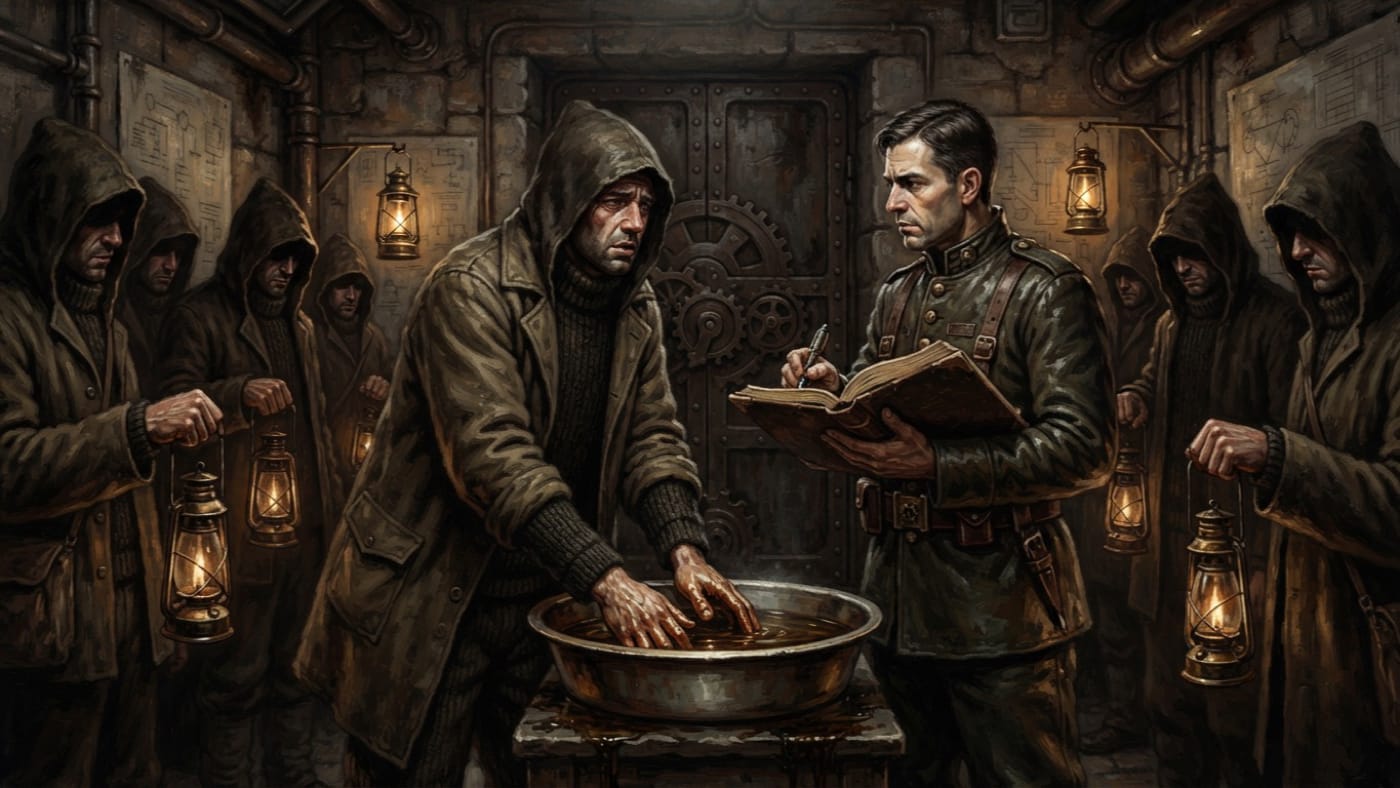
Before the shift the Brothers wash their hands in lamp-oil. It is thin oil, the same allotment that feeds the hooded lamp and forms part of their wage, and it does to skin what thin oil always does. It loosens the soot from the knuckles, works into the cracks, and leaves the hands slick enough to feel every draught through damp wool. No priest presides. The Lantern Brotherhood has made a rite out of the oil it is paid in, and I find the economy agreeable.
With their hands still wet, each member names one fear and one lie. The lie has to be one already told, and told, as the Brothers put it, "in service of vigilance." It then goes into the catalogue and is not absolved. Nobody pronounces it forgiven and nobody assigns a penance. The Brother goes back to his lamp with exactly what he brought into the room, plus a record that he admitted it.
That is everything about the observance that can be documented. The Triangle of Witness folio places it before some shifts, especially among the older Circles. I will not turn that into a nightly law binding all five.
A parish Confessor-Penal of the Church absolves and listens for the names of neighbours in the same sitting, so that grace, which the Church dispenses on the Creator's behalf, and surveillance pass through one screen. The Brotherhood has removed the grace and kept the file.
#On the Fear and the Serviceable Lie
The fear comes first, because the occupation runs on it. Under the writ of toleration a Brother may carry a lit lamp past the Ninth Peal, question whoever he finds abroad, and detain them. He may only detain. Arrest belongs to the Bureau of Purity, which guards the prerogative with tongs. He uses this small authority in lanes the Wardens leave unwalked, against people who may be carrying knives, contraband, or errands of the Great Deceiver, and his licence can be revoked by the nearest Warden-Captain without notice or appeal. A frightened man with a blade and a lamp is a danger to everyone. If he has said out loud, in front of his squad, what frightens him, he is at least a danger that has been declared.
The Lanternman folio says the fear goes unremarked. Whether anyone writes it down I cannot say. The sources record that the lie is catalogued and say nothing about the fear, and I will say nothing either.
The lie is harder. "In service of vigilance" is a narrow category with a generous door. The Brotherhood's work produces lies told to a stallholder about what a light permit protects, to a clerk about where the Anchor stood, and to a mother about where her son was taken. I list these as the kinds of falsehood the trade produces. They are not entries. I have read no entries. What I can say is that the catechism ends then we must make proof, and an organisation that trains its members to make proof will need somewhere to keep the knowledge that it has done so.
The lie is also retrospective. A Brother names something he has already said. Nothing in the rite licenses tonight's falsehood in advance. The Circles that want that licence keep other furniture for it.
#On the Wick-Sergeant's Catalogue
The Wick-Sergeant leads a squad. He keeps the patrol arithmetic, meaning the routes, the intervals and how many lamps stand where. He also assigns "proof," the Brotherhood's word for what a night must produce before a Circle can report that it was watched. And he keeps the catalogue. So the man who decides what proof the squad brings back also holds the written record of every lie the squad has admitted to telling. I have known Bureau directors with clumsier chains of custody.
He holds no Church office, since no rank on the Brotherhood's ladder is one, and he carries no Bureau commission. He receives the lie without any power to forgive it. That may be why the rite asks for no forgiveness and only for filing.
I attended an Oil-Confession once. I will not write down what was said in my hearing, because the record of it belongs to the catalogue, and I was refused the catalogue. When the rite ended I asked the Wick-Sergeant to let me inspect it. He told me, politely, that it was a spiritual document and therefore classified. I admired his initiative then. I admire it now with more irritation. A tolerated auxiliary, whose legal existence is a subordinate clause in Anselm Rihn's Curfew Ordinance of Quiet Hours of A.S. 94, had invoked the sanctity of conscience against a state theologian of the Church, and he had done it correctly.
I saw the procedure: the oil, the hands, the two acknowledgements, the entry made. I did not see the contents. I cannot report whether the catalogue is a bound book, loose leaves or a slate. I do not know how long entries are kept, how they are indexed, who besides the Sergeant may open it, or what becomes of it when a Sergeant dies or is broken in rank. The field manual's warning against carrying proof past dawn concerns evidence. Nothing in it says the catalogue is burned.
My question about the catalogue is an administrative one. What is a written list of every lie a squad has admitted, kept in the hand of the man who assigns its proof? It may be discipline, or a conscience trained into procedure, or a set of reins. I have no evidence that any entry has ever been used against a Brother, carried out of the room, or punished. I note only that a Sergeant who holds it does not need to use it for it to work.
#On Witness After Confession
From the oil room the squad goes out to form its Triangles. The Anchor stands fixed at the chokepoint, the Blade pair searches, and the Echo walks one lane over and writes the first report. The result is testimony whose corners line up, which a clerk files at dawn without looking up.
The Oil-Confession comes before that agreement. A squad that has spent the evening naming its lies to one another walks into the alleys knowing which of its members bends a report and how far. My reading is that this shared complicity binds more tightly than an oath and also works as a rehearsal. Before patrol, the Brothers learn what an orderly account costs, and that the cost is entered in someone else's book.
Many Triangle reports are accurate, and many stop knife fights and bread riots that would otherwise have left a body by morning. The rite does not tell me which reports those are. It tells me the Brothers know there is a difference. The field manual makes the same admission in its fifth lamp-signal: a Warden is present, so switch to clean procedure.
The Circle of Nine Wicks provides the cruder example. Its staged seizures and scheduled contraband discoveries supply the proof its quotas require. Its Confession Closet holds blank confessions and pre-signed citations for nights when heresy will not cooperate. That drawer is a separate article. It stores confessions manufactured for other people, while the Wick-Sergeant's catalogue stores Brothers' own admissions about lies already spoken. An inspector who confuses the two will open the wrong drawer and learn the wrong thing.
The rite should not be confused with the Brotherhood's other observances either. The Taking of the Wick is the initiation: a skull-candle kept alight through a full curfew cycle while the names of the dead are recited, and the lesson is that light is quota. The Hooding teaches authority. A senior thins the flame and opens it again until the initiate stops flinching. Oil-Confession comes back shift after shift, and what it teaches is bookkeeping.
This office has handled Category C/44, "Moral Rectification through Shadowed Vigil," as a free-standing classification.
Corrected. In the Third Revision the Bureau of Records merged C/44 with C/12, "Auditory Catechism Enforcement." In either form, the Bureau of Doctrine's category classifies Brotherhood personnel and patrol activity. It authorises no rite. Oil-Confession has no classification of its own, so there is no category to contradict a Wick-Sergeant who calls his book spiritual.
#On the Shift That Follows
The Brother leaves with oil still on his hands and lights a lamp fed from the same allotment. His lie stays entered in the Sergeant's keeping through the night's questioning and detentions, and through the report the Echo writes and the Anchor confirms. Nothing has been lifted from him. The rite does not pretend otherwise, which is more than some parish screens can say.
The profession's documented end is the Brother who stops seeing people and begins to see checkpoints. The Triangle folio says that those who tolerate the rite too well become checkpoints wearing boots. To that I would add one administrator's observation. A man who enters one lie per shift into a book he cannot read, kept by the man who decides his proof, learns to make the entry efficiently, and a checkpoint is made of efficiency.
The Mercy Preachers, whom some Circles have found it convenient to shield, are a separate profession with a separate heresy. They offer what the oil room withholds. I record the contrast and do not recommend it.