
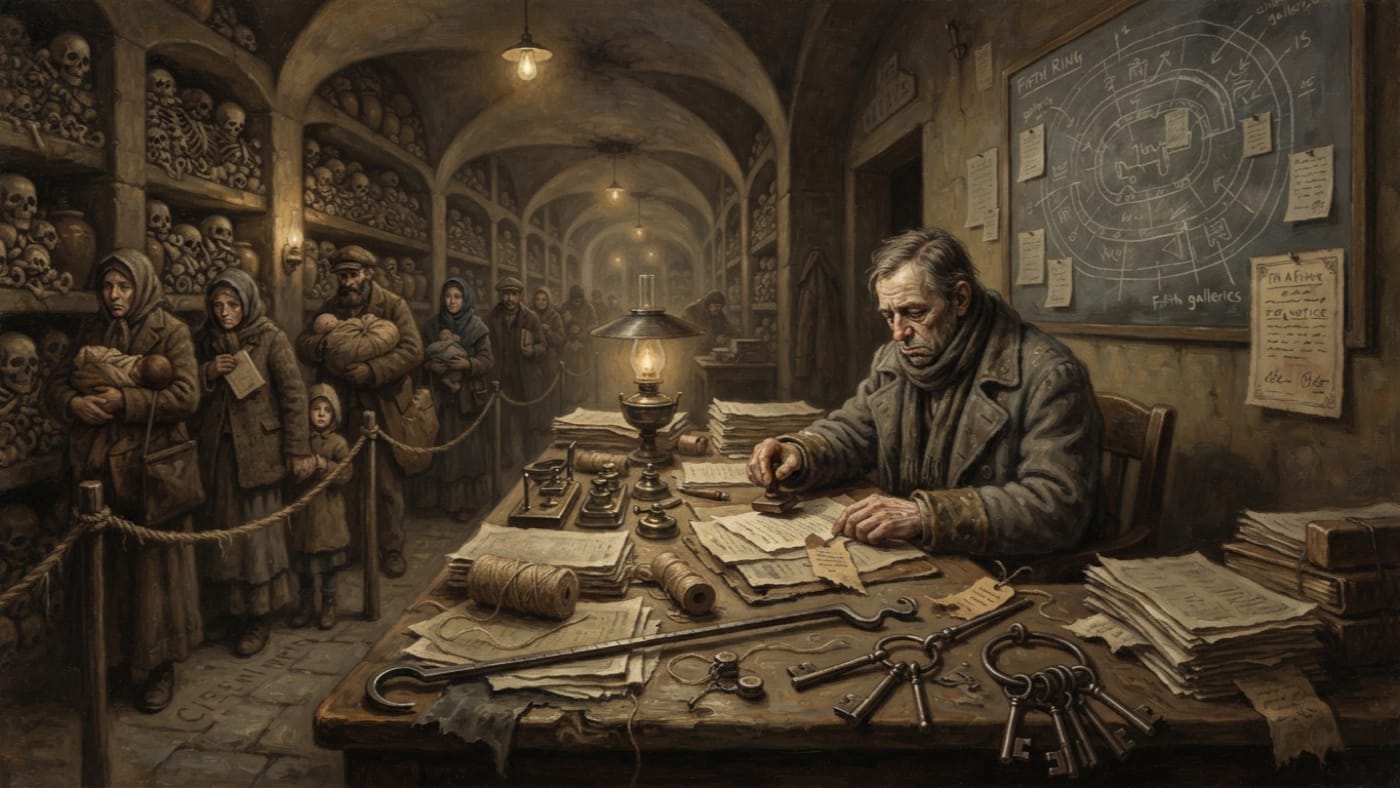
#On the Notice and the Permission
"You do not live here. You are permitted." — corridor notice, Fifth Ring, south wall
The Office of Ossuary Accommodation works in the Fifth Ring of the Ossuary Rings, the administrative ring of Bastion-Constantinople. The allocator offices, corridor maps and measuring rods are kept there, because it is the one ring of the six in which paper outranks bone. The Office's authority comes down to a single verb, and the verb is permit. It decides which living body may lie down against which stretch of the dead, for how long, under which curfew and against which ration.
The notice on the south wall states the arrangement in Bureau of Settlement standard script, beneath the Office's seal. I have already recorded that it hangs beside a door through which three children came carrying bread. The children were hungry and the notice was correct. Both conditions continue.
A resident holds a right. A permitted person holds a favour, and a favour can be withdrawn with one signature, without hearing and without appeal to anyone who sleeps above ground. The Synod chose the second word with care. In a fortress at the southern anchor of the Sagittal Line, where Kargath's fog comes in off the marshes and the open field offers no protection at all, the difference between the two words is the difference between a wall and a tent.
#On the Inventory of Shelter
"Dry beats holy." — allocators' saying, unattributed
The Office keeps four kinds of shelter on its books. Wall niches are cut into or between the bone-courses. Stacked catacomb bunks run in rows along the inner galleries. Corridor alcoves are the leftover hollows where a passage widens. Grave-field plots are measured out in chalk against the Rings' outer faces, among the tent rows and drainage strips. The first three are stone, and the fourth is a permit to pitch canvas in a field the dead have already claimed.
All four count as permitted, and they differ widely in value. A niche set high stays drier than one set low. A bunk within clear hearing of the Sub-Carillon is worth more than one where the half-hour bell comes faint and late. An alcove on an open route to the evacuation lanes is worth more than one at the end of a blind gallery. Every one of them gains value the farther it lies from a sealed door. The corridor map records the permission. It does not record which wall breathes against the sleeper's cheek at night, and every household learns that within a week.
The inventory has grown with the dead. The Sixth Ring's extension during the Ninth Bell Famine of A.S. 143 added new galleries, and the famine also added new tenants for them.
The Office's clerks work beside the Bureau of Records' filing annexes, Sub-Vaults Twelve through Nineteen. Who keeps the keys to those vaults is a matter for the Bureau of Records. Where the Office's ledgers go once they leave the Fifth Ring, and whose desk they cross before reaching Mother-Cryptor Sabine, who administers the Rings, is set down in no document I am permitted to cite.
#On the Desk
An allocator at intake wears the profession's grey coat, with wax on the cuffs and a scarf against the dust. Tag rolls hang from the belt. Senior clerks also carry a ring of keys and a map-case. The procedure is older than any clerk now holding it and runs in the same order at every desk.
The applicant is classified first: citizen, indentured, pilgrim or refugee. Each is then sorted as sealed or unsealed, with a clean tag or without one. The clean and unclean queues are kept physically apart, because a cough in one queue becomes an accusation in the other.
Space is assigned next. Here the measuring rod comes off its hook. It measures the dimensions of a niche, the spacing of a bunk and the legal distance between a sleeping child and the nearest course of remains. A family that does not fit the space is told that it does not fit. The space is never altered.
A tag follows. The occupancy tag carries a ration tie and curfew conditions, so the same strip that permits a family to sleep also lets them eat and sets the hours they may move. Lose the tag and all three go together.
Then the map is amended in ink on the corridor map and in chalk on the stone. The profession keeps living-bunk chalk separate from dead-niche chalk, and allocators are superstitious about confusing them. Sleepers marked with the wrong chalk are said to have stopped waking. The Office does not certify the story, and no allocator I know of tests it.
Enforcement covers relocation orders, evictions and quarantine notices. Exceptions are handled last and recorded least.
The order matters because the galleries are also a fortification. Emergency lanes must stay unslotted, and a clerk who fills a corridor with sleepers to spare them a freezing night has blocked the route a whole ring would need on the night the bells fail. Every desk faces the choice between keeping the lane clear and leaving a family outside in the weather. Desks differ only in how often they admit that.
#On the Price of a Better Corridor
"One corridor closer." — allocators' idiom for an upgrade obtained by payment
The Office's power rests on scarcity. There is a limited amount of dry stone within the bell perimeter, and the number of desperate people grows with every season and every bad night. It would be strange if nobody offered to pay. The profession's own records describe the usual currency: wax candles, fuel chits, medicine, dry cloth, and now and then a wedding ring laid on the desk.
The allocators' handbook of grievances records one request as so common that it has become a set phrase. A mother asks whether her child can sleep one corridor closer to the bells. The clerk can arrange it if somebody else moves out. The moving out is the price, and someone other than the mother pays it.
The ways an allocator can fail are set out plainly in the profession's records. A clerk can sell the same niche twice. A clerk can issue a ghost permit to an occupant who does not exist, with a ration tie that very much does. A "map correction" relabels a gallery on the public map so a paying family moves without technically moving. Tags can be laundered by swapping their colours under amber lamplight. A patron letter can arrive ordering a corridor cleared for a client of quality. I list these as weaknesses of the trade. I have not certified any of them as an incident at this Office, and I will not invent one to liven up the paragraph.
The Office is staffed by people, and that is always the trouble with offices. Some clerks are worn-out pragmatists who stopped arguing with the arithmetic years ago. Some are Purity Clerks who evict by the letter and sleep well. Some are patron captives whose sense of fairness became somebody else's property when they accepted a favour. And some are Stability Clerks who quietly bend the tags, because a grave-field that believes the count is rigged will riot before the next bell.
#On What the Office Cannot Allocate
The Office permits a family to sleep beside a course of bone. It cannot vouch for that course. Authenticating and placing the remains belongs to the Ritual Bone-Stampers, who press their stamps under Bureau of Rites procedure. A permit beside an improperly stamped course is still valid paper. What it is worth as shelter is a different matter.
The same applies to the bells. The Bureau of Bells keeps the Sub-Carillon of the Widow's Lanes ringing on the half-hour, every half-hour. In the winter of A.S. 178 a maintenance failure silenced it for eleven minutes, and the Fourth Ring answered with a disturbance that the Bureau of Records still declines to describe. An allocator who sells "bell coverage" is selling another Bureau's work, and that work has been interrupted once on record.
The Sub-Carillon of the Widow's Lanes comprises nine bells.
Corrected: seven. The Bureau of Bells' inventory of A.S. 194 counted two echo-returns as instruments, and the correction stands in the parent entry. A bunk advertised as lying within range of nine bells lies within range of seven.
After curfew the corridors belong to the Circle of Ashen Steps. They walk clockwise only, keep their lanterns at sternum height and record candle tallies. The Office's tags mean nothing to them.
Every allocator also knows the Third Ossuary by its distance. The maps record how far each permitted bunk lies from it. They do not record why that distance raises the bunk's value. The dead are not consulted on the matter.
#On the Annual Count
The Rings' administration can recite forty-six thousand, three hundred and twelve catalogued urns in order without error. That figure counts urns. The Office counts living people, and it can state its living population only as far as the word "significantly."
The parent entry estimates that roughly forty thousand people live around the Rings, in the corridors, alcoves, tent rows and drainage strips. That is a broader estimate made from a different vantage, and I will not subtract one number from the other to manufacture a precision the Office has declined to supply. The register gives its own figure, and the register is the Office's document.
The review was filed and the notice is still on the south wall.