
#On the Surviving Harvest Report
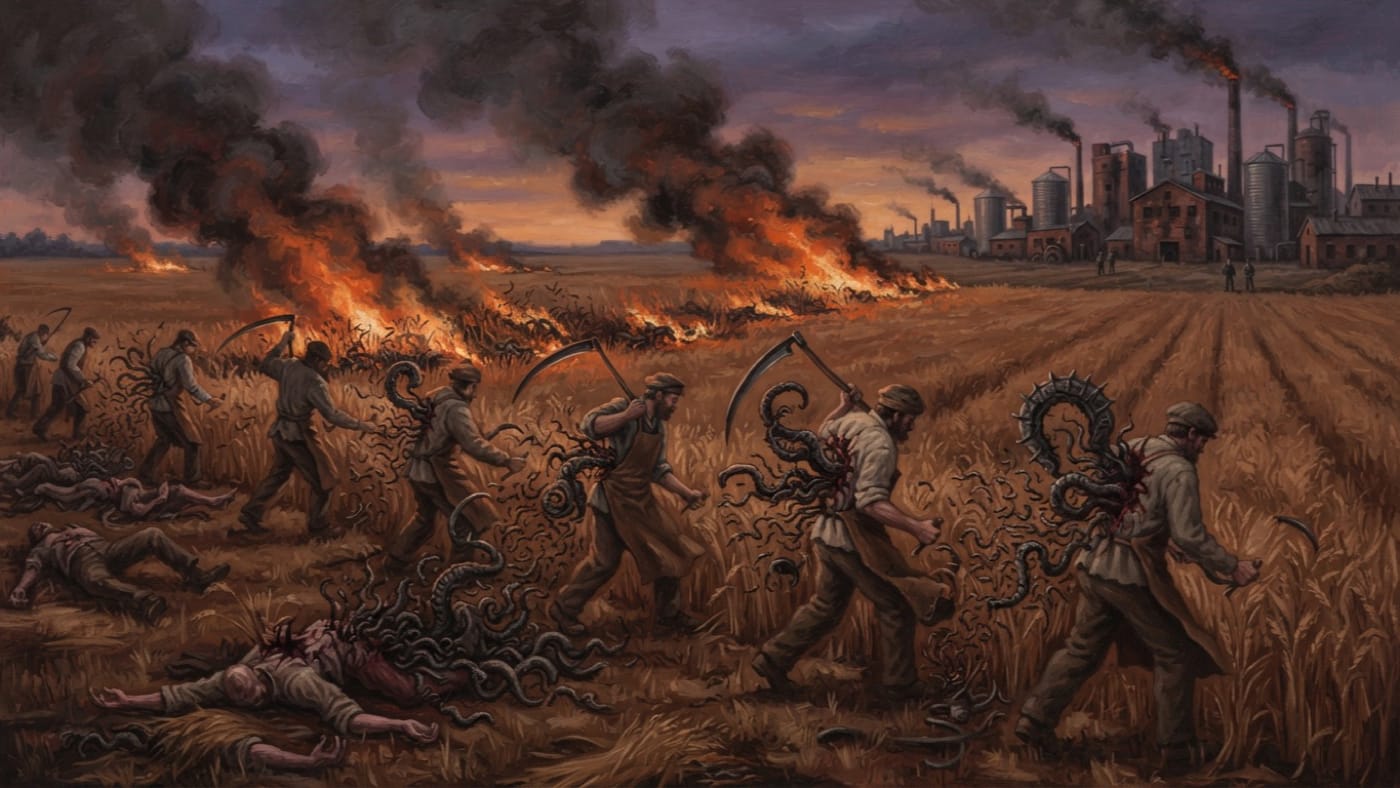
This survey was compiled in A.S. 201. It concerns one surviving report from the Odessa Fields, and the report gives no year. It names a season, which is cutting time, and a crop, which is wheat. It records a sequence that a junior clerk can recite after one reading and will still be reciting in his sleep after the second. Harvesters turned Wormhost in the rows. Their scythes rose, the hymns they were singing broke off, and the farmers split open where they stood. Parasite swarms sprayed out across the crop until, in the report's words, the field itself writhed like muscle.
Three Bureaus then wanted three different things done with the grain. The Bureau of Agriculture wanted it burned. The Bureau of Tithes wanted it salvaged. The Bureau of Purity burned the field.
That is the whole of the entry. It gives no count of hosts and no count of the dead. It names no farmer, no reaper or gleaner, and no reeve. It does not say how the parasites first entered these people. It does not say what grew in that ground afterwards. I have not supplied any of this. A Codex that invents its casualties so the page feels fuller has started forging its own ledger, and the Bureau has kept enough forgers on salary already. Readers who came for a chronicle of some city called Odessa may leave. The heading belongs to the field.
#On the Harvesters' Rupture
The report keeps its sequence short, and each of its verbs earns its place. Turned comes first. By the time anyone noticed, the harvesters had already become Wormhosts. The report does not describe the conversion, and the Lore Book's general account explains why. A Wormhost is a person seeded with parasitic things that coil around bone and organ and fatten inside him until he is only a container. He keeps walking. He keeps breathing. He keeps working, and he looks human enough to fool trained eyes. The Odessa report adds nothing to this description of the host. Nothing needed adding. At cutting time a host looks exactly like a man cutting wheat.
Rose comes second, and here the report is more cruel than any embellishment I could add. A scythe rises at every stroke of an ordinary harvest. The report does not say that the blades were turned on neighbours, and it does not say that the cutting set off the parasites. It says only that the scythes rose. The last ordinary thing those men did was the motion of their work. Whatever came next took place in the middle of that gesture.
The published Wormhosts entry records hymn fragments breaking off. Harvest crews sing to keep the stroke together. They sing what the parish taught them, in whatever key the parish could manage. The report keeps only the break.
Split comes third. The farmers split. In general, rupture sends out armoured coils and swarms of smaller things, and it leaves the host's body behind like a vestment someone has torn off. The Odessa report says swarms and stops there. I won't give these swarms plates, mouths or a size, because the report gave them none. The swarms spread through the wheat. A standing crop is a crowd of stalks at waist height, packed close and moving in every breeze, and the report's image makes sense once you picture something else moving among them. The field writhed like muscle. That describes how it looked to whoever was standing there. It does not record that wheat turned into flesh, grew a will, or changed by itself. The Bureau has enough trouble with crops that scream when cut. That is the Weeping Fields account, a separate matter of A.S. 159, and it lends Odessa neither its date nor its causes.
#On the Grain and Its Claimants
The three positions in the report would have embarrassed a theatre company for lack of subtlety.
The Bureau of Agriculture had governed seed, soil, yield and storage, and it wanted the grain destroyed. The report does not give its reasoning. Its object is plain enough. A contaminated crop had to be kept off the threshing floor, out of the granary and out of the mouths of the parish. When the office whose whole purpose is wheat asks for wheat to be burned, the wheat has become evidence.
The Bureau of Tithes wanted salvage. This also fits its character. Tithes oversees every harvest that flows toward Strasbourg, and its Assessors travel with scales, ledgers and armed escorts and teach that withholding a tithe starves the soul of the Synod. To Tithes, a field is a sum that has not yet been weighed. Part of that sum had splintered into parasites. The rest was standing grain, and standing grain can be cut, stacked, assessed and entered in the ledger. The report does not say how Tithes proposed to tell the clean sheaf from the occupied one. I suspect it planned to settle that later, as it settles most things, by bill.
The Bureau of Purity did not argue. It acted. It burned the field. Purity treats fire as a sacrament of cleansing and needs no other theology to light it, and its writs give it the authority to burn whatever it judges unclean. In this case Purity's judgment matched Agriculture's request. Two Bureaus agreed for one afternoon and the wheat went up. Tithes was overruled. Its proposal stands in the record only as a proposal.
The report keeps no minutes. There was no hearing, appeal, vote or exchange of letters that I can cite. An earlier Codex entry says that Purity burned both the field and the argument. I keep the phrase because it is the right one. It is rhetoric, and it does not mean any official was put to death for disagreeing. The argument died the way arguments usually do in the Holy Bureaus: someone holding a torch ended it.
#On the Threat Within Ordinary Labour
Wormhosts are listed among the mortal auxiliaries of the Legions of Sin and are kept under the husbandry of the Shadow Court. Their whole value to the Enemy lies in looking ordinary. A Thrall's vacancy warns a rifleman. A Wormhost warns no one. He keeps his face, his gait, his trade and his place in the line until the moment he loses all of them at once. The Shield Paladins hate him for breaching a wall from the second rank. The Odessa report shows the same treachery in a peacetime trade. No parapet stood in that field and no checkpoint stood at its edge. It held a row of people the parish already counted as its own, doing work the parish needed done.
That is why recognition gives no protection. A gatekeeper is at least supposed to suspect the refugee in front of him. Nobody has to admit a harvest crew. The workers were already there, and already known to the bailiff and the priest and to each other. Every safeguard the Church builds around a stranger fails against a neighbour.
Wormhost events are rare and isolated, and do not warrant general suspicion of settled populations.
Corrected under the A.S. 195 Records erratum. Records found villages hollowed and seeded and processions infested beneath their cloaks, and it withdrew "rare" from operational use. The Odessa report was always consistent with the correction. Only the classification needed amending.
I describe countermeasures here only in general terms. None is recorded at Odessa. The standing tools against Wormholes are quarantine at crossing points, inspection by bell-metal and by interrupted prayer, and fire once rupture begins. All of them assume a border, a gate or a holding cell. A wheat field has rows and nothing else. The report does not say whether anyone had inspected the harvesters, and I will not pretend that anyone did.
#On the Recorded Disposition
The field was burned. That is the last act the report records, and I leave it as the last act.
Burning settles the dispute in the record. It does not prove the parasites were destroyed. Fire was certainly the right tool, but the report does not say the fire found every coil, or that anyone walked the ash afterwards and called it clean. Tithes asked for salvage, and nothing shows that anything was salvaged. The report says nothing on replanting, on families, on whether the next season was cut, or on who holds that ground today. A surveyor who finds a silence in the archive writes the silence down and moves on. I have done so.
The Church lost a harvest and some number of its own labourers, and the number was never written down. The Great Deceiver got a field of human bodies that had looked like his enemy's until the hour they stopped. In return the Bureau of Records got one paragraph, three positions and a fire. By the standards of that Bureau, Odessa is unusually well documented.