
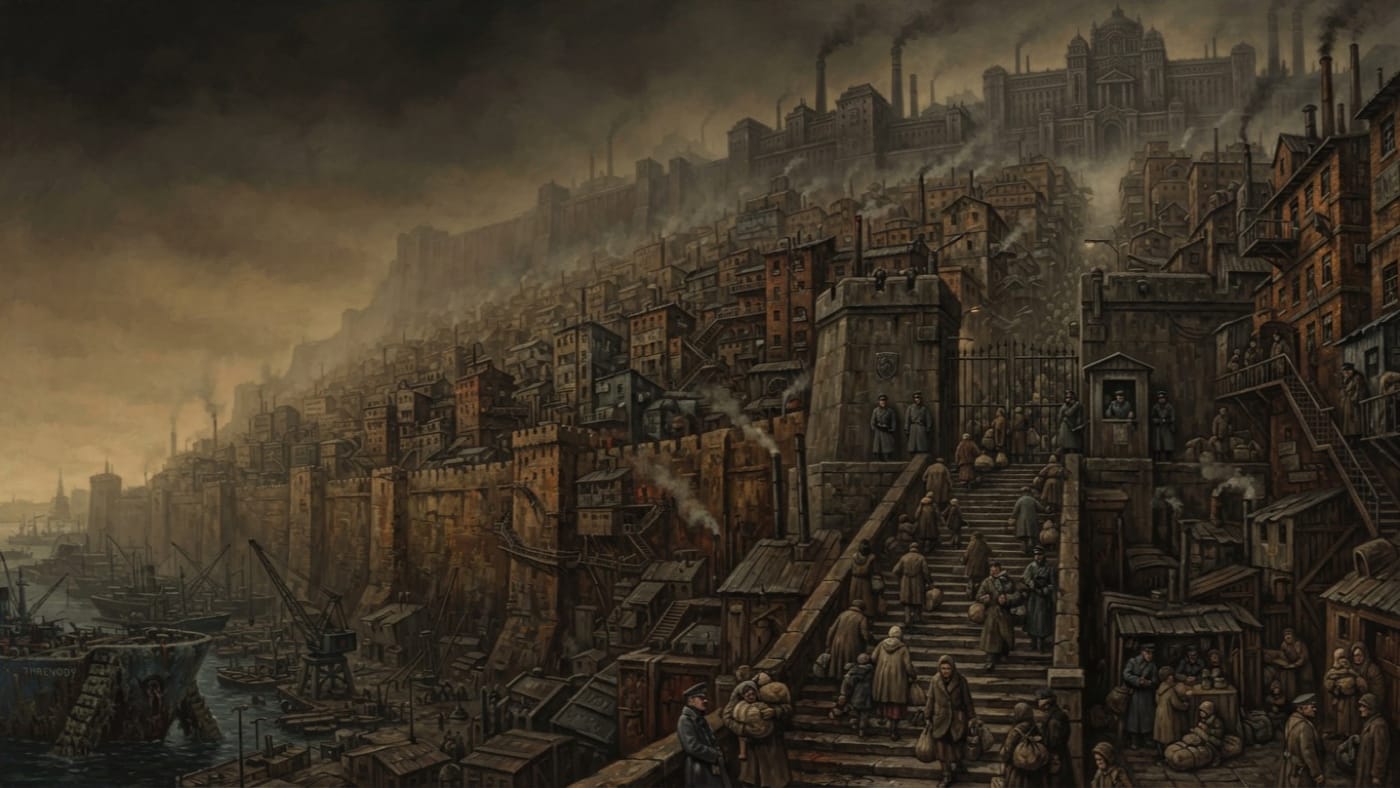
#On the Terraces Above the Walls
Ochre is a place where people sleep. I put that first because the word draws decoration the way a vacant pew draws pigeons, and the Bureau of Doctrine has asked me for a survey, which is a humbler thing.
The civilian residential terraces of Bastion-Constantinople stand above the old walls. Beyond that phrase the sources do not identify the walls, and I will not number them among the Ossuary Rings to make the paragraph tidier. The Codex's survey of the Blue ledger entry records the rest of what can be certified. The households are stacked on a slope. The slope can be seen from Blue and is reached by stairs. Its air is drier than the harbor's, and the harbor bells reach it later than they reach the quay. Those are observations on file. I adopt them as filed and do not improve them. I have not counted the stairs, and nobody has sent me a surveyor's chain to measure the bells.
The ledger enters these households as civilian residence. That tells you where a family sleeps. It tells you nothing about where its members earn their bread. A man entered under Ochre may spend the daylight on the Harbor of Chains and climb home at closure. The column does not say so, because the column was never asked.
#On the Ochre Entry
"One colour to a household. One dye to a permit."
The Bureau of Settlement divides Constantinople into seven ledger colours. White covers the Sanctum Mile and the Hierarchate Offices. Crimson covers the Foundry Quarter and its military workshops. Black is the Ossuary Rings garrison and Grey is the Hammers, the conscript barracks. Blue covers the harbor district and the maritime quarter. Ochre covers the civilian residential terraces above the old walls. Green covers the Pilgrim's Coast approach and its satellite communities.
These colours belong to the city. They have no relation to the numbered Zones of the continental map, where Constantinople sits in Zone 4 as the southern anchor of the Sagittal Line. A household may be Zone 4 and Ochre at the same time without any contradiction. The first designation tells Strasbourg how near the household lives to the enemy. The second tells the clerk across the street which counter it must queue at.
A resident of the terraces carries a Zone Permit dyed to match the entry. Under the general rule Settlement publishes for the city, that makes it an ochre-dyed permit. Each colour is administered by a sub-Archonate, and Settlement's stated policy changes the local administrator every three years so that no one grows fond of a district or a district of him. I do not name the present holder of Ochre, and I will not calculate one from the rotation. Sub-Archon Provisional Yvette Langres heads the Bureau as a whole from a cellar in Strasbourg. She is not Ochre's administrator and should not be blamed for its stairs.
What the entry records is the household. The register names who sleeps under the roof. The ration roll counts their mouths. The Bureau of Tithes assesses what the roof owes. The Great Ledger of Souls holds the assignment from baptism onward. A marriage, a birth or a death changes the household's composition, and that change runs through every one of these lists. Settlement's published death procedure applies here as everywhere. The certificate reaches Settlement before the body reaches the ground, the permit is cancelled, and the survivors are recorded anew on a two-page form. The widow's copy arrives within six working days. The Ochre column gives her no faster form, and none was promised.
#On Passage Between Colours
A household in Ochre can hold three different kinds of standing, and the city's lawyers live in the gaps between them.
Residence is the entry. It says where the household belongs and where its bread and tithe are reckoned.
Passage is the transit stamp. Crossing from one colour into another requires one. Settlement's published example concerns a Crimson permit-holder found in White without a stamp. That person is detained, and on a bad morning reassigned to Grey as a "volunteer auxiliary" whose consent the form treats as a preference. The example is about the system in general. I know of no penalty schedule written for Ochre and will not draft one on the city's behalf. A Blue permit gives no leave to climb into Ochre, and an Ochre permit gives none to go down to the quay. Each traveller needs the stamp.
Reassignment is the third and rarest kind: the household's entry itself moves from one column to another. A visit does not accomplish it. A stamp worn soft from daily use does not accomplish it. A stamp moves a body up a flight of stairs, while the entry decides where that body is counted.
The stairs are not the only connection between harbor and terraces. The Widow's Syndicate, through the House of Black Pennies, keeps lending and relief counters from Blue up through Ochre. They lend against pensions, dock wages, ration arrears and burial reimbursements, so the debt runs in both directions on the slope. The House of Grey Veils keeps household archives that the Bureau of Records considers too irregular to file, and the House of White Cups does document work. I place neither of those Houses on the terraces. The sources place only the Black Pennies there, and the Black Pennies require no help in being everywhere money is owed.
#On the Redrawing
"A rebalancing of demographic pressure."
Someone will want a founding date for the terraces. None is recorded. The bastion's standing as the southern anchor dates to the settlement of A.S. 68. The seven-colour system was imposed on the city in A.S. 95. That year is when Settlement began writing "Ochre" beside the terraces, and the ink tells you nothing about when the masonry beneath was laid. People were living on that slope before the colour was applied to them. How long before, the file does not say.
The system was revised in A.S. 130 and again in A.S. 155. Settlement has not published what either revision changed on the terraces, so I have nothing to report about them.
A.S. 188 is documented in full, and the documents are grim. Under Mandate 188-A, the Administrative Redrawing reached the Hintermark, seventeen subsidiary settlements behind the Line, and Constantinople's eastern terraces. About forty thousand civilians were moved from those eastern terraces to the western approach, a movement Settlement described as "a rebalancing of demographic pressure along the Ochre-Green axis." They were given fourteen days' notice. They were given transit stamps, forwarding address cards and a pamphlet, On the Joy of Service Through Relocation. Settlement admits that the newcomers pushed the existing residents of the western approach further west, and those residents pushed others, and so on until the line of displaced families stopped against the Hinterland. The Bureau filed this cascade as "secondary administrative adjustments."
The forty thousand are a count of the displaced. They are not a census of Ochre, a count of its households, or evidence that the terraces were built in 188. The record does not say that every terrace was emptied. Ochre's continued appearance in the ledger in A.S. 201 does not prove that any particular vacated house was filled again. I know what was vacated. I do not know who lives there now.
The Bureau of Records' count of the A.S. 188 relocation: "approximately twenty thousand."
Corrected by the Bureau of Settlement to forty thousand. Records had counted households instead of persons. Settlement's published account reports that the responsible clerk was reassigned to the Ochre zone. I record the reassignment and pass no judgment on whether it was a penance.
#On the Household That Came Uphill
The Codex holds one attested arrival in Ochre from below, and it came from the harbor's least reputable source of news.
At low tide the harbor children throw pebbles at the barnacled tread guards of the Threnody at Pier Seven and dare each other to listen. According to the carrier's dossier, one boy claimed to hear marching. His mother beat him for lying. Within the week she had moved the family from Blue to the Ochre terraces. The Blue survey repeats the account, credits it to the harbor, and notes that the way the move was accomplished is not on file.
I certify that the terraces were the destination. The marching remains the boy's claim. I do not know who approved the transfer, what it cost, which papers carried the family up the slope, or how they have fared since. The terraces are higher and drier. Whether they are safer is not stated anywhere I can read, and I will not say it for the mother.
#On the Present Survey
As of A.S. 201 the Ochre entry still does what it was built to do. It holds the city's civilian households in one column under one dye. It ties each roof to a register, a ration roll and a tithe assessment. It requires a stamp for every crossing into another colour. Its sub-Archonate changes hands on schedule, and the stairs go on carrying wages up and arrears down. The Black Pennies keep their counters open along the way.
The terraces have no charter of their own. They have no city council or civic seal, and no administrator who stays long enough to be resented by name. Ochre is a district of Bastion-Constantinople, entered by the city's Bureau, and anyone who calls it a separate city should have their permit inspected.