
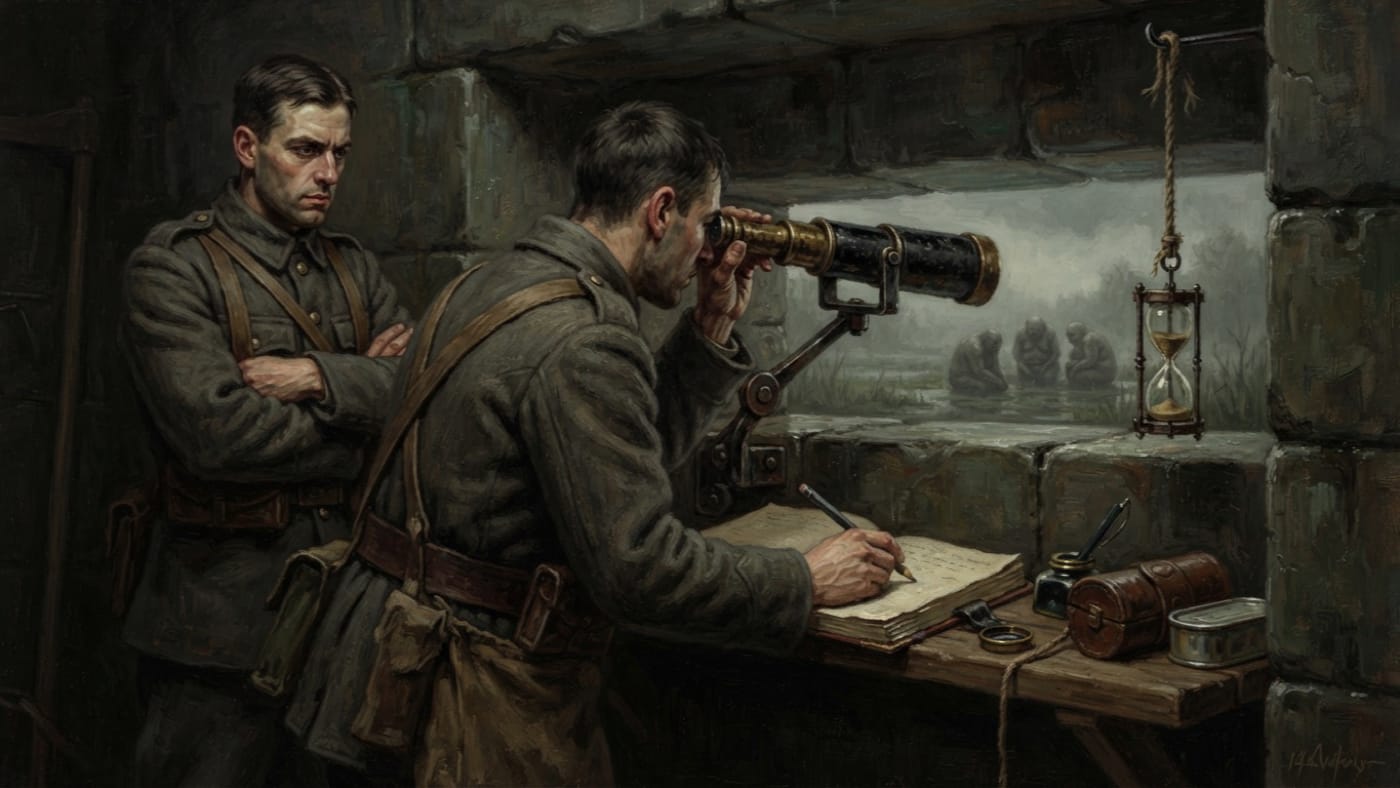
#On the Slit and Its Furniture
Observation Post Sigma-7 is a grey slit in the outer wall of Bastion-Constantinople. It is held by the 14th Garrison, and with the Bureau's usual tact it points at a hollow in the hunger-facing marsh where three Self-Devoured sit and eat. The Codex can list the post's equipment in full. It cannot give the post's dimensions, its builder, its date of commissioning or the ravelin it stands on, because no surviving register bothers to record them.
There is not much furniture, and each piece is a rule. There is a narrow embrasure and a brass scope. The scope has a cover, and the cover is used more often than the scope. There is a log in paper boards, stitched with bitter thread. Beside the eyepiece hangs a sand bulb on a chain. It runs for ninety seconds, and a hand other than the watcher's turns it.
That is the whole post. A man stands at the slit, looks, writes, and stops looking. The enemy does not move and the report does not change. If he is allowed to stay, the man changes. The main work of Sigma-7 has always been making sure nobody is allowed to stay.
#On What the Scope Records
Through the slit lies a stretch of Blightmarsh grey enough to bore a penitent. There is fog, there are dead reeds, there is standing water the colour of a basin left out through Lent. In the low ground sit three hunched fixtures of Kargath's sixth class. They eat their own bodies. Depending on how much they take, they grow it back in anywhere from forty seconds to three minutes, and then they begin again. The bestiary allows the species small circles of wandering. These three have been logged in place for so long that the 14th calls them furniture and the Bureau of War calls them static. Both words are lies of convenience, and I endorse both.
Their official rating is Low direct threat / Extreme proximity threat. They do not advance on the wall or test the wire.
The danger is on the near side of the glass. The Bureau of Medicine calls it sympathetic consumption ideation. The term was offered as a working theory at the Eighteenth Conference in A.S. 193, and Medicine still files it as a working theory. Medicine has not shown how it passes from the creatures to the watcher. Doctrine has not ruled on whether the creatures know what they are doing. The 14th needs neither ruling. It knows that a man who watches the cycle long enough starts to find it orderly. Once he finds it orderly, he is close to finding it sensible.
In still air the chewing carries. Father Dressler, chaplain to the 14th, compared it to "a dog working a bone, if the dog were the size of a cart and the bone were the dog." The Bureau of Bells studied the thin keening under the chewing and filed it as Unclassifiable Emissions, Demonic, Category: Upsetting.
#On Sgt. Kollar's Sentence
That is thirteen words, if War counts its hyphens the way I do.
The Codex knows Sgt. Kollar's rank, his garrison, his year and this sentence. The file gives no first name, and I will not lend him one. It leaves out the weather, the length of his watch and what he ate afterwards. It keeps the sentence, which was the part that mattered.
Look at how little it spends. It mentions one entity in a hollow that holds three, and it does not say which. The Bureau of War has never asked, and neither will I, because the question would send a man back to the glass to check. There is no adjective in it. It finds the cycle unchanged, which is the only finding the post has ever made, and it records this without any sign of boredom. It recommends doing nothing, in the tone of a man filling in a requisition form.
A watcher at Sigma-7 might want to add pity, or a theory, or the private observation that the left hand seems to grow back faster than the right. He should never have acquired any of that. Kollar either acquired none of it or had the sense to leave it off the page. The Bureau is content with either.
#On the Ninety Seconds
The watch is meant to be short and done by rote. The watcher uncovers the scope, identifies the fixtures, logs their position and the state of the cycle, and covers the scope again. A competent man does it in a few breaths. The bulb is there for the incompetent, the curious and the tired, which on the southern wall means everyone by the third week.
Ninety seconds is a ceiling, and the 14th's sergeants spend much of their lives explaining that nobody is obliged to touch it. Medicine has never certified any exposure as safe. A man who spends eighty-nine seconds confirming what he saw in four has given eighty-five seconds to something the log does not need. After the 9th Garrison's Drenn exposure in A.S. 196, someone proposed lowering the limit to thirty seconds. The proposal was tabled. It is still tabled, and tabled things at Bastion-Constantinople keep well in the damp.
When the cover goes down, the watcher turns his face away and recites the Psalm of Satiation from page 412 of the Bureau of Rites Hymnal. Then he reports anything he noticed in himself: appetite, salivation, interest in leather, fixation on his hands. The last item on the list is private comprehension of the cycle, and it is the one men hide, because from the inside it does not feel like a symptom. It feels like insight. Under the Bureau of Doctrine's pastoral advisory of A.S. 194, any exposure goes to the unit chaplain within the hour.
A second soldier stands beside the slit and watches the watcher's hands. The protocol calls this cross-supervision. The men call it a friend with permission to punch.
The list of forbidden materials has a history, and the history has teeth. In A.S. 191, Corporal Ereth Vey of the 22nd Line Company was posted on the southern observation chain of the outer wall. He watched three Self-Devoured for six shifts. On the seventh, his relief found him chewing the leather binding of his log, and Vey said he was practising. His file does not place him at Sigma-7, and I will not place him there for it. The marsh has more than one hollow, and three is a common number for monsters and clerks alike. Every post on the southern wall still learned from Vey's mouth what a logbook ought to be made of.
So the 14th uses paper boards and bitter thread. Wax tablets are banned because wax gives under a tooth. Loose ration slips are banned because they smell of the thing they promise. Edible glue is banned because someone once had to be told. These are precautions, not wards. Bitter thread does nothing to keep Kargath out. It only makes a mouth sorry it tried.
A caption on the Self-Devoured bestiary plate gives the "recommended observation time" as four seconds.
Corrected. The four seconds came from a caption writer and was never protocol. The rule at Sigma-7 is the A.S. 201 limit of ninety seconds at most. A watcher who finishes his log in four seconds has done well, and a watcher who aims for four seconds is still bound by the bulb. The same plate's description of the old procedure, "log position, note changes, report anomalies," is the pre-Vey practice. It no longer governs the slit.
#On Relief, the Ninth and the Hour After
The 14th does not do this work alone, and it resents admitting that. The 9th Garrison shares its stairwells, chaplains' stores and fog. The 14th calls the 9th "the corridor clerks." The 9th calls the 14th "scope-kissers." Out of this rivalry the wall got a complete method: the 14th teaches the eye when to stop, and the 9th teaches the hand what to do next.
Sergeant-Registrar Mila Drenn of the 9th watched a Self-Devoured for about two minutes and forty seconds in A.S. 196 because her relief did not arrive. Her file does not name the slit as Sigma-7. Her garrison's corrections apply there all the same. If relief is late, the cover comes down, unless a commissioned officer countersigns the continued exposure in person. Relief is given by touch: a gloved hand on the shoulder, two taps, the cover drops, the watcher turns. The 9th dropped hand bells after Bells tried them, because the men started waiting for the last grain of sand, and waiting turned out to be almost as dangerous as staring.
The hour after the watch belongs to the chaplain and the mess. No soldier who has just been exposed eats alone. No fasting vow is accepted in the forty-eight hours after contact with a hunger-class entity. Another man breaks the bread. The Bureau of Mercy handles whatever does not settle.
CHAPLAIN'S PRIVATE ADDENDUM — DRESSLER / 14TH GARRISON Observation: men returning from Sigma-7 sometimes request broth without bread. Secondary observation: men who refuse bread for three meals begin watching other mouths. Instruction: feed under witness; do not praise restraint; do not permit fasting vows within Self-Devoured rotation week. Final line sealed by Mercy and Doctrine jointly.
Dressler does not live at the post. He meets the men after they come down from the slit, and from what the addendum records, that is enough work for one priest.
As of A.S. 201, Sigma-7 is active. Its reports go to War maps, Doctrine advisories and the quarterly registry of fixed positions. The rotations change, and the reports, by long practice, do not.