
#On the Northern Standard
"The bell is certified. The ear is not." — Annotation in an unidentified hand, Bureau of Bells Northern Correspondence File
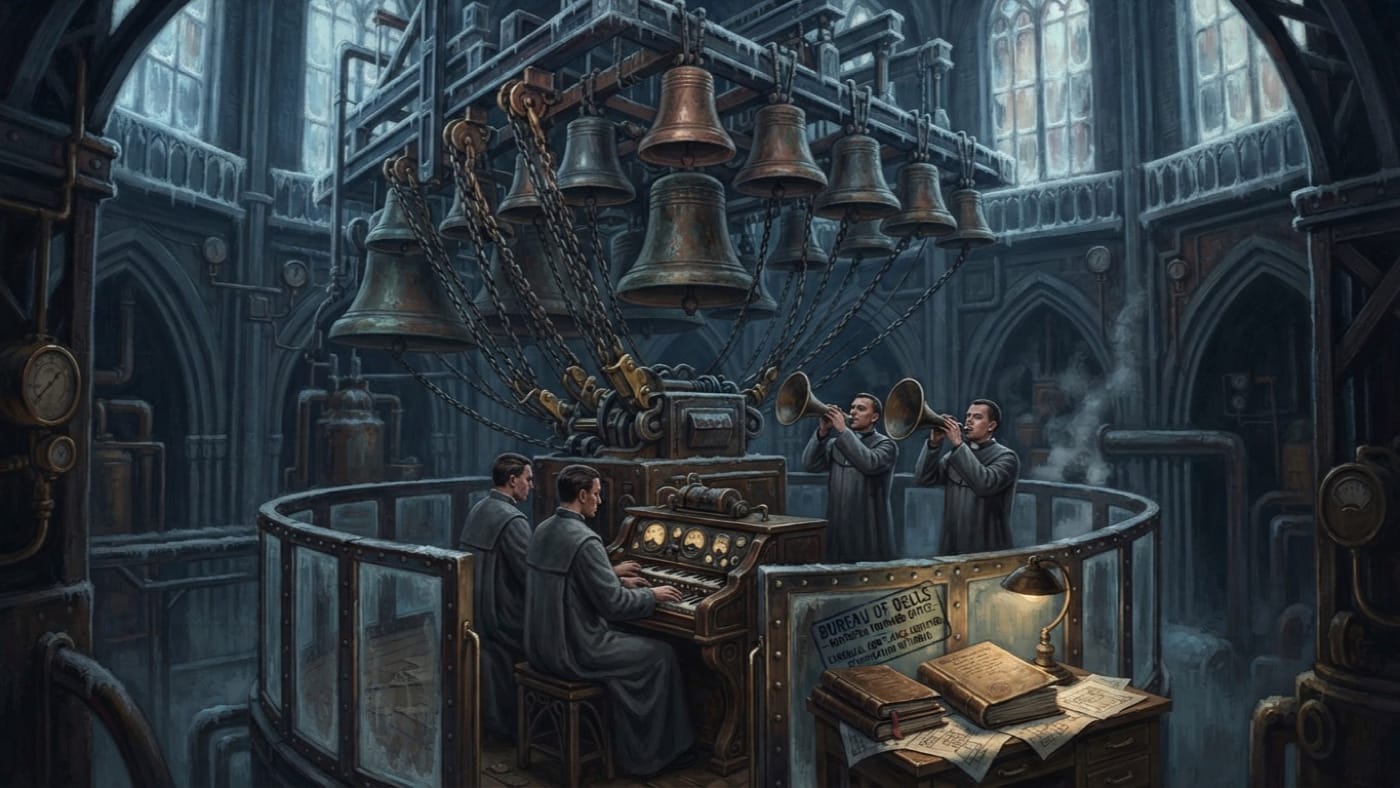
Northern Standard Resonance is the designation under which the Bureau of Bells files the tuning of the Northern Carillon, the forty-one-bell instrument housed in the cathedral of Bastion-Königsberg. That is the whole definition. I have read it in four Bureau registers, and it is no longer in any of them.
The designation does three things. It records the Carillon's pitch as a matter of state. It names that pitch separately from the ordinary bell-schedule rung elsewhere on the Sagittal Line. Most importantly, to the Bureau, it puts the whole arrangement under Strasbourg's canonical authority, so that whatever the Königsberg bells do, they do it lawfully.
None of the registers I was shown gives frequencies, interval ratios, a temperament or a tolerance. They contain a certificate of compliance, renewed on inspection, stating that the Carillon rings within canonical parameters. They contain nothing about what the chaplains of the Cathedral Close hear when it rings. One of these documents is sealed and the other was never written, and this entry is about both of them.
#On Bronze and Authority
"Gun-metal makes good bell-metal. It has already learned obedience." — Bureau of Engineering survey, Königsberg, attributed
The bells were cast between A.S. 97 and A.S. 107, during the great rebuilding of the bastion, from bronze recovered from the guns of the pre-Synodic Prussian military. The Bureau of Engineering liked the economy of it. The Bureau of Doctrine liked the symbolism. Neither founder blessed these bells, because both were dead before the first mould was dug. That has not stopped people from hoping otherwise.
The Office of Bells was constituted in A.S. 52, and its practices and folios governed every pour at Königsberg. The current Bell Codex came later. A passage still in circulation dates Strasbourg's Bell Codex to A.S. 231, which would be impressive, since that year has not happened yet. The Codex was ratified in A.S. 115, eight years after the last Königsberg bell left its mould. So the Carillon was cast under older practice and came under the present Codex afterwards. I have found no record of how that transfer was made, and I will not invent one to tidy the shelf.
The Bureau keeps its largest forward staff in the Cathedral Close, and it needs every one of them. Baltic salt eats bronze. The cold stiffens fittings, frost gets into the timber of the frames, and the harbour freezes from December to March. Replacement clappers are cast at Essen and arrive through the Harbour Quarter when there is open water, or overland through the Polish corridor when there is not. A bell-master at Königsberg spends more of his year writing requisitions than tuning bells.
There is one more point, and the Bureau would prefer it went unnoticed. The Königsberg file calls the tuning distinct from the ordinary Line schedule. The same file says the Carillon rings the Strasbourg standard. In the Bureau's grammar both statements are true. Northern Standard Resonance is Strasbourg's authority applied at Königsberg under a local name. The registers do not say whether the application differs from the standard in pitch or only on paper.
#On the Voices Between Peals
"We sing for God. Whatever sings back is singing for something else." — Rector-Chaplain Wendelin Grau, to the Hieromnemon
Bells are struck at intervals, and between strikes a bell falls silent. The Bureau found those silences unacceptable at Königsberg. In A.S. 188 it established the Choir of the Northern Standard to supplement the Carillon. The Choir's harmonies reinforce the bell-frequencies and fill the gaps between peals.
The establishment is twenty voices. Readers who imagine twenty throats singing at once have misread a staffing table. The twenty serve in continuous rotation on twelve-hour duties and two-year terms, so the Close is never without a voice, and no voice is used past what the Bureau thinks it can bear. Candidates come from the Bureau of Bells' seminary at Essen. They are chosen for range and tonal precision, and also, I am told, for psychological resilience, a criterion that appears in no published specification.
The Bureau of Bells designed the hymn-cycle. The Bureau of Doctrine approved it. Rector-Chaplain Wendelin Grau, who has held the Close since A.S. 186, runs it, and the annual inspection rates his precision "exemplary." The cycle is in no published hymnal. Its content and its purpose are classified. I know some of both. You will not find them on this page, and anyone who claims to have reconstructed the cycle from a balcony in the Close has reconstructed his own vanity.
"That they sing continuously ... has been observed for the past thirty years."
Incorrect, and the error is the Codex's own. It appears in the entry on Bastion-Königsberg. The Choir was established in A.S. 188. By A.S. 201 it has sung for thirteen years. No earlier choir is on record. The extra seventeen years were added by enthusiasm, which does not hold a commission.
#On the Answering Quality
"A bell is rung and silence follows. That is doctrine. A bell is rung and something answers. That is Königsberg." — Bureau of Bells, internal memorandum, A.S. 196
Since about A.S. 190, the resident chaplains have reported a change in the Carillon that they call "answering." A struck bell, they say, sounds as though it is completing a call that began somewhere else. Each of them describes it in his own words. Every one of those words is about direction.
The Bureau's standard pitch-gauges register nothing. The Bureau's position is that the tuning remains within canonical parameters. I accept that the gauges are accurate. A gauge measures pitch, and the chaplains are reporting something else. Their testimony does not prove that any frequency has changed. The gauge readings do not prove that nothing has changed. The Bureau has filed the gauge readings as a conclusion.
It has also behaved as though the chaplains were right. The clappers have been replaced twice. Three bells have been recast. The frames have been inspected for fatigue. The answering persists. You do not recast bronze that is within canonical parameters unless you suspect the parameters are not the whole story.
A.S. 190 is also the year the northern contact reports were first classified under the heading that now covers the Grey. The Bureau of Bells noted the coincidence in its files. The Bureau of Doctrine removed it from its own. I record it here as a coincidence of dates and nothing more.
The returned hymns are a separate matter, and I keep them separate on purpose. When the Choir sings, the Grey sends the hymn back with its notes, its words and the singers' own timbre intact. On three documented occasions the singers lost their place because they could not tell themselves from the return. On two documented occasions the return began several bars before the Choir did. The file does not say whether those two are among the three, so I will not add them up to five. No one has shown that the bells' answering and the voices' return share a mechanism, and I will not join them because they share a building.
Harmonic-isolation screens now stand around the Close. They reduce the vocal return without stopping it. The registers credit them with no effect on the bells. Grau's singers have learned to sing through the return, and the Bureau calls this a success.
#On the Other Northern Bells
"Your bells are tuned wrong. They have been tuned wrong since the Concordat. This is not an insult. It is a diagnosis." — Attributed to a Scandinavian elder, A.S. 193
Across the Baltic, the communities of the Fractured North keep their own bell-schedules, older than Strasbourg's and beyond its effective reach. They are faithful communities. They are policed by kin and council more than by Wardens, and in the shrinefjords the faith is kept by families who do not wait for a writ. When the wind carries their bells and the Carillon across the water at the same time, the Bureau of Bells records the result as "acoustically non-canonical." The garrison chaplains call it deeply unpleasant.
The Scandinavians say their tunings were set against det grå vattnet, the grey water, and that both the tunings and the water are older than the Sundering. That is their testimony, and I record it as theirs. The Bureau has asked three times for copies of the old tunings and been refused three times. The third refusal came with a demonstration at sea. The account of it is sealed. I am permitted to say only that it was effective, and that the Bureau has not asked a fourth time.
At bottom this is a quarrel about who knows what. Strasbourg claims authority over every bell in the north. It cannot certify a tuning it has never been allowed to copy, and it cannot forbid a tuning it would rather have.
#On Present Application
As of A.S. 201, the Northern Carillon rings under Northern Standard Resonance, and its certificate of compliance is current. The Choir keeps its rotation. The chaplains go on reporting the answering, and Castellan-Warden Ingrid Halvorsen has logged it since she took command in A.S. 191 as an operational fact of her bastion. She did not write the standard and cannot amend it. Her job is to stand under it.
What the bells accomplish against the Grey has not been established. The fortress stands, and that proves only that the walls stand. Men have been harmed in mind by what comes in off the water. The Choir's terms are short for a reason, and the Sea Wall rotation is shorter still. Nobody in the Close calls any of this a victory except the inspection reports.
Disposition: the standard remains in force, and the certificate stays on file. The reports have been filed too. The two files have not yet been placed in the same drawer.