
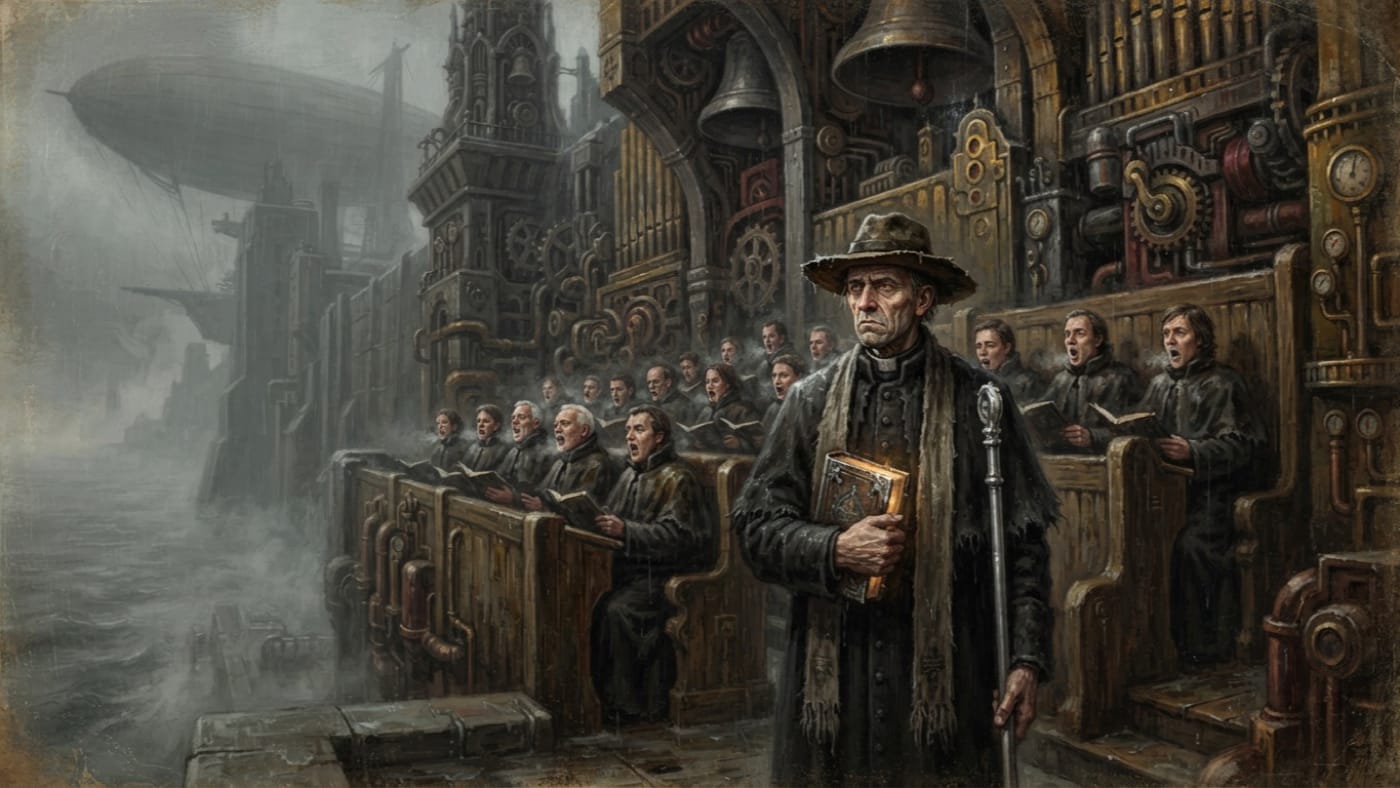
#On the Title in the Personnel Review
The title Northern Liturgical Inspector reaches the Codex through a struck line in the dossier of Rector-Chaplain Wendelin Grau. A personnel review suggested that Grau be promoted to Northern Liturgical Inspector and transferred to Kanzleiburg. At that point he had kept a choir singing on the Baltic wall for longer than most priests keep their tempers. The suggestion was denied by operational necessity. Grau remained at Bastion-Königsberg. For once the Bureau also wrote down why.
That is everything the record says, and I have read it more often than some catechisms. It gives the title, the destination, the candidate and the refusal. It names no holder before Grau and none after him. It publishes no charter, staff, seal, salary, uniform or list of offences the Inspector may punish. It does not say Grau asked for any of it.
The review carries no date either. It appears in the dossier sealed in A.S. 201. That tells the reader when the Bureau finished writing about the matter, and nothing about when the clerks began.
An earlier draft of this entry stated that Wendelin Grau served as Northern Liturgical Inspector at Kanzleiburg before returning to Königsberg.
Struck. Grau never held the title and never left. A personnel review suggested the promotion and the transfer, and the suggestion was denied by operational necessity. He has been Rector-Chaplain at the Cathedral Close since A.S. 186. The draft mistook a proposal for a career. Records makes that error weekly. I prefer to make it once, publicly, and then confiscate the pen.
#On Kanzleiburg and the Northern Administration
Promotion in the Church runs one way, away from the fog and toward the inkwell. Kanzleiburg was called Berlin until A.S. 95. It is now the seat of the Northern Hierarchate and runs everything the Synod does between the Baltic and the Carpathians. The Archonate Isle holds the Hierarchate, the Bureau of War's northern command, the largest archive the Bureau of Records keeps outside Strasbourg, and a sub-office of the Bureau of Doctrine. Königsberg's supply allocations pass through the Archon's logistics directorate. So do transfer applications from Königsberg, through a sub-office whose backlog was last counted at eleven years.
To a frontier priest, transfer to Kanzleiburg is the Bureau's highest compliment. It brings a warm room, a corridor of colleagues and trains to Hamburg, Warsaw and Danzig. Above all it brings the privilege of reading about the Grey instead of hearing it, a mercy the Creator reserves for administrators. The title itself is three words. "Northern" is a geography, "Liturgical" is a competence and "Inspector" is a posture. From them one may deduce that the holder would look at northern worship and report on it. Anything further would be drafting, and drafting is the sin I struck out above.
No record gives the office a building, a district or a reporting line. Grau's dossier files him under the Bureau of Doctrine and the Northern Theater Clerical Office. That is his own affiliation. It is no map of a post he never received.
#On the Standards and Their Custodians
Whatever an Inspector might inspect, the standards already have owners, and the owners are jealous.
The Bureau of Bells was constituted in A.S. 52 and regulates every sacred peal in the Synod. The Bell Codex, ratified in A.S. 115, is the measure that finds a carillon in tune or in disgrace. The Bureau of Orison and Song keeps the hymnals and governs every voice the Synod trains, broadcasts or cages. The Bureau of Rites sets the grammar of observance, down to the angle of the censer. Doctrine approves, and its signature comes last on any text to be sung where the enemy can hear.
At Königsberg all four jurisdictions meet in one rota. Bells calibrates the Choir's hymn cycles and Doctrine approves them. The cycles are inspected every year and corrected every quarter. The texts come from authorized books. The singing comes from tired throats in the stalls of the Cathedral Close, under a rector who answers for what those throats do between corrections.
The annual inspection is an existing process, and so is the quarterly correction. I have found no record naming the Northern Liturgical Inspector as the officer for either. I will not give the title a duty merely because the duty lies unattended on the same desk. A Bureau that hands out functions by proximity will soon have bell-masters hearing confession and confessors recasting bronze. Orison would then compose a hymn about the arrangement and license it.
#On the Conditions at the Far Nail
Königsberg anchors the northern end of the Sagittal Line. This is the Far Nail, where the Baltic produces a fog the Bureau has kept under pending classification since A.S. 190. The Grey sings back. It returns hymns note for note, word for word and timbre for timbre, so close to the singer's own voice that men lose their place in their own throats. On two documented occasions it returned the melody before the Choir of the Northern Standard had sung it. The Bureau filed this as anticipatory acoustic resonance, mechanism undetermined. The file is still open, like every question I would like to ask of it.
Against this the Church sets forty-one bells and twenty voices. The Northern Carillon rings the Strasbourg standard from the Close. The Choir, established in A.S. 188, sings in twelve-hour rotation. Twenty is the establishment, and seventeen were fully fit in A.S. 201. The missing three are echo-sickness. It starts with a singer hearing himself half a beat late. If the rota allows no mercy, it ends with a man correcting his neighbours for mistakes they have not yet made.
Grau's discipline is to keep singing. When the answer comes, the verse is finished anyway. His singers learn to mark the clapper delay, ignore the second voice and hold the authorized pitch until an authorized replacement relieves them. He pulls failing singers before they fail completely. He forbids speculation in the stalls, and he visits the men he has removed. The Bureau of Bells calls his administration exemplary. In Strasbourg that means the forms arrive complete.
Compliance can be measured from Kanzleiburg. The Grey cannot. Every column on the rota sheet can be filled in a proper hand while the thing beyond the Sea Wall sings the final antiphon a breath ahead of the boy meant to sing it. The only instrument that registers the difference is a priest standing in the stalls.
The mortuary correction of A.S. 199 shows the gap in miniature. After the standing body was found in the Frost Yards, Grau had three bells rung outside the approved sequence. Bells protested the irregularity. The next morning the body lay flat again. The finding read "correlation unverified," with orders not to repeat the act without approval and to keep the ability to repeat it if necessary. Paperwork can record such an act, but it cannot perform one. A quiet morning also licenses no claim that approved liturgy defeats the Grey. The Codex holds observations on that point and is licensed for nothing more.
The Choir's trust is the other instrument, and it cannot be shipped by rail. The singers obey Grau without flinching because he has never told them the echo is harmless. A visitor from Kanzleiburg would meet the Grey now and then, the way a traveller meets weather. Grau meets it at Sext, at Compline and in the dead hours of night rotation, and has done so for fifteen years. Four of those years came before the classification went pending, and eleven since. The Bureau calls this seniority. The Choir calls it Grau.
#On Retention in Post
The review weighed a frontier priest who worked against the frontier that made him work, and the frontier won. Promotion would have taken away the one priest the Choir obeys without flinching. His replacement would have arrived qualified chiefly by not yet knowing what to fear. The Bureau calls this operational necessity. I have read worse theology under better seals.
The denial does not condemn the title. The record does not abolish the office, declare it vacant or report that anyone was appointed in Grau's place. It records that the Church needed this man at Königsberg more than at a desk. Someone in the review had the wit to say so before the transfer papers joined the eleven-year queue. Who holds the title, what its charter says and who may be appointed later all lie outside this survey.
Grau requested no transfer. His dossier shows he recommended six younger chaplains for reassignment away from the north before they arrived, and five of those recommendations were accepted. The sixth man came, heard the Grey return the Asperges, and asked to leave. Grau filed the form for him.