
#On the Tavern Beyond the Wall
"Who has not paid for the beer?" — Shouted by Sella Vorn from her doorway during an inspection by the undersigned, A.S. 201. It restored public morality to the rubble lots faster than either of my clerks could have managed.
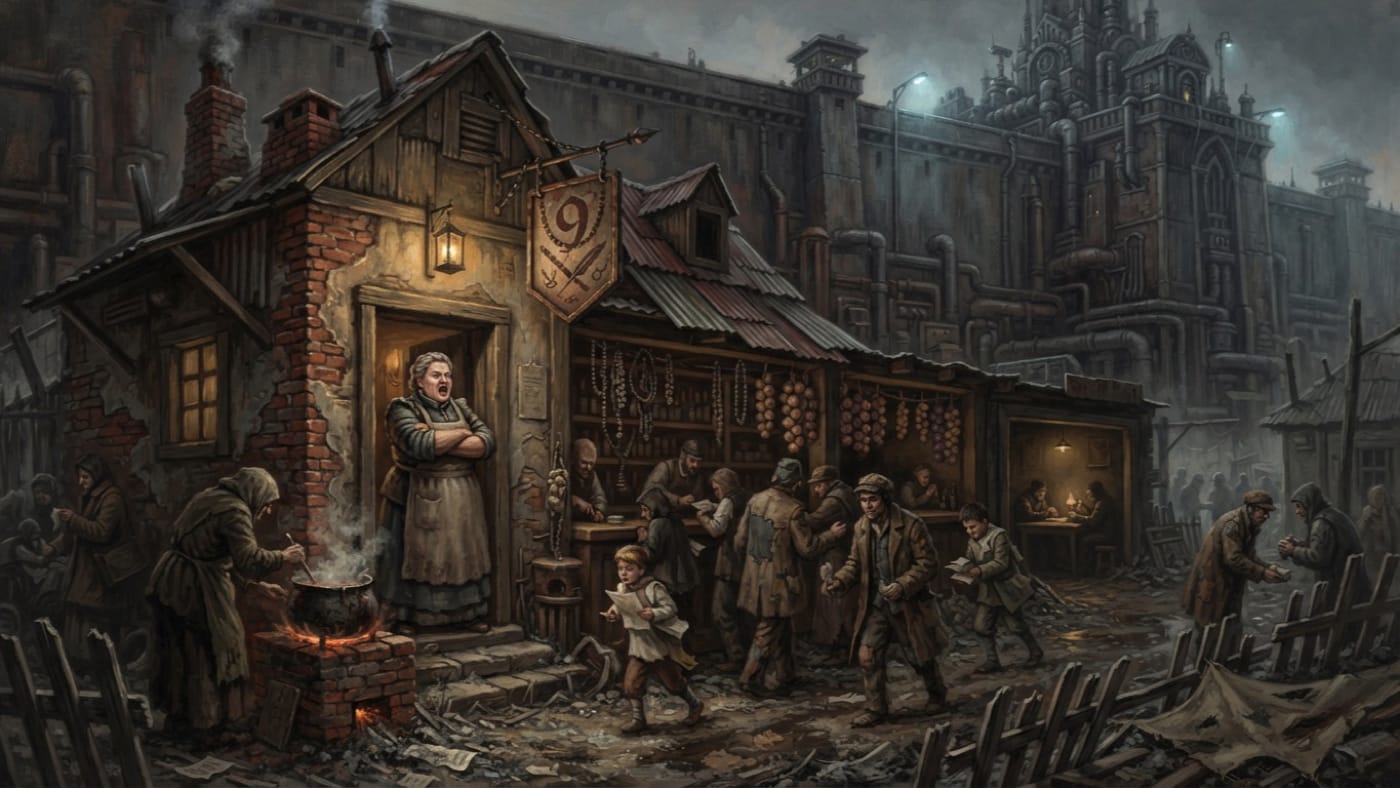
The Ninth Count stands in the rubble lots beyond the wall of the Cloister of Miscounted Beads, on the outskirts of Strasbourg, in the grey ash-silt where the refuse canal, the outer gravefields and the eastern drain wall meet. It is built from whatever the district leaves lying about: brick taken from older brick, timber that used to belong to some other building, a roof patched with whatever did not burn. Soot covers it. Tallow lights it. The sign hangs from one chain. Nobody filed a note on when the second chain went.
The house sells sour beer. It sells broth and fried offal to men who have lived on boiled grain in the Dorm Rows and would trade a confession for grease. It takes lodgers. In a district where the only other bed is the lee of the compound wall, that makes it a hostel of some consequence. Knife fights happen often enough that the municipal watch treats them like the weather.
Bead strings hang on the shelves behind the counter. The house calls them decoration. They are counterfeits, threaded to the Synod's specifications by forgers with the patience of jewellers. They hang where a pilgrim with a miscounted string can study them over his beer and do his sums.
#On the Front Room and the Onion Pantry
The front room is an ordinary public room: benches, a counter, and smoke that prefers the room to the chimney. A displaced pilgrim gets advice from a stranger. A debtor learns which clerk drinks. A widow learns that a broker has been heard saying her husband's name. All of this is conversation, and conversation over beer is still lawful, so far as the statutes have ruled.
The real commerce happens further back. Behind the counter is a pantry with braids of onions strung from the joists, swinging like censers whenever someone squeezes past. The back room lies beyond it. In dry weather the Grave-Name Market stays outside, under torn canvas and fence slats, spread across the ash so that no single seizure takes all of it. When it rains the ink runs, and the price talks move indoors.
The back room has a table, a lamp and a habit of silence. The lie it tells is a small and durable one: brokers who meet in a tavern are just customers, and a customer can sit wherever he likes once he has paid for his beer.
#On Sella Vorn and Those Who Stand Outside
The proprietor is Sella Vorn. The Doctrine account of the Market credits her with four arrests, two fines, one absolution granted by clerical error, and a commendation from the municipal watch for keeping order during a knife fight she had arranged, though not well enough to avoid needing the order kept. The account does not say which arrest led to which outcome, and I have not tidied it. A woman with that record has learned that procedure punishes tidiness and forgives confusion. She keeps her house exactly as confused as the watch can tolerate.
She governs her premises. She does not govern the trade. The Market has no king and no guild. It has conveners, who gather sellers, settle price quarrels and disappear before any title can harden. In A.S. 201 the most active of them is believed to be Aunt Pell, who sells boiled onions outside the Ninth Count's door and has never been seen writing. I decline to decide whether Pell cannot write or prefers to have others hold the pen. Her onions are adequate. Her spot on the threshold is ideal: every buyer passes her twice.
Runners pass through all the time. Children are preferred, with slips behind their ears and beads under their tongues. Former Cloister workers drink at the benches and sell what they remember. A dismissed copyist sells the shape of a form. A corpse-cart man sells the habits of the tags. A runner from the Outer Watch Post sells the hour when the sergeant counts keys by touch. Some of the watch drink here too, with their armbands on and with them off. The Sponsor-Seal Brokers denounce the house from the Supplementary Entry Office and buy rumours in its back room. Their lawful seals remain lawful. Their curiosity about the unlawful kind is a matter for their confessors.
#On What Is Purchased Over Broth
A customer at the Ninth Count buys two kinds of goods, and the house makes sure the second kind always looks like the first.
The first is hospitality: a bowl, a bed, beer, warmth. The second is paper and the things that go with it. A counterfeit string from the shelf, counted to match a route the buyer never walked. A sponsor impression lifted from warmed wax, good enough to pass a junior clerk in bad light. A copied death notice. A route fragment with the lower half torn off, so the missing station cannot be checked. These are sold in pieces, because whole pasts are expensive and rarely convincing.
The demand is made inside the wall. The Cloister holds a pilgrim nineteen days on average before the Counting Hall lets him go. Clerical debt turns a filing fee into weeks of corpse-cart labour. Tired men keep the death rolls through fever season, and they keep them badly. Every delay, every smudged tag and every name filed dead before the body is cold sends another customer to Sella's back room.
The goods often fail. At intake, Jossa Rill makes the body answer before the documents do: name your mother, name your last hunger, name who would mourn you. A buyer carrying a bought string and grief he never bought fails her yard in a sentence. The string goes to the Bead Vault as evidence. The buyer goes back to the Ninth Count, poorer, to try again.
The Grave-Name trade presents itself, to any official who asks, as "records assistance."
Corrected. "Assistance" implies the records were helped. In fact they were impersonated, abbreviated, or buried under the wrong tag. The house sells beer. The back room sells everything else.
#On the Watch, the Raid, and Names Too Warm for a Roof
Prior-Scribe Erem Vale tolerates parts of the Market for three reasons. Illegal hope delays legal riot. What criminals sell shows him what detainees need. Corruption dragged into the mud leaves footprints. His tolerance is selective, and it gives the tavern no immunity. Theft from the Vault brings a cordon. A warm name sold to a child brings a quiet seizure. A broker who embarrasses the Office finds his old fines revived. The Ninth Count survives because it is useful to watch, which is a condition of employment rather than a licence.
I inspected the lots at dusk in A.S. 201 with two Doctrine clerks, a Purity listener and an Outer Watch sergeant with a selective memory. The sign swung on its one chain. The tavern door shut with the lazy timing of well-rehearsed innocence, while the sellers outside turned into broth-servers, mourners and children playing knucklebones. When an arrest scattered the lot, Sella stepped into the doorway and shouted about unpaid beer, and the scene recovered its morals at once. The Purity listener wanted to burn the tavern. I did not authorise it. Once a tavern burns, it can no longer show you who drinks there.
Anomaly Weeks change the house's rules. When the Cloister gates lock and the dead start appearing on rosters, Market prices climb and its taboos harden. Ordinary bargaining carries on in the back room under the onions. Hot names do not come inside. A hot name is one tied to a live anomaly: a name seen on a roster before any hand wrote it, or a name that answers from two places at once. No one speaks or sells such a name indoors. Brokers take that business out into the rain, with the seller standing on ash, the buyer on brick, and payment made in food. Informant copies of the Market's taboos list this rule first. When my clerk asked a broker why, he was told that a roof keeps what is said under it. I record the answer and certify nothing.
The A.S. 200 index-fragment scandal brought three nights of fighting across the lots over copies of a Vault index leaf. Three men died in the rubble before Archivist Keth reweighted the grey cases and rotated the shelf marks into nonsense. The record does not place those deaths inside the Ninth Count, and it does not place Sella at any of them. I have been invited to infer otherwise. I decline.
#On the Present Condition
As of A.S. 201 the Ninth Count serves beer, broth and offal and lets beds. It displays counterfeit strings as ornament, hosts wet-weather brokerage behind its onions, and keeps Aunt Pell's pot steaming on the step. The post-A.S. 198 backlog keeps the Cloister full and the benches crowded. The Sponsor-Seal Brokers have tripled their prices inside the wall, which drives their customers outside it. The Quiet Thread condemns the hot-name trade and still uses the lots to pass its warnings. I have not established whether any of them pass through this back room.