
#On the Designation
A formation that leaves its name and no history has done the Ledger one favour and one injury.
The 19th Ravelin Sappers survive in the Ledger as a designation written beside one corporal's surname. I have searched for them the way one searches for a mislaid seal: carefully, with irritation, and in the wrong drawers first. The search produced a numeral, a fortification term, a trade and Corporal Maes. No charter has reached my desk, and no founding year, colonel, muster strength, battle honour, disbandment order or present station came with it. The formation is remembered because a clerk wrote its name at a lantern table, and the man under that name then did something the confession boxes could not hold.
A ravelin is a detached outwork set before a curtain wall. Engineers on the Sagittal Line use the word as freely as chaplains use "amen," and it fixes a unit in a trade. It does not fix the unit in a place. I have seen enthusiasts march the 19th to Constantinople on the strength of the noun alone. They may go there without me.
The formation's surviving personnel are Maes and his captain. I may not give the captain's name, and the reader will not find it here.
#On Sappers and the Roll
The sapper's trade on the Line is wet and plain. Sappers cut saps forward under fire, shore the cuttings with green timber that never dries, pump out water that comes back by evening, and lay or lift charges where the enemy has been too inventive with earth. At the ordained end of the trade stand the Litany-Engineers, who psalm over their powder and record fuse lengths in the margins of their hymnals. Nothing I have read makes the 19th part of that order. They are not shown with its kit, its patron or its campaigns. I offer the Litany-Engineers as an occupational neighbour only, and I have no warrant to admit them to the 19th's file.
The designation matters chiefly at the moment a sapper stops digging. A Trench-Court Clerk opens every case with the same three words: name, unit, vow. Identity requires one tag and one living witness, or two tags when no witness survives, and the unit roll settles which of the Line's many men called Maes lies on the plank. From that match come the death attestation, the burial clearance and the bequest slip, and the household's entitlements follow from those. A surname alone is a rumour. Add the unit and it becomes a claim on the Synod's purse.
#On Wound-Site 14
Wound-Site 14 was a forward medical cutout in the northern sector, east of a trench spur whose map designation was changed several times by men in dry rooms. It operated for thirty-six hours during an assault the after-action file calls a limited push, troubled by weather interference and accompanied by acceptable attrition. The thirty-six hours belong to the cutout. They tell us nothing about how long the 19th served, how long the assault lasted, or how long Maes spoke.
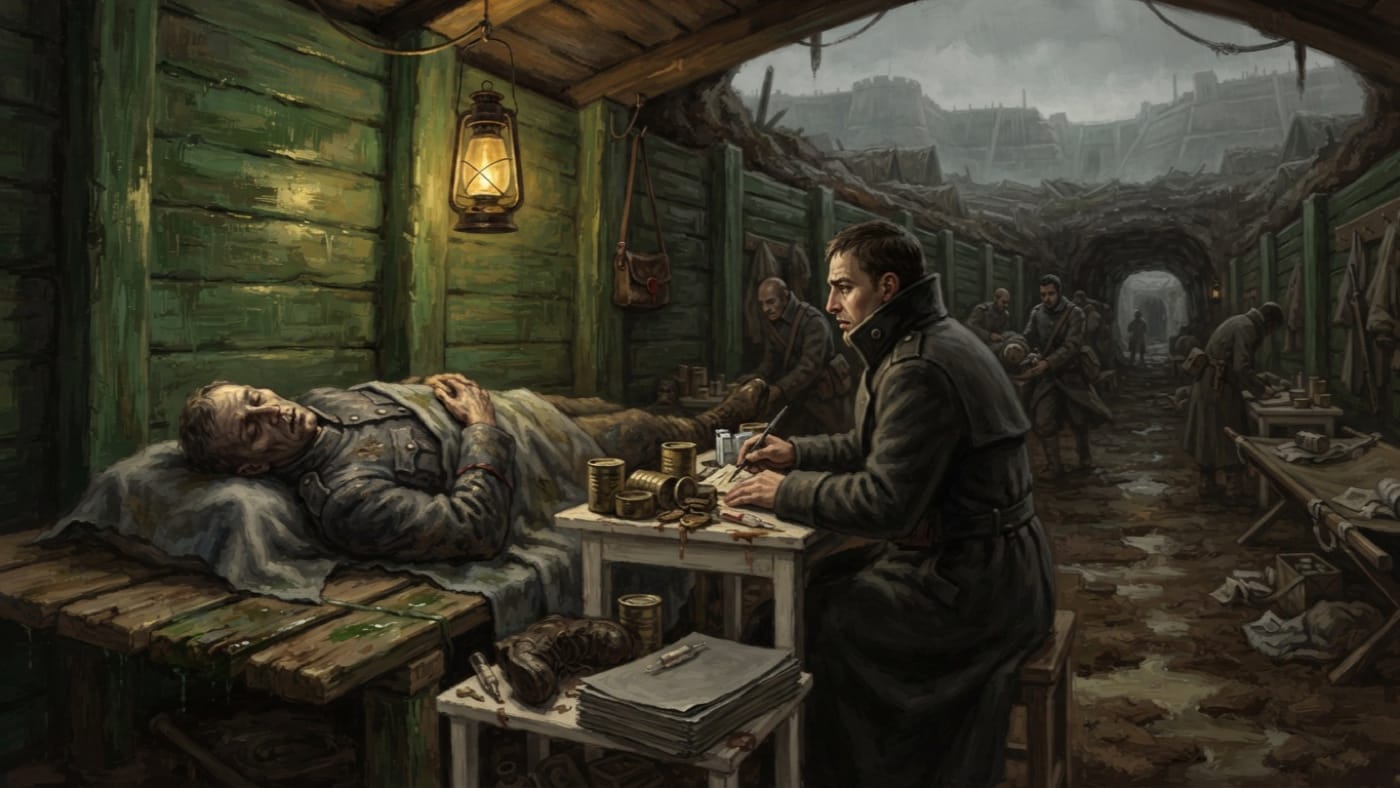
Medics carried the salvageable west. The rest came to the lantern table: a plank on wet timber, a seal tin, a brine cloth going grey, a stack of waterproof sheets that resist ink the way a bishop resists audit, and the contradiction pouch on its hook. The lamp turned every face the yellow of old vellum. Ration tins, boot-mud and morphine shared the floor.
In the founding-cluster account, Maes is the first case described. That makes him first in the telling and nothing larger. Corporal Maes of the 19th Ravelin Sappers spoke in his captain's voice. The captain was alive at that hour, three miles to the rear, eating tinned beans. Maes used the captain's childhood name, which was held in a sealed Records schooling file that no sapper corporal had any lawful means of reading.
No transcript of his words has reached me, and I will not invent one. The speaker on the register is Maes. The voice is attributed to his captain by the published account. Those are two entries, and I keep them in two columns. The account calls the site a demon breach. It does not say what spoke through the corporal or by what route, and it gives no reason to suspect the captain of anything beyond his lunch.
The clerk marked contagious doubt and kept writing.
The cluster went on to produce a tongueless gunner, a sapper asking after another man's wife, a man who sang a bell pattern before any bell rang, and a silent man who spoke only to correct a wrongly written name. None of them is shown on the 19th's roll. The three sealed pouches, the clerk who could not hear his own speech, the medic who would not enter, and the chaplain uncertain whom his rites addressed belong to the night as a whole. I will not hang any of them on Maes's plank.
The first field summary described Wound-Site 14 as "echo contamination under shell stress."
Withdrawn. Echoes repeat. The voices recorded there answered.
#On the Settlement and the Custody of Last Words
The Trench Court settlement of A.S. 91 (1801 CE) adopted Cadence Anomaly as the fifth confession category. It sat one year after the Concordat of Strasbourg made the Synod formal, and neither founder had any hand in it, both being dead before Strasbourg convened. Maes's confession came before the settlement. Its day, month and year are not separately attested, and I will not certify any of them.
Faithful, drift, contrition and contagious doubt all judge what a dying man meant. The fifth box asks whether the voice, identity or knowledge belonged to the body producing it. The Wound-Site cluster drove the category's adoption and gave the Cadence Examiners their field ancestry. Maes is part of that cluster. He was neither its whole cause nor, so far as any record shows, the first borrowed voice the Line ever produced.
The handling now required was written after his bedside, for the cases that followed: exact wording, without rubric compression; speaker and voice identified separately; witnesses and bell-hour recorded; an examiner's review; no repetition aloud; and routine burning under Burn Directive 7-C suspended until the proper countersignature. At Wound-Site 14 the clerk had four boxes and a pouch.
The stakes are clerical, which makes them sharper. Contagious doubt seals the page into the pouch under the Contradiction Doctrine and sends the family the standard notice. If the voice on that page was a captain's, the clerk faces three questions with no box for any of them. He must decide which file receives the confession, whether the corporal died confessed at all, and whether a living officer has acquired deathbed testimony he never gave. Record-True Clerks would keep every syllable. Rubric Clerks would reduce it to language a widow can survive. The Bureau of War wonders whether a voice that crossed three miles of trench could be sent across the wire.
I have seen no attestation, burial line, effects ledger or list of heirs for Maes. I do not know what his household received, or whether it received anything.
#On What the Record Permits
The file permits three things: a known member, an unnamed captain, and an institutional consequence that outlived both of them on paper. It permits little else. The eleven confirmed uses of Cadence Anomaly are spread across several courts. They are not eleven sappers of the 19th, nor eleven events within its ranks. Of the clerks who used the category, seven had their transfers granted and four have dispositions still unresolved. Those are aggregate figures, and nothing ties Maes's clerk to any one of them. I have been invited to make that tie and have declined. The personnel appendix has unexplained clerks enough without my supplying another.
Whether the 19th were disbanded, renumbered, folded into another establishment, or are still digging somewhere north of the rain, I cannot say. The present year is A.S. 201 (1911 CE). That is a fact about the calendar and says nothing about the formation. No garrison report lists them. No roll has surfaced, and I have found no memorial and no legend of a lost company singing under the mud. Any such legend would be the work of the next man who loses his drawer key and then explains the loss with a story.
The formation's significance lies in one line of a confession register and in the procedure built afterward to keep that line from being burned unread. For a unit of sappers, that is a fair epitaph: they were remembered for one cut through the ground beneath the Ledger.