
#On the Authorized Material
Nemea ash-ink is brewed at the Hollow-Script Scriptorium of Nemea and travels under the seal of the Bureau of Records. By Synodal practice it is the standard for sensitive documents, meaning any document whose falsification would cost the Synod more than the ink does. That is the whole of its official description. I have read the official description many times in the hope that it would grow. It has not.
A clerk who handles the ink long enough learns to know it the way a confessor learns a voice through the screen: by its blackness under the lamp, its drag on the nib, and the faint smoke it gives off well after the stroke has dried. Recognition is the ink's great service to the Church. A Records auditor holding a disputed folio can say with some confidence where its ink was brewed and which sealed road it came by. He cannot say whose hand dipped the pen. Petitioners confuse these two questions. So do magistrates, and so, on the occasion I will come to, does the Bureau of Doctrine.
The ink will tell you where it came from. Nobody has ever got it to say who wrote with it.
#On the Inkhouse Work
The ink is made in the Inkhouse Quarter, on Nemea's inland ridge above a slow river, among lime pits and groves of burnwood. The working day starts with the dawn ink boil. The Quarter smells of tannin, smoke and iron. Across the lane the scriptorium halls smell of soot, vinegar and hot wax, and lime dust settles over both. A visitor who has spent a morning there can be identified by smell at forty paces and by cough at sixty.
The vats are blessed. The Scriptorium keeps the ash-ink blessing among its own rites, alongside the nightly correction bell and the vow of blankness, and nobody at Nemea considers a batch fit to issue without it. Whether the blessing works on the ink or only on the brewers is a question the Chapterhouse has never needed to settle.
The labour is monastic, which in Nemea means owed. Brewers work beside novices bound by vow contracts and copying quotas, and the townspeople pay what they call page debt in night shifts and confessions. Lye and poison burns from the vats are common. Ash lung is more common still. None of this appears on the brick.
The finished ink leaves the Quarter as bricks. Every load crosses the Inkhouse Bridge, the single span all Nemea freight must use, and goes on to the Courier Spur, where sealed carts and relay stables carry it into the Synod's administrative country. Unstamped ink is one of the things that cannot be moved through Nemea at all. The rule is enforced with an enthusiasm that suggests the Chapterhouse knows exactly what the ink is worth on the open road.
I am regularly asked by persons who should know better to publish the formula. The Bureau publishes what it is given, and I have been given soot, vinegar, tannin, iron and a guarded door.
#On the Written Obligation
Nemea says its ash-ink binds to paper like law. In this the town is almost modest. A stroke of it does not lift cleanly. Scraped, it tends to bleed new meaning into the place where the old meaning was, so the redactor who tries to remove a line can end up with a different line and a worse afternoon. Nemea's redactors have their own methods of correction, the Redaction Yards make their own smoke, and I do not propose to inventory either here.
That durability is the whole reason for the ink's market. Records decide who exists. A Records Scribe's entry can decide whether a household draws a ration, whether a son inherits his father's lease, and whether a woman counts as a resident of the town she was born in or as a vagrant who happens to sleep there. Line-soldiers call Nemea the place that decides whether your death counts, and they say it without irony. Decisions like that need a medium that does not run when a widow with a bucket and a grievance throws water at the page. The Synod is a patient institution, but it is not a fool about buckets.
The ink does not make a document lawful. Seals, witnesses and proper form do that, and the Scriptorium keeps a whole Collegium busy checking all three. Silence-Master Rhu Tern's people run silence tests on suspect documents and keep mirrors covered until they want to catch a page in the act. The mirrors are there because some pages have learned to behave while being watched.
#On the Uncommissioned Addenda
In A.S. 194 a Paper Keeper auditing the Fourth Vault of the Burnless Archive found a folio that was not in the master index. It amended a passage writ dated A.S. 118, and by doing so it imposed seventy-six years of retrospective toll liability on caravans that had never been assessed. The seals were genuine. The ink was wet. Three of its four witnesses had been dead for decades.
The Bureau of Records identified the ink as Nemea ash-ink from the Archive's own sealed supply. It is the identification I praised above, made correctly and to no purpose. It placed the brick on its shelf beneath the cutbank of the Steppe Gate. It put no hand on the pen.
More folios followed. The ordinary living addenda are wet when they are found and dry within the hour, which is roughly how a careful scribe would expect fresh ash-ink to behave in cold limestone air. The ink behaves normally. Everything around it does not.
The Caravan Court of Nine Weights has ruled that an addendum meeting procedural standard is binding, and the addenda keep meeting it. Authentic ink, genuine seals and flawless form are the ordinary proofs of a valid document. Here they only show that the forgery, if it is one, has nothing wrong with it.
Nemea has a complaint of its own. Its Night-Rewriting Contracts shift their clauses after dark. Obligations grow, names move from one line to another, and seals reseat themselves. Signatures appear faintly on the page before anyone has signed. The Chapterhouse, speaking the Synod's line, calls this sabotage. The monks call it ink sickness. The town's precautions are salted lampglass over the page, salt-lamp circles, mirror checks, silence tests, and the old rule to burn the second draft. Nemea uses these against suspect documents. None of them has been shown to cure the condition or to apply to every brick that crosses the bridge.
Nobody has shown that the Archive's supply came from a bad batch. Nobody has shown that the restless contracts at Nemea and the unrequested clauses at the Steppe Gate are the same disease. It is very convenient to blame the ink, since an ink can be recalled, reformulated and invoiced. A cause that cannot be invoiced the Bureau does not care to discuss.
STAMPED ERRATUM — to the entry on the Burnless Archive That entry says the ink of the first living addendum "was the Archive's own." For "the Archive's own," read "drawn from the Archive's sealed Nemea supply." The Archive owns the ink by requisition. Nothing in the record shows that the Archive wrote with it, and the Bureau of Records declines to draw that inference on the Archive's behalf.
#On the Outstanding Specimen
In A.S. 199 the rubbing of the Third Stone's southern face disappeared from the Archive. The Bureau of Purity lists such rubbings as Prohibited Material. Where the rubbing had been, the Keepers found a blank folio, and the ink on it was wet.
It was still wet at the Archive's assessment in A.S. 201. Measured against the ordinary addenda, which are dry within the hour, this is badly abnormal. I state plainly that it is the exception. The folio is not evidence of how Nemea ash-ink dries, and it is not certain that what wets the page is Nemea ash-ink at all. The Bureau of Records can assay a stroke. It cannot assay a stroke nobody has written.
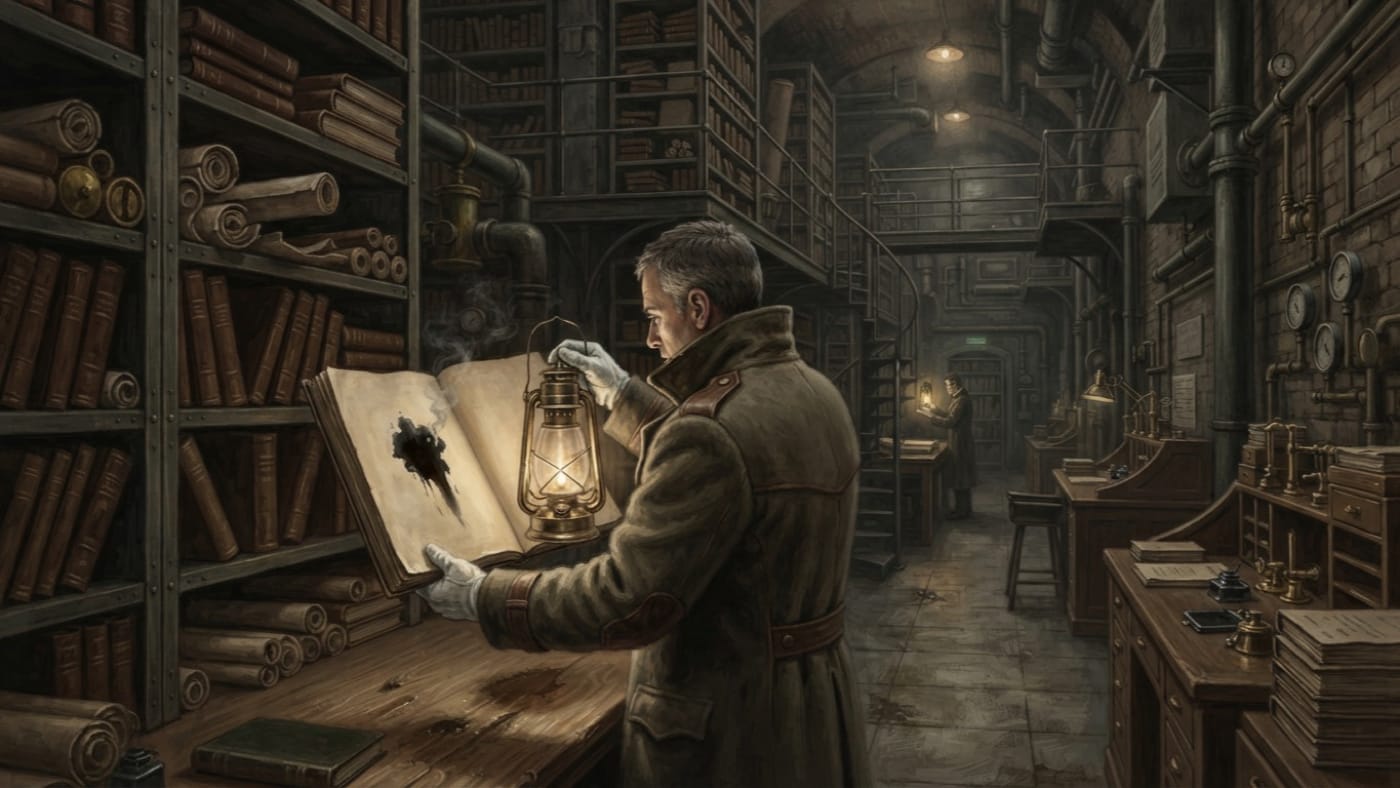
Paper Keeper Seld inspects the folio every morning. He puts on his white cotton gloves, lifts the page, and holds it to the lantern, looking for text. So far he has found none. If text does appear, it will no doubt be in the right ink, on the right paper, under the right seals and in perfect procedural order. It will be a clause, and the Caravan Court will find it binding. The Bureau will be able to certify where the ink came from within the day. The question of who wrote it will go into a file that already holds the A.S. 194 folio, the dead witnesses, and every contract in Nemea that changed its terms overnight.