
#On the Division's Station
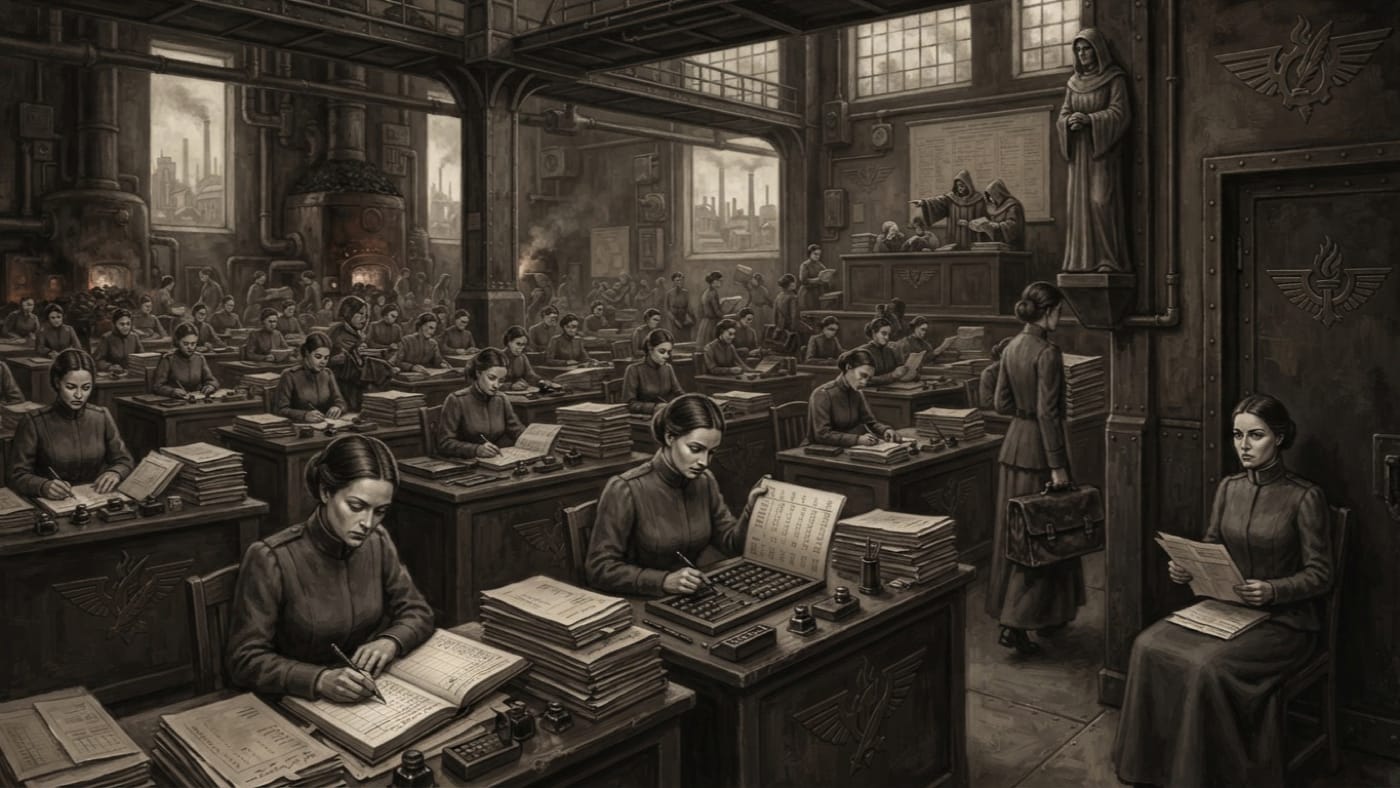
The Natal Division is the room in Strasbourg where the Bureau of Records teaches young women to write a pregnancy down so that it stays written. Its graduates go out to the parishes as Womb Registrars, the deputies of Records at the cradle. The parishes receive them the way a house receives damp.
I have heard the Division called a school. It is a desk with ambitions. The pupils know it as copy hands, sanded ink, and the household sum worked in the margin and then checked by someone older and less forgiving. The parishes know it secondhand, every time a door opens on a satchel.
Its purpose fits in one sentence. Records regards a birth the Synod cannot see as a birth it cannot count, name, provision, tithe or recover, a small private schism conducted in a back bedroom. The Division exists to make births legible before hiding them becomes convenient.
On its founding I have nothing to say. The Natal Registration Act of A.S. 158 constituted the corps the Division now trains. The Division's own charter has not reached my desk, and I will not invent a ribbon-cutting for readers who will have forgotten it by vespers.
#On the Instruction
The curriculum, as the Bureau states it, has five subjects: handwriting, household arithmetic, approved saint-names, hostile-door posture, and congratulations. The fifth is my own summary of a skill the Division prefers to leave unnamed. It means saying "congratulations" while calculating a debt. The Division would call it bedside manner, and it would be lying with excellent posture.
Handwriting comes first because a Registrar's entry outlives her. A notice taken in a tenement kitchen will be read in a parish office, then in a district file, and perhaps later beside a Purity requisition. Every reader after the first will judge the household by the shape of its letters. A blotted seven becomes a one. A one becomes a missing child. The pupils copy until their wrists ache, and they learn that a clean hand counts as evidence.
Household arithmetic comes next. The pupil learns to count mouths, beds, ration chits and prior births, and to set those figures against what the household declares. She does not learn the whole of the Tithes calculation. She learns enough to read a projection table sent down from above, and enough to notice when a kitchen eats more than its register admits.
The approved saint-names are learned the way a seminarian learns his psalter, by rote and under correction. The Bureau of Doctrine rules on which names are admissible, and the Registrar must know the list better than the mother knows her own grandmother.
Hostile-door posture needs little explanation. A door opened four inches is a negotiation. The pupil learns where to stand, where to hold the satchel, and when to cough.
#On the Papers Sent Into the Parish
A Registrar leaves Strasbourg knowing her papers better than her prayers. Four of them matter.
The pregnancy notice ledger is hers. In it she records the pregnancy, the expected window of delivery, the household's standing, the assigned midwife, any requested ration adjustment, and her suspicion marks. A suspicion mark needs no proof, only a steady hand.
The approved name list carries Doctrine's rulings and reaches her through Records. The Registrar applies it and has no power to amend it. She carries it the way a sacristan carries keys to a chapel whose altar belongs to someone else.
The quarterly tithe projection table comes from Tithes. The Registrar reads it, enters what it asks of her, and forwards the projected obligation upward. Tithes keeps the full calculation in its own counting rooms, and the Division teaches its pupils to be grateful for their ignorance.
The fourth paper is the blank. Each licensed midwife receives numbered sheets of the Natal Registration Writ, Form 7-NR, through the Registrar's desk, and the Registrar logs every serial. A blank that cannot be produced is an inquiry. So is a blank produced smudged. Nothing in that drawer is ever merely paper.
The pupils must also learn the order of events, which the public muddles daily. The pregnancy notice comes before the birth and belongs in the Registrar's ledger. The writ comes after it and belongs to the midwife, who must file it within forty-eight hours of first breath under the Act that Hierarch-Procurator Marius of Cologne ratified. The two documents meet when the Registrar reconciles them, and a household's fortunes are settled in the gap between them.
The Natal Division prepares its Registrars to deliver the children of the Synod.
Corrected. The Division delivers nobody. The attending midwife assists at the birth and must file Form 7-NR within forty-eight hours of first breath. The Registrar supervises that filing, keeps the notice, and answers for whether the household can be read on paper. The original wording was a recruitment flourish. It has been returned to its author with the obstetrics corrected.
#On the Other Hands at the Cradle
The Division trains one pair of hands among several, and it teaches its pupils whose hands are whose.
The midwife holds the child and the writ. Records, through the Registrar, holds the notice and the audit. Tithes holds the arithmetic it has not shared. Doctrine holds the names. Purity holds the boots and keeps them in a cupboard until someone asks. Alongside all of these work the Plenty aides and the Mothers of Plenty, who link a pregnant woman's notice to her flour. The household that declares its belly eats. The household that hides it learns the price of discretion at the bread queue.
The Registrar is tolerated because she is useful. She can win a ration adjustment for a pregnant household that would otherwise go without. She can produce the serial log that clears a midwife falsely accused of failing to file. She can certify the order of a notice and a writ so that a grieving household is spared an inquiry it did nothing to deserve. The same desk can also strip that midwife of her licence over one missing seal. The Division sees no contradiction, having taught both uses in the same room.
#On Absence and Referral
The pupils' last lesson concerns the birth that never reaches paper.
The Pale Kin live in that gap: a child born without notice, a midwife never summoned, a writ never filed, an entry falsified under a borrowed name. Registrars call the result a natal absence. An absence leaves no mark of its own, so the Division trains its pupils to find one by its edges. A pregnancy notice with no writ behind it. A household drawing more flour than its register feeds. A Mercy visit with no matching entry. A gap in the baptismal roll. A numbered blank that cannot be found.
Here the Registrar's competence ends and her referral begins. Standing Order 34-PK binds Records and the Bureau of Purity to act together against natal absences. Records supplies the pattern and the suspicion. Purity supplies the enforcement. The Division teaches its pupils to write a referral so precisely that the officers who act on it need not think. To their credit and their shame, the pupils learn it well.
A child recovered under the Order goes into the custody of an Orphanarium and into Administrative Recovery, where it receives an approved name and a registration number. The mother receives a file. The Registrar receives her next ledger.
#On the Present Work
As of A.S. 201, the corps the Division trains serves everywhere from the heartland parishes to the forward cities behind the Sagittal Line. Every parish office has at least one Registrar, and the cities keep whole rooms of them. Each one learned her letters at a Strasbourg desk. Each one carries the satchel, the list, the ledger, the folded table and the numbered blanks.
Women go on giving birth wherever the Synod reaches. The Bureau has never once taken this as a reason to rest the pen.