
#On the Account Retained
This survey was made for the Bureau of Doctrine in A.S. 201. It covers one undated tradition and the little that holds it up. The tradition belongs to Saint Caldrin the Jubilant Scribe, born Caldrin of Essen, a junior clerk of the Bureau of Festivals and patron of the Receipt-Procession Pageant Captains. His patronal dossier lists three miracles, and the Multiplication of Receipts is the third. That order is the order of the catalogue. It tells us nothing about which wonder came first in the saint's life, and the survey will not treat it as though it did.
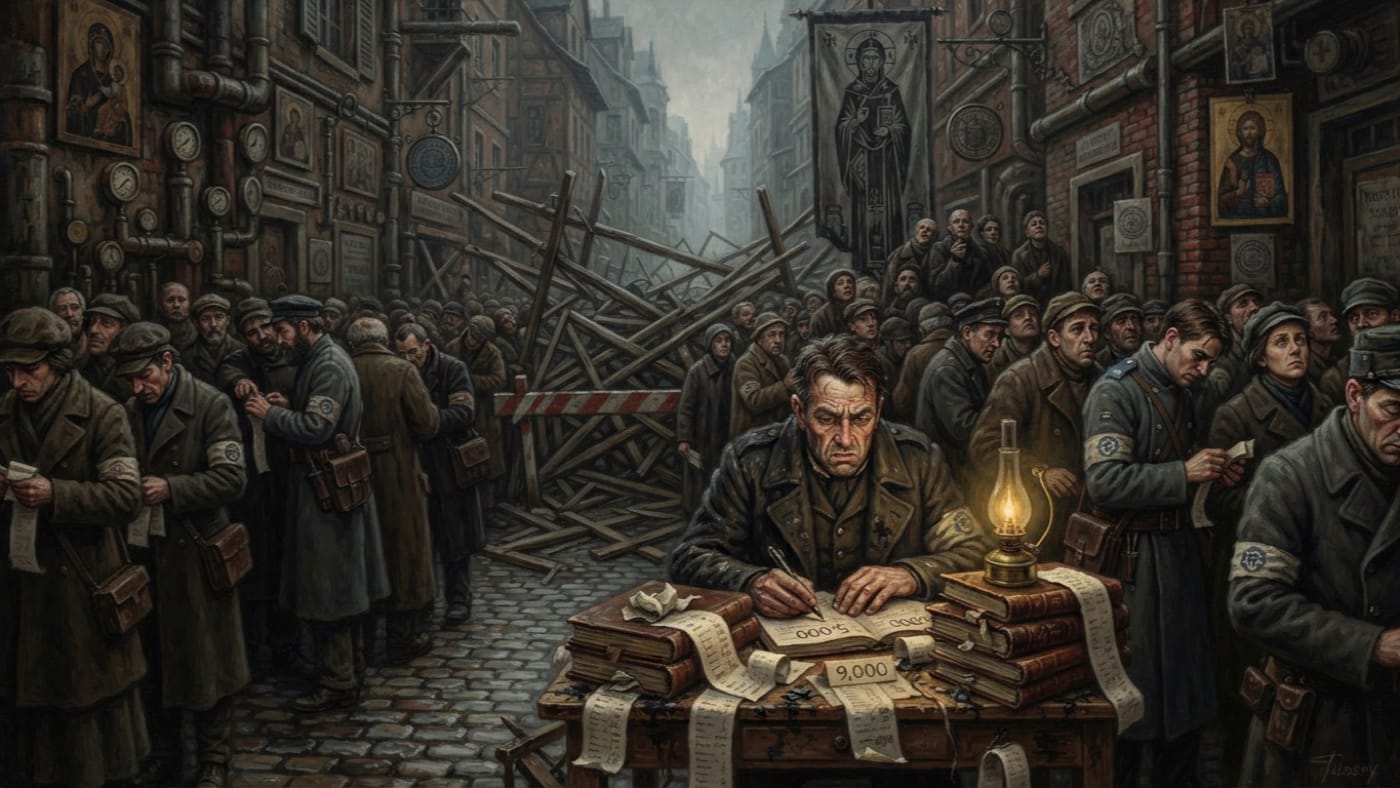
The whole surviving claim would fit on the back of a ribbon-chit. After a route collapse in the Lace District of Strasbourg, Caldrin reconciled nine thousand attendees from five thousand ribbons. Pious tellings call this abundance. Professional Captains call it fraud under pressure, and they grant that it was executed with style.
There the account ends. It gives no year, no feast, no route and no list of anyone hurt. This survey keeps it that size.
#On the Ribbon and the Receipt
The two figures embarrass anyone who reads them closely because each belongs to a different instrument.
A receipt-procession is a census in festival clothes. Caldrin devised it after the open grain audits of Gray Week ended in riot, a famine whose year Records and Festivals still date by rival calendars of grievance. His first memorandum proposed three devices. The Ribbon Runner worked the edge of the crowd with punch-tool and smile. The receipt-scroll carried names reconciled against parish ledgers. The gratitude pause stopped the procession beneath banners, saints or free cider, and while the crowd looked up at the painted face, clerks counted wrists.
The system keeps three kinds of evidence, and the miracle depends on keeping them apart. The first is the ribbon, which anyone can see: a band punched through the wrist in a pattern for procession, district and feast. The second is the name, which the receipt-scroll carries from the street into the parish roll. Reconciliation comes last. The Captain sits up at night with returns, scrolls and anomaly list and makes them speak with one voice. The profession's own working lore defines this labour as making the story align with the totals. The trade wrote that about itself, and the survey has nothing to add.
A ribbon count records what was punched. An attendance total records what the Captain was willing to sign. The two are meant to agree. When they do not, the Captain gets an anomaly list and a long night, and if his patron is listening he gets Saint Caldrin.
#On Nine Thousand and Five Thousand
The account gives a ratio and an outcome, and nothing else.
The only circumstance it gives is "route collapse." The words could mean timber that gave way, masonry that gave way, or a crowd that stopped moving as a route requires. The tradition does not say which, and the survey will not choose for it. The cause, the duration and the consequences go unrecorded. If anyone lay beneath whatever fell, they go unnamed, and the Codex will not supply names to fill the gap.
Everything the tradition claims rests on the verb "reconciled." Reconciliation is paperwork done at night: returns brought into line with rolls, scrolls with ribbons, anomalies with explanations. A Captain who reconciles nine thousand from five thousand has produced a ledger in which nine thousand attendees stand accounted for and five thousand ribbons stand as the visible evidence. The account tells us the ledger balanced. It does not tell us how.
Subtract one figure from the other and you get four thousand, a number that means nothing on its own. The account never says anyone went unribboned, so the four thousand cannot be read as a count of bare wrists. It names no dead, no duplicates, no invented households and no rescued citizens, so it cannot be read as a count of any of those either. The difference between two totals is arithmetic, and arithmetic is all the tradition hands down. A commentator who sorts the four thousand into kinds is doing the Captain's reconciling for him, without his licence and without his returns. This Codex offers no reconstructed ledger.
#On Abundance and Professional Judgment
The pious reading is kind to the saint and kinder to the Bureau. Abundance is what the Church promises when it is in good humour: bread that suffices, oil that lasts, a festival that counts more joy than it ribboned. In this telling the Creator blessed the ledger after the route failed, and the total came out large because the faithful were more than the instruments could measure. Festivals likes the reading because it turns a broken procession into overflowing attendance, and overflowing attendance is the Bureau's favourite weather.
Captains read the same sentence as people who have sat through reconciliation night. They work to quotas. They are judged on totals, on the thickness of the anomaly list and on the calm of the route, and the trade's lore admits plainly that everyone adjusts counts to meet those quotas. A collapse is the moment of greatest pressure. The route has failed, the returns are ruined, and the office above still wants a number by morning. A Captain told that a clerk produced nine thousand from five thousand in those conditions recognises the craft at once. He calls it fraud because he knows how he would have done it, or knows that he could not have.
That recognition is evidence about Captains, and it proves no forgery was done in the Lace District. The accusation is a professional opinion, and it is held by people who pray to the accused. They invoke Caldrin after reconciliation, when the anomaly list will not balance: "Saint Caldrin, keep the smile on the count." Whoever says that prayer believes in the Multiplication exactly as far as he needs it to work tonight.
Doctrine classifies Caldrin's miracles as procedural. A procedural miracle need not break the order of nature. It needs only a procedure that worked better than anyone can explain. Both readings fit inside that classification, which is why Doctrine chose it.
The Bureau of Festivals' earliest saint's vita states that Caldrin "heard the people's distress and answered with joy."
Corrected, as already entered in his patronal dossier: Caldrin read the riot returns, marked the audit failure, noted the census gap and proposed an instrument by which hungry citizens could be brought to gather under banners of their own accord. The vita's charitable phrase may not be cited for his motive in the Lace District. That tradition records two totals and no motive at all.
#On the Survey's Disposition
Three neighbouring entries must be kept out of this file.
The Receipt Reform of A.S. 138, under Directive 88-F, made wrist-ribbons mandatory at sanctioned processions, and Caldrin's canonisation belongs to the same administrative season. The tradition does not say whether the collapse came before the Reform or after it, and the survey assigns it to neither side.
The Calming of the Marrow Quarter is a separate miracle, set in a different quarter, with its own four thousand ribbons and its own reported outcome. That the figures coincide explains nothing.
The Lace District's dated procession for the Feast of Saint Merrow's Tally, in the first season of the Lantern Accord, has its own report, its own tent and its own redactions. None of them may be borrowed to furnish this account.
What remains is retained. The Multiplication of Receipts stays in Caldrin's patronal record as an attributed miracle of the procedural class. It is undated and set in the Lace District, with two totals and no mechanism. The Bureau of Records may note the totals. It may not cite them.