
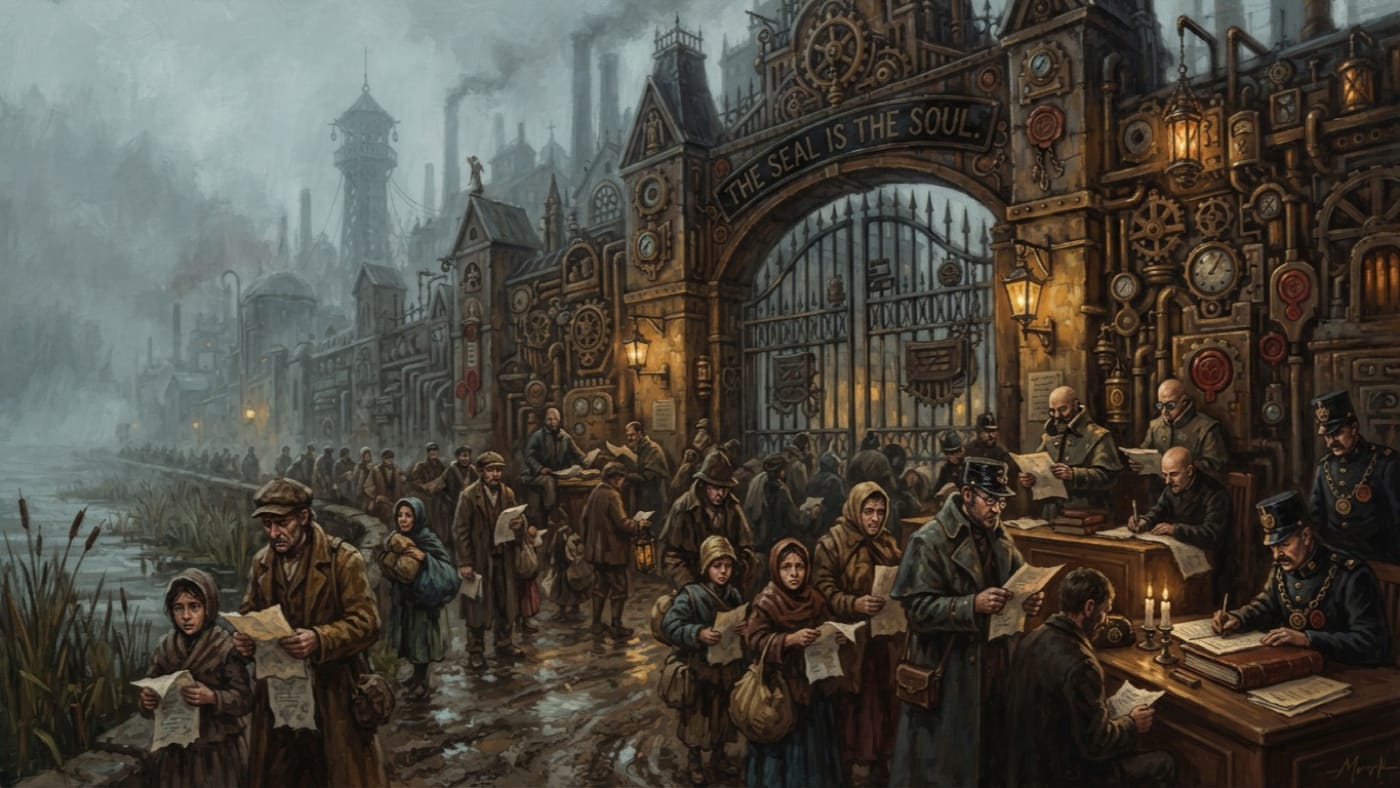
#On the Upstream Entrance
"THE SEAL IS THE SOUL." — Lettered above the Mordant Gates, Candlewick Palatinate.
The Candlewick Palatinate has two throats. Barges coming downstream are swallowed at the Seal Locks. Everything that comes by land enters at the Mordant Gates, which control the upstream approach: carts, drovers, clerks on foot, and apprentices carrying one bundle and one cough along the dike roads. The Gates hold that approach the way a confessor holds his grille. Nothing passes until it has been heard.
The motto hangs above the entrance in letters of lacquered tin. The Palatinate's own account says a clerk renews the lacquer each equinox and that no one has ever seen this clerk arrive or leave. I record the account and do not certify it. A city that makes the Synod's seals can presumably manage a ladder and a pot of lacquer without an audience. It may also be that the people who might have watched have learned what watching costs in Candlewick. The Bureau of Doctrine has taken no position. I am content to share its silence, because the letters are bright and the doctrine they state is sound.
At the Gates that doctrine is also a working instruction. The soul a traveller shows the inspector is the one written on his papers, sealed in a registered shade, and legible in fog. Whatever else he carries in his chest is between him and the Creator, and the Creator does not issue shade tokens.
#On Road, Water, and Marsh
The Palatinate sits on low terraces in the Flemish marsh, near where the old maps put Bruges and Ghent and where the Bureau's maps put a coordinate of roughly fifty-one degrees north. It is ringed by dikes. Chain towers guard the canal approaches. Beyond the dikes lies the marsh ring, which the city keeps as a quarantine buffer: reed, standing water and soft ground, with the sick kept on the far side and the healthy reminded to stay well.
The dike roads cross this ring and end at the Gates. I will not describe the number of openings, the towers, the stone or the machinery of the Gates. No survey in my possession records them, and the Codex does not invent masonry to please an engraver. The Bureau of War's surveys of Candlewick count gates as kill-switches, since a sealed gate can shut the city in an hour. That doctrine applies to the city as a whole. I extend it to these particular Gates only so far as their name already does.
The conditions on the approach are better documented than the building. In winter the marsh fog is thick enough to turn a registered amber into an unregistered brown at twenty paces, and the city lists that hazard beside fire and sinkholes. In summer the heat softens wax inside a satchel. Paper takes the damp in every season. The road smells of wet earth and tallow smoke, with a sour note of vinegar mordant drifting from the vats. Near the entrance the smell turns to rust-iron and damp canvas, and to the breath of whoever is queued in front of you, filtered through a mask that should have been replaced a week ago.
The Seal Locks downstream have their own iron, their own procedure and their own drownings. I do not repeat them here.
"Nothing enters without passing the Seal Locks." — Candlewick Palatinate, On the Economy of Legitimacy.
Canal barges enter through the Seal Locks. Road traffic enters along the dike roads through the Mordant Gates. War contracts arrive occasionally by the rail spur. The Locks remain the physical choke on canal cargo, and the statement is corrected to that effect.
#On the Examination of Persons and Cargo
Three offices examine whatever arrives at the Gates. Each looks at a different thing and none of them trusts what the others have found.
The colour-inspector reads shade: the shade of the transit seal, of the shade token, and of the strip of House cloth that some travellers wear as legal identification. An inspector with a good eye can tell a lawful variance from an ambitious one by lantern light. A poor eye in fog creates criminals, and the Chromatic Registry has never complained of a shortage of those.
The Records clerk reads the text and enters the passage. His annex was installed in the Palatinate in A.S. 92, at the charter, as an extension of a Bureau of Records that had been doing this work elsewhere long before. In Candlewick the clerk's ledger is the last word. A traveller the ledger did not admit has not been admitted, whatever the inspector saw.
The Seal Provost acts on what the other two find, or on what he would prefer to find. The Provosts wear brass seal-badges and carry the warrants and chain keys. Their remit covers gates, docks and Registry queues. Officially they guard against forgery. The street considers them a shakedown operation with a sideline in political policing, and I have not seen a street opinion in Candlewick overturned on appeal.
The shade token is asked for first and handed back last. It is scrip and licence in one, keyed to particular districts and particular hours. Holding the wrong shade in the wrong ward is a misdemeanour. Holding no token at all makes the bearer what the Provosts call a vagrant, which in the Palatinate means a person whose disappearance will generate no paperwork. Lantern colours govern movement and patrols across the city. When the fog thickens, a traveller with perfect papers can still be judged guilty of standing under the wrong light.
Cargo is searched against a short list, and the list is brutal. No unregistered pigments. No blank seal dies, since a blank die is a forged soul before anyone has signed it. No unauthorised bells, no unlabelled ash, no unstamped books. No colourless paper, meaning paper without a watermark, which is the most dangerous thing a carter can bring to Candlewick because it is the only object there that has not yet been told what to be.
Tallow, beeswax combs, mordant salts, clean water, rags and linen, die metals and coal all come into the city. I have no ledger that divides them between road and canal, so I name them without assigning them to either throat. Whatever share of them rolls through the Gates is inspected under the same suspicion as the people driving it.
#On the Price of Admission
Candlewick cannot feed itself, light itself or fix its own ink without what arrives from outside. Two Houses have a direct interest in how long arrivals are kept waiting.
House Wickwarden controls the wax supply and so the city's light. A curfew enforced by lantern colour depends on lanterns, and lanterns depend on tallow. House Vatmarsh controls the mordant salts and fixing agents, which decide whether a document lasts or fades. Neither House owns the Gates and I do not claim that either does. Both understand that a delay at an entrance can do the work of a shortage, and that no one keeps minutes of a delay.
Bribes at the Gates are paid the way bribes are paid everywhere in Candlewick, in small legal luxuries: a vial of clean wax, a few drops of registered ink, a fresh mask filter. The street calls bribe wax "drip." It moves from hand to hand on the dike road with the quiet efficiency of a collection plate.
The price varies with the person paying it. A merchant with a House-backed name pays the motto its respect and goes through. An apprentice holding an oath-note pays in waiting, in questions, and in whatever his master's name is worth that week. The unlicensed canal poor have nothing the Gates recognise. For people the Gates will not admit, the Black Canal Syndicate offers alternatives from the under-dike routes of the Black Canal: false lantern codes, counterfeit seals, and the rewritten identity it sells as a new name. Every one of these products exists to make the Gates believe something untrue. The demand for them is a fair measure of how far the Gates are believed.
#On the Present Condition
In A.S. 201 the Gates work under the Fading Winter, which began in A.S. 199 and has not ended. Across the River-belt, documents are losing their text while their seals and identifying marks survive. Hungry Ink, the Palatinate's older affliction, does worse. It eats the words around a seal, or rewrites them, and leaves the seal itself genuine.
The method at the Gates rests on one assumption: an authentic mark proves an authentic text. The inspector judges the shade, the clerk reads the words, and the seal ties the two together. The Fading Winter cuts that tie. The inspector now holds a transit pass with a seal in a perfect registered shade and a body that is blank, or half blank, or legible but no longer what it said when it was sealed. If the clerk admits the bearer, he has admitted someone on the strength of a seal attached to nothing. If he turns the bearer away, he has refused a genuine seal, and in this city that comes close to blasphemy against the motto over his head.
I know of no record of a particular outbreak at the Gates themselves, and I do not supply one. None is needed. A fading pass carried in from upstream fades just as well at the entrance as anywhere else.
The Registry has responded the way it always responds, by expanding itself. It has issued new purity standards, required shade revalidation in every household, and pursued the programme it calls chromatic reconciliation. Each measure gives the Gates more to check, and none of them restores a single faded line. The cause of the Fading Winter is still unestablished. The Vatmarsh chemists blame failures in the supply of mordant salts. The Registry blames heresy. In A.S. 143 the Bureau of Alchemical Standards noted that Hungry Ink outbreaks correlate with atmospheric ash. Doctrine has instructed that the correlation be disregarded, and so I disregard it here, in full view.
The letters above the entrance are still bright. Inspectors still read shade, clerks still write in the ledger, and Provosts still collect drip. Travellers still line up along the dike road with papers that may be blank before they reach the front of the queue.