
#On the Corridor
The files use the name Morava for a river and for the roads that run beside it through the Serbian interior. They give nothing more exact than that, and this survey will not supply what the files leave out. It chooses no branch and names no crossing. Any clerk who comes to my desk with a ruler and a confident expression will be sent to the Bureau of Engineering, which collects such men.
What the record does establish is function. The published account of Serbia places the country's approaches on the Danube and the Morava, and it says plainly that the Morava roads draw armies through the interior. The Danube is the great public river, the one with customs houses, packet boats and a career's worth of tolls. The Morava was how a man left the river and went inland, toward monasteries, garrisons, orchards and grain, and toward the parishes that owed Vienna their quarterly reports. A traveller came up from the Danubian approaches and the corridor carried him into the country. A letter went the other way.
That was the whole of its usefulness, and it was enough. A road that carries soldiers in also carries correspondence out. Cut it and the interior does not fall silent so much as become unprovable.
#On the Bridge Report and the Silence
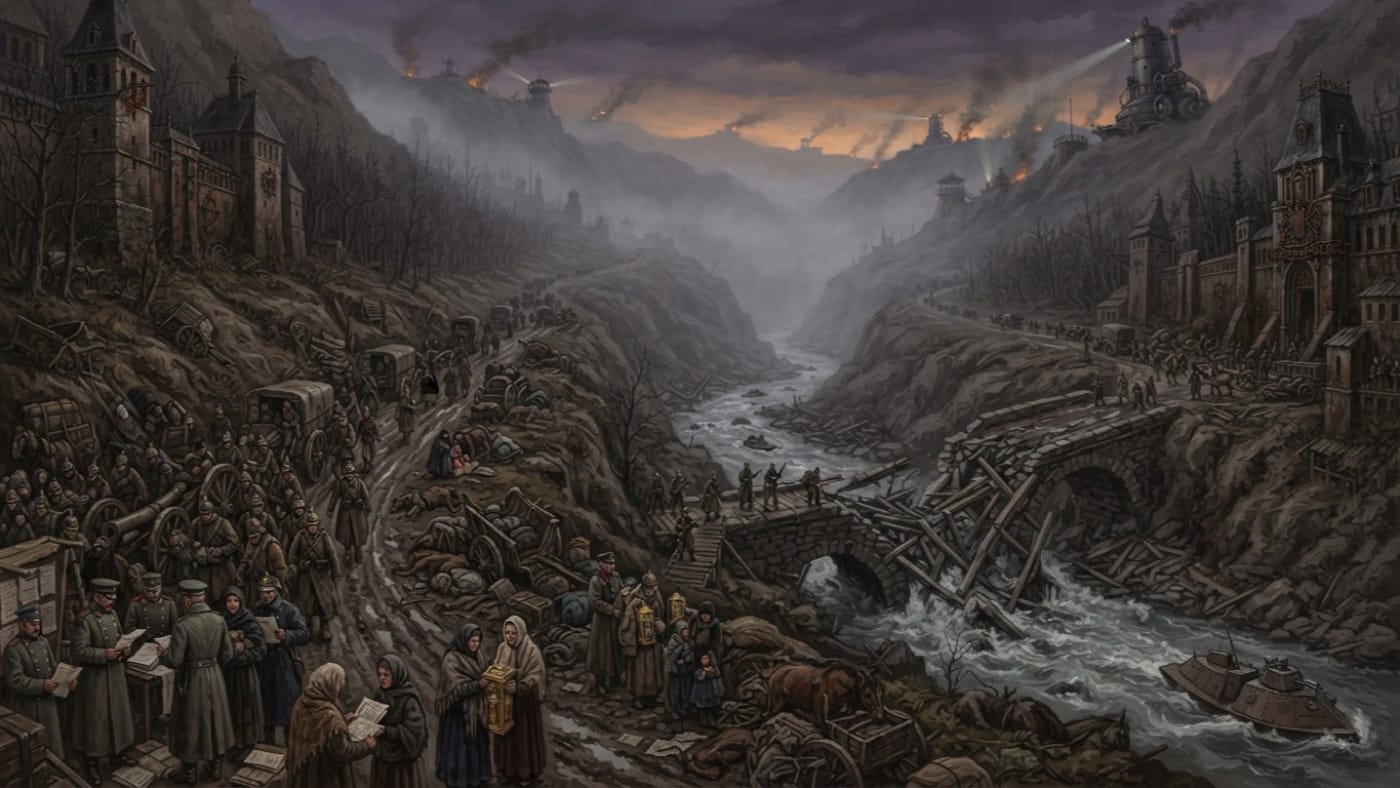
In A.S. 38 the East stopped answering, and the Morava contributed one sentence to the catastrophe. The account of the Eastern Silence lists it among the first failures, the ones that still made sense: a bridge washed out near the Morava.
That is the report, and I read it as written. The bridge was near the Morava. The record does not say it crossed the river, and I will not march it into the water for the convenience of a later map. Its name is unknown, and so is its builder. Whether it was stone or timber, repaired or abandoned, standing today under a toll-broker's lantern or lying in silt, nobody knows, and this office will not guess in print.
In A.S. 38 the report had one great virtue: it was plausible. Bridges wash out. Spring water rises, timber rots, an embankment softens, and a courier takes the long way or does not come at all. The Rationalist clerk who received it could file it beside the bandits on one road, the fever at a posting station, and the monastery track closed because peasants swore trees had grown across it overnight. Each cause was small, and each fitted a memorandum. Together they gave Vienna a quarter's worth of excuses for a failure no one there wished to measure.
Then the plausible explanations ran out. Couriers vanished on roads with no fallen bridges. Monastery packets arrived with their wax intact and their pages blank. The Serbian file records bridge reports that contradicted the river's height, the kind of discrepancy a sound clerk underlines twice and a frightened one initials without reading. The record does not say whether any of those reports concerned the Morava bridge. They concern Serbia, and I keep them there.
So the washout remains what it was on the day it was written: an account that explained late letters, written before late letters became a missing region. It proves nothing about who or what took the bridge. Flood, rot, sabotage, or something with appetites: the folio gives no verdict. A Hieromnemon who invents one is only a pamphleteer with better stationery.
Rationalist quarantine notices described Serbian road failure as "epidemic interruption aggravated by rural superstition."
Corrected. The roads were failing before the fever registers were written. The Republic's notices went from plague to banditry to fog fever to disorder to courier indiscipline, and they grew more confident as the correspondence grew thinner. In this case superstition was simply intelligence without a stamp.
#On the Warning and the Sundering
Seven years separate the washout from the screaming. The Silence began in A.S. 38. The Sundering came on the first of November, A.S. 45. The school plates keep collapsing that interval, as though the bridge went into the water one evening and the legions crossed the next morning.
They did not. For seven years the corridor did something less dramatic and more damning: it failed to report. A road through the interior that should have carried tallies, arrears and parish grain returns carried gaps instead. The Rationalist Republic (Unregistered) answered the gaps with quarantine, with prosecution, and with gaps of its own.
Present Doctrine holds that the Silence was hostile preparation, the Great Deceiver testing the seals of the East before he broke them. That is Doctrine's holding, and I file it under Doctrine's name. It does not promote the washout to an act of Hell. A corridor that stops communicating is one event. A country that opens under fire and fog is another. The second gave the first its meaning. It did not give the first its cause.
#On the Retreat Roads
Two flights belong in separate ledgers. During the Silence, witnesses came west along the Danube roads and through the Carpathian approaches, carrying children, icons, coin, and bread gone grey at the crust. Those were irregular entries in the margin. After the Sundering the entries filled the page: first the desperate flight, then the long compression the Bureau dates as the Great Retreat, A.S. 48 to 65.
The Serbian roads took the worst of it. The published account lists the columns: soldiers, relic carts, widows, cattle, monks, artillery teams, wounded Rationalist officers, children with older faces than their mothers, and clerks with ledgers. It describes the roads too. Mountain tracks broke wheels. Low roads vanished into fog. River passages filled with crowds, each with a valid claim to go first: the wounded, the relics, the children, the powder, the food, the bells.
Every answer killed someone. The Serbian file says so in four words, and I will not improve on them.
A corridor that draws armies into the interior draws them back out, and a retreating army never moves alone. By the plain logic of the Serbian file, the Morava roads were part of that compression. I can say no more without lying. The record names no convoy on the Morava, and no crossing disaster, no rearguard, no count of the dead. The broken wheels, the fog on the low road and the quarrel at the river passage are conditions found across Serbia. They are not depositions taken at a known Morava ford. Anyone who quotes this plate as though they were will receive a letter from me on heavy paper.
What the Retreat taught on those roads was precedence. Someone had to decide whether the cart carried the wounded boy or the reliquary, whether the mule hauled flour or shot, whether the bell was buried here or carried on to be buried somewhere colder. The armed queue, the passage notary and the stamp beside the club all found early custom in Serbia. The Serbian file says the Retreat gave cruelty a desk. I have sat at that desk for most of my career and can confirm that the chair is comfortable.
#On the Present Record
As of A.S. 201, Serbia is contested country, inhabited at its margins and entered only under layered licence. Maldrake presses through the heated mountain valleys. The fog of Syrion holds former Serbian lands within the grey reach of the Vales of Stagnance, where roads stop agreeing with their own milestones. Neither pressure has been mapped onto the Morava, and this office assigns the corridor to neither. Fire may hold one stretch, fog another, a toll-broker a third. The file cannot tell me, and the file is all this survey consulted.
The licensed traffic is regional. War patrols go in for reconnaissance and denial, and some come back through the river approaches watched from Irongate. Bells teams test fog cadence from ridge posts. Records copies names from stones, doors, bridge beams and old toll ledgers. Records has not reported whether any of those beams once spanned anything near the Morava. I have not asked, because asking creates an obligation to file the answer.
One account belongs to this corridor in its own words. Among the witnesses the Serbian file preserves is a deserter found near the Morava with the soles of his boots charred from below and frost in his hair. The record gives no name, no date of recovery, no regiment and no route, and I supply none of them. Heat below and cold above will tempt the reader to see Wrath under his feet and Sloth on his head, and to conclude that the two Sin-Generals shared him, the corridor, and very likely the bridge. The reader may give in to that temptation at their own expense. The deserter proves where one man was found and what state his boots were in.