
#On Their Classification
The trench puddle is the cheapest mirror in the Church, and the most widely issued.
The entry on Morwen, Sin-General of Envy, gives the Mirror-Stalker one paragraph. This survey gives it more. It cannot give it much more knowledge. The Bureau has always had more ink than facts, and this commission, sealed in the two hundred and first year of the Synod, was ordered so that the ink and the facts might at least be kept in separate columns.
The field scholars count six kinds in Morwen's host. The Mirror-Stalker is the least demanding of them. A Hollow One must be stationed beside its victim for days. A Face-Thief studies one chosen target for weeks or months. The Mirror-Stalker requires only that a man look into a reflective surface for too long. What eventually walks out of that surface is the man himself, improved. The garrison of Bastion-Irongate, which holds the Danube gorge against Morwen's spite, has more experience of this creature than any other body on the Sagittal Line. Its experience is the subject here.
A note on the name. In its accounts of the troops of Velkara, Sin-General of Lust, the Lore Book applies "Mirror-Stalkers" to reflective assassins that pass between reflections and strike out of them. The Bureau has not established whether the Velkaran and Morwenite usages name one kind serving two masters or two kinds sharing a field name. I decline to establish it for them. This survey describes the Morwen usage only, and the Velkaran account keeps its own particulars.
#On What Watches
A reader who has studied the mirror-lakes of the Hollow Vale will expect a creature of grand surfaces, silver water under a wrong sky. The reader should discard that expectation. The dossier on Morwen's demons and the published entry list what the Mirror-Stalker uses: mirrors, windows, still water, polished steel, and the puddle that forms in the trenchworks after rain. The last item matters most. Every soldier on the Irongate works carries steel. Every rainfall lays a new mirror along the duckboards. The Church has spent two centuries putting a sheen on the things it issues, and every shine is one more place for the creature to watch from.
They watch, and they learn by watching. When one emerges, it is a perfect copy of someone who looked too long. That is the whole of the sourced account. The record does not say how long "too long" is. It does not say what the creature is while it watches, or what labour turns a reflection into a body that can stand in a corridor and return a salute. I have searched the folios for these things as a confessor searches a penitent's pockets, and I found nothing I could seal.
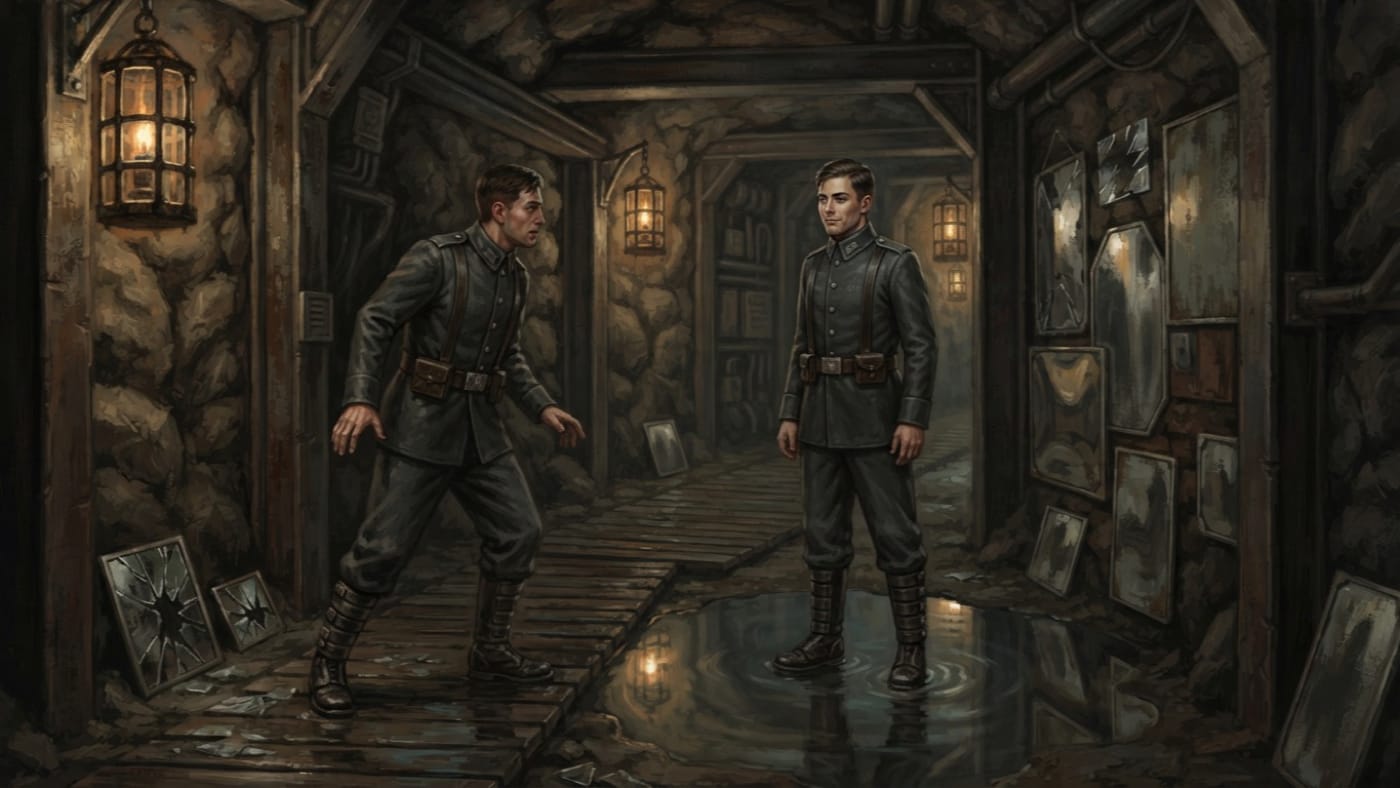
The dossier adds one terrible detail. The original may not know he has been copied until he meets himself in a corridor. He receives no ceremony and no warning. He turns a corner of the gorge-tunnels and finds his own face coming the other way, and the face looks rested.
#On the Better Self
It is you with your flaws corrected. It is not you.
The sources agree on how the copy differs. It is more confident, more capable, and more charismatic; the dossier says charming, and the two words mean the same thing on a parade ground. The published entry describes it as the man he would have been if every choice he made had been the right one. I wrote that sentence and I stand by it as rhetoric. I do not claim that the creature has visited the roads its victim did not take. It carries itself as though it had, and the effect is the same.
The original, confronted with this better self, tends to falter. The copy does not. I have kept the word tends. The record does not say that every original breaks, that he surrenders, or that some enchantment drains the fight from him. It describes a man who meets an improved version of himself and hesitates, and I have watched enough men at the inquisitor's table to know that hesitation is the most damning testimony a person can give against himself.
The operational problem follows directly. Two soldiers with one face stand before the chaplain-of-the-watch. One stammers, contradicts himself, and looks at his boots. The other answers cleanly, meets the chaplain's eye, and asks politely how he can help resolve the matter. The Synod has trained its officers to prefer composure, competence, and a steady voice for two hundred years. Here the creature brings every quality the Church rewards, and the man brings only his claim to be the original.
The comparison with Morwen's other imitators clarifies the danger without explaining it. Echo-Kin copy a man's gestures and fail at arm's length. Face-Thieves select a target and devote themselves to studying him. The Mirror-Stalker selects nobody that the record can name. It is given its victim by whoever lingers over the water, and it gives him back better than it found him.
#On Mirror Discipline
Break the glass, dull the cloth, and do not wait at the water.
The Synod's answer is Mirror Discipline, the restriction of reflective surfaces maintained by the Bureau of Purity across the Irongate sector. It answers one question only: how to give the creature fewer surfaces to watch from. It does not answer the harder question of which of two identical men is the original.
The Irongate garrison has a standing order to shatter any reflective surface larger than a hand-span within three hundred yards of the perimeter. Those are the order's own measurements. They do not show that the creature cannot use a smaller surface, and they do not show that it cannot work from farther away. They are the limits a commander could enforce with the hammers and patrols he had. Nothing in the record shows that breaking a surface harms whatever was watching from it. The shards are swept up. The rain comes again.
The Bureau of Ordnance has requisitioned forty-seven thousand yards of matte-finish trenchcoat lining since A.S. 195. The record says requisitioned. It does not say how much was delivered, how much was issued, or how much was sewn into anything. The year marks the start of that procurement and nothing else. The Mirror-Stalker's first appearance, and whatever served as its creation, are absent from every folio I hold.
The other practices do not form a single procedure, and I will not present them as one. The dossier records installations that ban mirrors entirely and cover or dull every reflective surface. The published entry records a ban on polished metal and standing water inside the perimeter. It also records assigned barbers for shaving, latrine mirrors replaced with polished tin that deliberately distorts the image, and, elsewhere in the same text, soldiers who shave by touch and cut each other's hair from memory. A garrison does all of these things at once when its commanders are improvising. None of them has been certified safe. A distorted reflection is still a reflection, and a broken one is only several smaller reflections.
Earlier editions of this Codex described Morwen's campaign against Bastion-Irongate as "containable by conventional fortification and sufficient prayer."
The Bureau of Doctrine and the Bureau of War withdrew that sector-wide assessment, as the entry on Morwen records. The hammer, the dull coat, and the tin mirror are among the conventional fortifications the assessment had in mind. Its withdrawal grants no particular immunity, and this survey claims none.
The discipline has its own cost. The dossier states it plainly: men who cannot see themselves start to forget what they look like. The garrison grows ragged and becomes less sure of its own faces. A soldier who no longer has a clear memory of his own appearance is badly placed to swear that the man in front of him is a copy. The Synod has taken the mirrors away to protect men's identities and made those identities harder for the men themselves to confirm.
The broader countermeasures against Morwen apply here only by extension, and I set them down with that caution. Recognition challenges catch bad copies. The Ledgers of Self record each man's scars, habits, and last confession, but a Ledger is a document, and documents can be altered. No record I hold shows either measure being used against a Mirror-Stalker in particular, much less succeeding. The final protocol, executing both duplicates, remains in force across the sector. Applied to this creature, it means the original's hesitation can hang him beside the copy that caused it.
#On the Present Survey
The record does not establish the exposure that produces a copy, the process by which a reflection becomes a soldier, or what the double is: whether it has a soul, memory, or any bond to the man it imitates. It does not say what becomes of the original after the corridor. It does not settle whether the Velkaran usage names the same creature. I have left these spaces blank because a blank can be filled later, and an invented answer would first have to be found out and struck.
The survey is filed under Morwen. The Velkaran question is returned to the Bureau that raised it. Mirror Discipline continues at the Irongate on the grounds that it is all the Synod has.
Inscribed in the Basilica by a man who wrote this entry at a desk with the inkwell turned away from him — Hieromnemon Valerius Drax, Warden of the Sacred Ledger, in the two hundred and first year of the Synod's dominion.