
A survey, made in A.S. 201, of the account of the Belgrade closure and of the glass it left behind. No record examined by the compiler gives a year for the closure itself.
#On the Scope of This Survey
This is a survey of paper. I say so at once, so that no reader takes the Hieromnemon for a tourist. My sources are two accounts of one event, and I have neither stood in the courtyard nor handled the glass. The older Lore Book calls the passages Envy's Mirror Gates and has them opening in the courtyards of Belgrade. The Codex's own treatment in Miracles and Sorcery narrows the matter to one open gate, one scribe and one stroke of ink. Both give the same sequence, and neither gives a year. This survey is dated A.S. 201, and that date applies to the survey alone.
The subject is a mirror that served as a door, the act that ended its service, and the fragments that have since gone into trade. Nothing more is covered. Readers who came for a general history of reflective sorcery may return their admission to the clerk.
#On the Passage
An ordinary mirror gives back what stands in front of it. That is its office, and the humblest looking-glass in the humblest vestry performs it without complaint. A Mirror Gate is glass that has abandoned that office. It stops returning the room and lets in traffic from somewhere else. The accounts say only that it was open, a door in the plain sense of the word. One could pass through it, and it stood where no door had been licensed.
The older account assigns these gates to Envy, and I record the attribution as written. The reader should also know that the Codex catalogues the Mirror and Perfume Arts under Lust, and that Lust's reflections at Belgrade's Shattered Courts are likewise said to open like gates. Two Sin-Generals share one vocabulary and one ruined city. I do not reconcile them. Reconciliation without evidence is how forgers earn their bread, and the Bureau of Records already employs enough forgers.
The Mirror Gate is also distinct from the many other unclean things that live behind glass. Envy's tradition is crowded with reflections that watch, copy and replace. As the Belgrade accounts describe it, a Mirror Gate does none of this. It opens, and that is the only charge the record will sustain against it.
The accounts do not say what made the glass a door, who made it, how often such gates appear, or where this one led. I leave those silences as I found them.
#On the Belgrade Closure
The record is short, and its brevity is its authority.
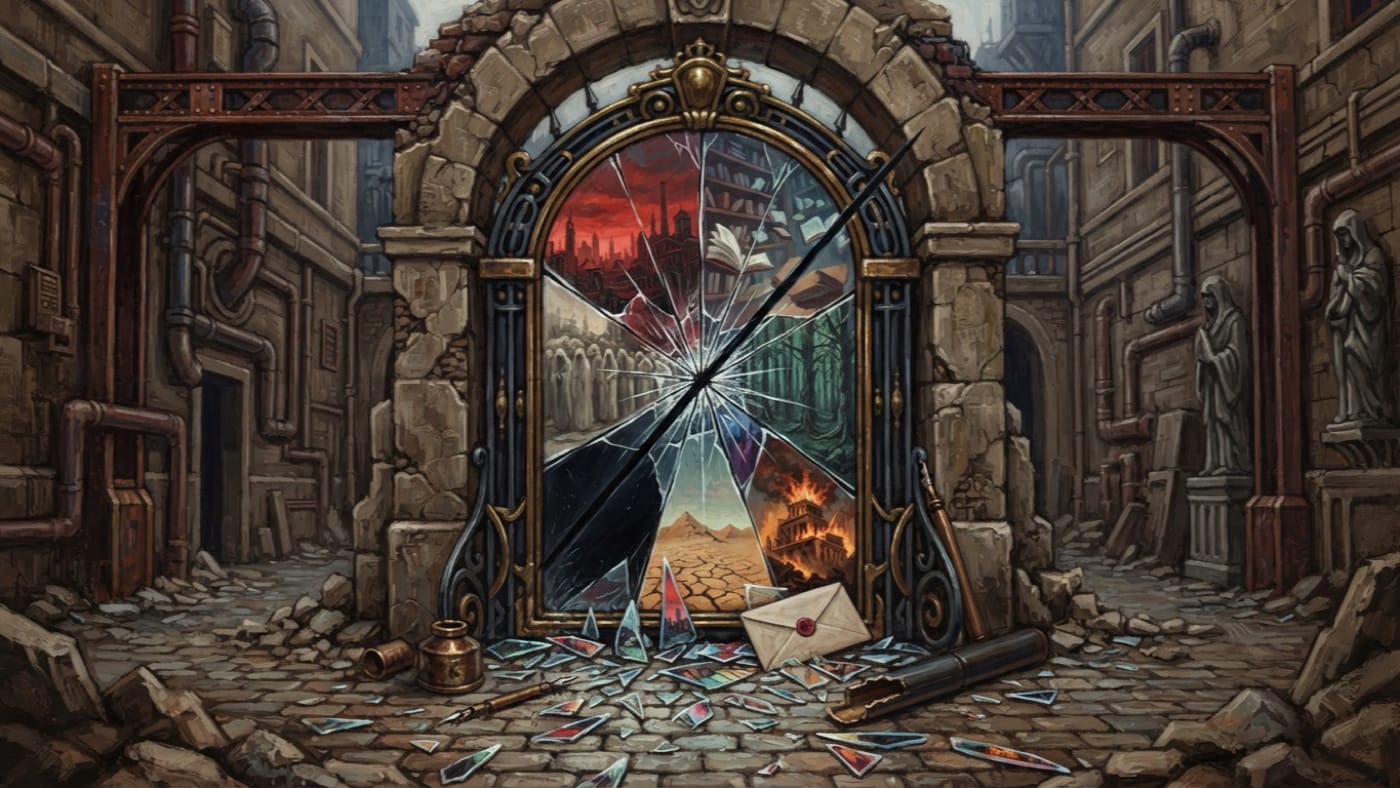
A Warden-scribe stood before the open gate in a courtyard of Belgrade. He wrote a true ledger-line across the glass in one neat ink-stroke, from corner to corner. The mirror ceased to be a door. It froze (the older account says it froze into glass, meaning it became again the thing it had pretended not to be), and then it shattered.
That is the whole of the deed. Read it twice. I have read it some hundreds of times, and its proportions still offend me in a way I find instructive.
On one side stood a passage opened by sorcery. It was a hole in the ordinary order of rooms and walls, and it gave the Great Deceiver's traffic a frame and a threshold. On the other side stood a clerk with ink. He performed the most despised act in the Synod's repertoire, the one every Bureau novice performs four hundred times a day with cramping fingers. He wrote a line, and the line was true.
The accounts do not say what the line said. They do not say whether he spoke, whether anyone stood with him, whether he survived the shattering, or what it cost him. The parent article places the episode among the collisions of grace and corruption. Every other example there exacts a price, a heart burst at the bell-rope or a marsh made sterile for a season. For Belgrade, no price is recorded, and I will not invent one to make the arithmetic balance. The Ledger balances when it has the figures and not before.
The record says very little about the freezing: one verb, then the next. Any commentator who adds a temperature, a rime of frost or a stopped clock has supplied it from his own imagination. I strike such commentaries from the reading-room shelves wherever I find them.
#On the Fragments
The shards did not reflect the courtyard.
This detail has kept the glass in circulation. According to the account, the fragments reflected seven different places, and each shard was a lost passage. The places are not named. The number seven counts places reflected; it does not count pieces, and this survey has found no record of how many pieces there were. Dealers who sell "one of the seven shards" sell a misreading along with the glass.
"Lost passage" is the account's phrase, and I keep it. A shard shows somewhere else. No record examined here shows whether anyone could pass through one, whether its view can be chosen or changed, or whether two shards set edge to edge show anything at all. A window onto a place one cannot reach is a picture, yet the trade prices these pictures as doors.
The trade persists all the same. Shards still turn up in the reliquary markets. The older account says they fetch high prices, and the Codex calls the prices absurd. Both are right, the Codex more so. The buyers share one ambition: to gather enough of the glass to rebuild the door.
This survey authenticates no fragment. It names no seller, route, price or owner, because the record names none. Every shard offered in the markets is offered on the dealer's word. The reader may weigh that word against the dealer's commission.
#On Countermeasures and Claims
The Synod's field kit includes iron mirrors, issued to deflect reflection gates. This is attested, and the Bureau of War, which prefers pragmatism to pageantry, packs them in oilskin beside the salt and the bells. They are the only standing safeguard against such passages that the record supplies.
The Belgrade stroke is a different kind of thing: one recorded closure, by one scribe, at one gate. It belongs among the interference events in Miracles and Sorcery, where grace meets corruption and the outcome is rarely tidy. It is not a rite. The record gives no wording, no recipe for the ink, no preparation, no vigil and no licence from the Bureau of Rites. A junior clerk who reads this survey and goes looking for a mirror to ink will learn something. It will not be what he hoped, and he will learn it alone.
Earlier editions of this Codex described miracles as "not breaking reality at all."
Deprecated under the Bureau of Records, Fourth Revision, in favour of "breaking without blemish." Readers still attached to the earlier phrasing are directed to the reliquary markets, where what is left after one true line of ink is sold by the piece, blemishes included.
#On the Present Account
The purchasers believe the door can be reassembled. The published account answers them in two words: it cannot. That is the account's conclusion, and this survey has found nothing to disturb it.
The answer has not slowed the trade. A shard sold this season will be sold again next season to a man with a deeper purse and a shallower reading. He will carry it home wrapped in velvet and lay it beside the others he has bought. Then he will sit at his table under a good lamp and wait for the edges to agree.
He will wait a long time. A Warden-scribe has already written the line, and the line was true.