
#On the Instrument Designated
Being a description of a document the faithful hear once a year and the Warden of the Sacred Ledger hears rather more often.
Miraculum Septimum: De Custodia Sancta, the Seventh Miracle, Concerning the Holy Custody, is the Bureau of Doctrine's official account of the sealing of the Sixth Ravelin's southern curtain at Bastion-Constantinople. It is filed under Pilgrimage Day Three. It is filed in A.S. 170, the year of the sealing. It is filed under the Fourth Ratification, which governs what may be said of the event and, with considerably more energy, what may not.
The account runs to three pages. I give the number because it is one of the few particulars about the instrument that nobody has ever contested. My Ledger records the filing. It records no author, no signatory, no scribe, no day of issue and no press. The title is Latin. The title is the only part of the instrument whose language I will certify, and in the whole history of the Synod a Latin title has never obliged the pages beneath it to follow suit.
The account's office is liturgical before it is historical. Nobody consults it. Once a year a chaplain reads it aloud to people standing on a parapet, which makes it the most widely heard document in my custody and one of the least read.
#On the Persons Offered
Being an inquiry into a collective noun.
The account names no one. It speaks of "forty-seven servants of the Synod, moved by the Spirit of Obedience." That phrase folds the Bureau of Records' tally into a single rank. The tally reads: twenty-nine soldiers of the garrison, eight civilian residents, four confessors, three ammunition-handlers, two clerks of Records who had not left their guardroom stations, and one widow entered only as K., assigned to Pilgrimage Intake. All forty-seven names are sealed under the Fourth Ratification. I know eleven of them. I will not write them, and the account will not miss them.
Doctrine states that the forty-seven approached the breach "of their own volition, moved by the Spirit of Obedience, which is the highest of the cardinal submissions." I enter the sentence in the Ledger as the Bureau's assertion, because that is what it is. The grammar repays a second reading. Volition is the subject, Obedience is the motive force, and submission is the rank awarded afterward. The sentence tells the pilgrim why they came. Whether they could have stayed away is a matter on which the account offers nothing, and neither do I.
#On the Account's Omissions
Being a comparison of four sentences with nine hours.
The surviving language read to pilgrims, so far as the Bureau has let it be quoted, is this:
"Forty-seven servants of the Synod, moved by the Spirit of Obedience, offered their persons for the preservation of the Wall. Their sacrifice was accepted. Their names are with God. The Wall endures."
There are three pages, and I do not claim these four sentences are the whole of them. They are the sentences the faithful carry home.
Offered is active. The forty-seven are its subject, and the verb belongs to them. Accepted is passive, and it names no one who did the accepting. Their names are with God is true as far as it goes, though the copy kept by the Bureau of Records is the one with a shelfmark. The Wall endures is the only sentence in the passage that the Bureau of Engineering would countersign.
What the account leaves out is better documented than what it contains. The night before, a Night Paper reached the Ravelin by an Index Damnatus Runner. It named the 14th Parish Regiment oath-broken under the Catechism of Obedience. Before midnight the regiment's colonel had burned his own men in their barracks: three hundred and twelve dead, and the relic artillery left without crews. Maldrake's forces struck the southern curtain at dawn, with Forge-Beasts in the van and a column of Hollowed walking behind, the Great Deceiver's cheapest and least particular soldiers. One hundred and forty metres of wall came down. The garrison held the gap for nine hours. Engineering's forward team then arrived with a pour-frame, sixteen cartloads of consecrated cement and their instructions.
The account mentions none of this. It begins at the offering.
It also leaves out the hymn. Fourteen witnesses depose that the forty-seven sang the Antiphon of Endurance, the thirty-two verses prescribed for siege conditions on page 4,117 of the Bureau of Orison and Song's Hymnal for Desperate Hours. The cement was mixed with bone-aggregate, relic powder and hymnal ash, and it rose as they sang. At the twenty-seventh verse it reached the mouths of the shorter volunteers. By the thirtieth, one voice remained. The account records a sacrifice and an acceptance. It has no cement, no verses and no final voice.
The volunteers were sealed by the routine operation of Bureau procedure.
This wording was withdrawn from the Bureau's entry on the Vigil of the Hollowed, and the withdrawal applies to any gloss on the Miraculum that repeats it. The pour-frame was designed for breaches cleared of personnel. No manual, regulation or memorandum provides for sealing living persons in consecrated cement. The Synod's penal immurements are sentences handed down by tribunals, and they supply no warrant, procedure or precedent for this event. The sealing of A.S. 170 is classified sui generis.
#On the Reading Appointed
Being the order of observance on the 23rd of Argent, as it has been kept.
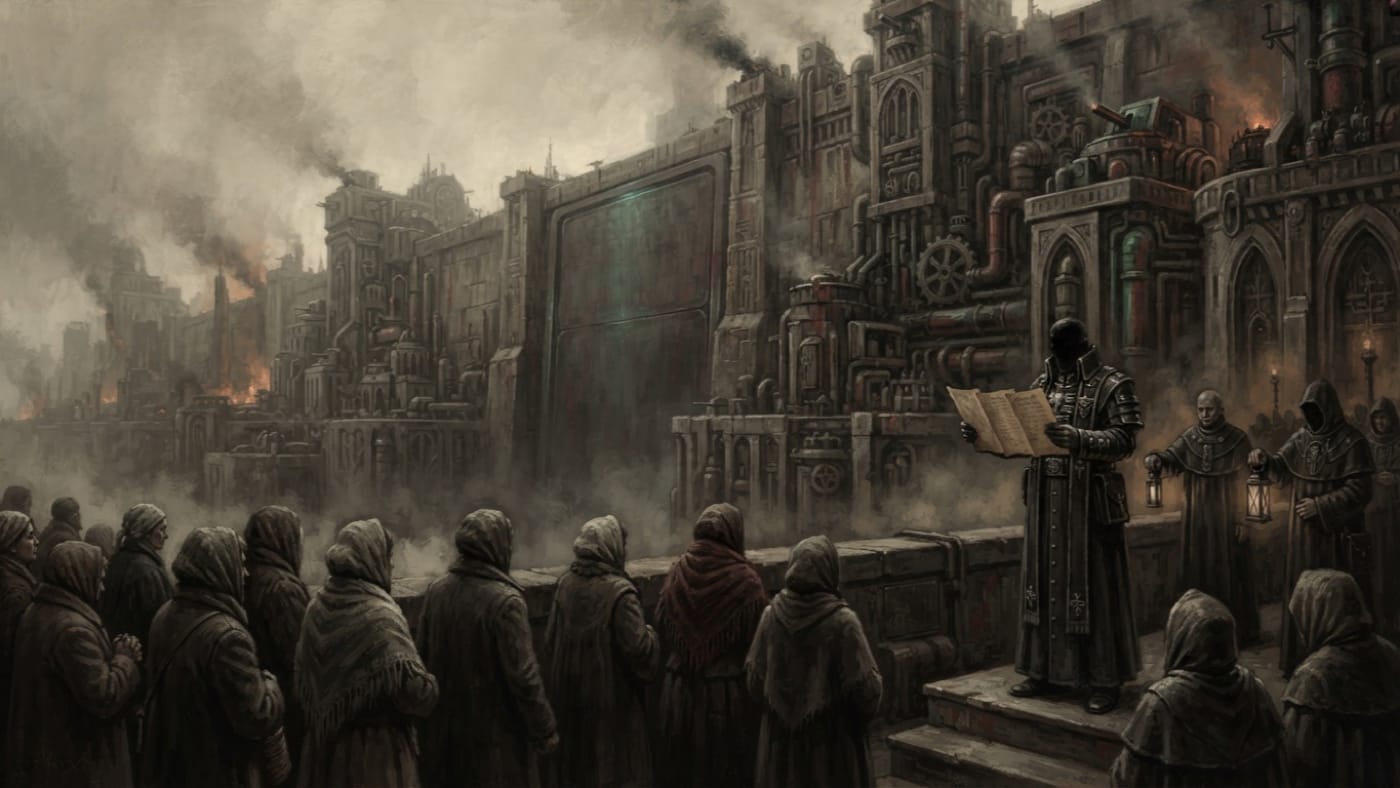
The Vigil falls on the 23rd of Argent, the third of the bastion's pilgrimage days. The Ravelin Chaplaincy leads a procession from the Cathedral of the Perpetual Registry to the Ravelin of Sorrow, the Fifth. Civilian traffic stops there. Pilgrims stand on the Fifth Ravelin's parapet and look across the intervening works toward the southern curtain of the Sixth, the Ravelin of Correction. On a clear day they can see the sealed section: a stretch of wall slightly darker than its neighbours, slightly smoother, with a faint sheen. They do not enter Chamber 7. They do not touch the wall.
The garrison choir sings the Antiphon of Endurance in full, all thirty-two verses. Pilgrims who know the words join in. The rest stand silent. The choir then reaches the twenty-seventh verse and sings past it, and the thirtieth, and goes on to the end in many voices, which is more than the hymn had the first time.
Then the Chaplain opens the three pages and reads.
I watched from that parapet at the Vigil of A.S. 199. The choir finished, and the pilgrims wept through the singing. The Chaplain read, and they wept through the reading. Nobody I could see noticed that the hymn they had just sung was a more complete history than the document read after it. The Bureau of Tithes collected the fees. The Bureau of Pilgrimage sold stamps.
#On the Custody of the Record
Being an account of what is held, and by whom, and under which seal.
Custodia is a word with two edges, and the Bureau of Doctrine has never said which one it meant. The holy custody of the title may be the wall's custody of the Ravelin, or the Bureau's custody of the record. The Ledger shows that the Bureau holds a good deal.
It holds the forty-seven names under the Fourth Ratification. It holds the Bureau of War's dispatch logs and the Bureau of Engineering's deployment schedules for the 22nd and 23rd of Argent, under the same seal. It holds the Night Paper, which should have been read once to a quorum, burned and weighed as ash. In A.S. 194, during a routine filing audit, a copy of it was found in Doctrine's own archives, in a drawer labelled VIGIL — REFERENCE COPY, in a hand Records attributes to no known clerk. I have asked whether anyone knew the frame would be needed before the wall came down. The question is stamped RECEIVED and nothing else. The sealed logs are the only documents that could answer it, and I have not been shown them.
The Bureau also holds the language for Chamber 7. Seven words are permitted: wall, cement, structure, strong, faith, sealed, appropriate.
On my authorised inspections, which have nothing to do with pilgrim access, I have put my palm to the sealed section. It was warm. It hummed, low enough that I felt it in the sternum before I heard it. Engineering attributes the warmth to residual exothermic curing. Its Structural Analysis Report 7-C/170-Ravelin-6, filed in A.S. 171, finds the section above specification and credits relic-calcium bonding. The Bureau of Rites credits faith. Doctrine has ruled that the two explanations are equivalent, which spares both Bureaus the trouble of being wrong.
The account mentions no warmth, no hum, no sheen and no gallery. It says the Wall endures. Thirty-one years later the wall endures. On that one point the account and the masonry agree.
#Determination
Entered in the Ledger by the Warden of the Sacred Ledger.
The Miraculum Septimum is what it says it is: Doctrine's account, three pages long, filed in A.S. 170 and read every year at the Ravelin of Sorrow once the Antiphon is finished. I have recorded its assertions as assertions. I have recorded its omissions as omissions. I have recorded the custody of everything else as custody.
The wall is strong. Faith sealed it. Both of those sentences use approved vocabulary.