
#On the Numbered House
Mill Seven was a building in the Foundry Quarter of Bastion-Constantinople, the southern anchor of the Sagittal Line, where the Bosphorus keeps the Synod's iron economy wet and the Thracian Plain keeps it frightened. That much is plain. Very little else about it is.
The surviving accounts establish furnaces, at least three of them. They establish a boiler gallery, with a night-watch and a bank of pressure gauges under glass. They establish a west wall laid in mortar courses, a roof, and a slag gutter below the furnace mouths. Every one of these details was set down because it broke. The record does not give the mill's founding year, its builder, its owner, its product, its floor dimensions, or the roll of men who worked it. Clerks recorded the hinges of the Foundry Quarter with devotion. Nobody, it seems, thought to record what this house was for.
The temptation, which I decline with visible effort, is to supply a purpose from the neighbourhood. The Quarter held powder mills, shell presses, proof ranges, carrier yards and the Shackled Flame workshops. A building with furnaces in such company could have served any of them. Calling it a powder mill would make a tidier article. It would also be a forgery, and I keep a professional distance from other men's forgeries and an intimate one from my own.
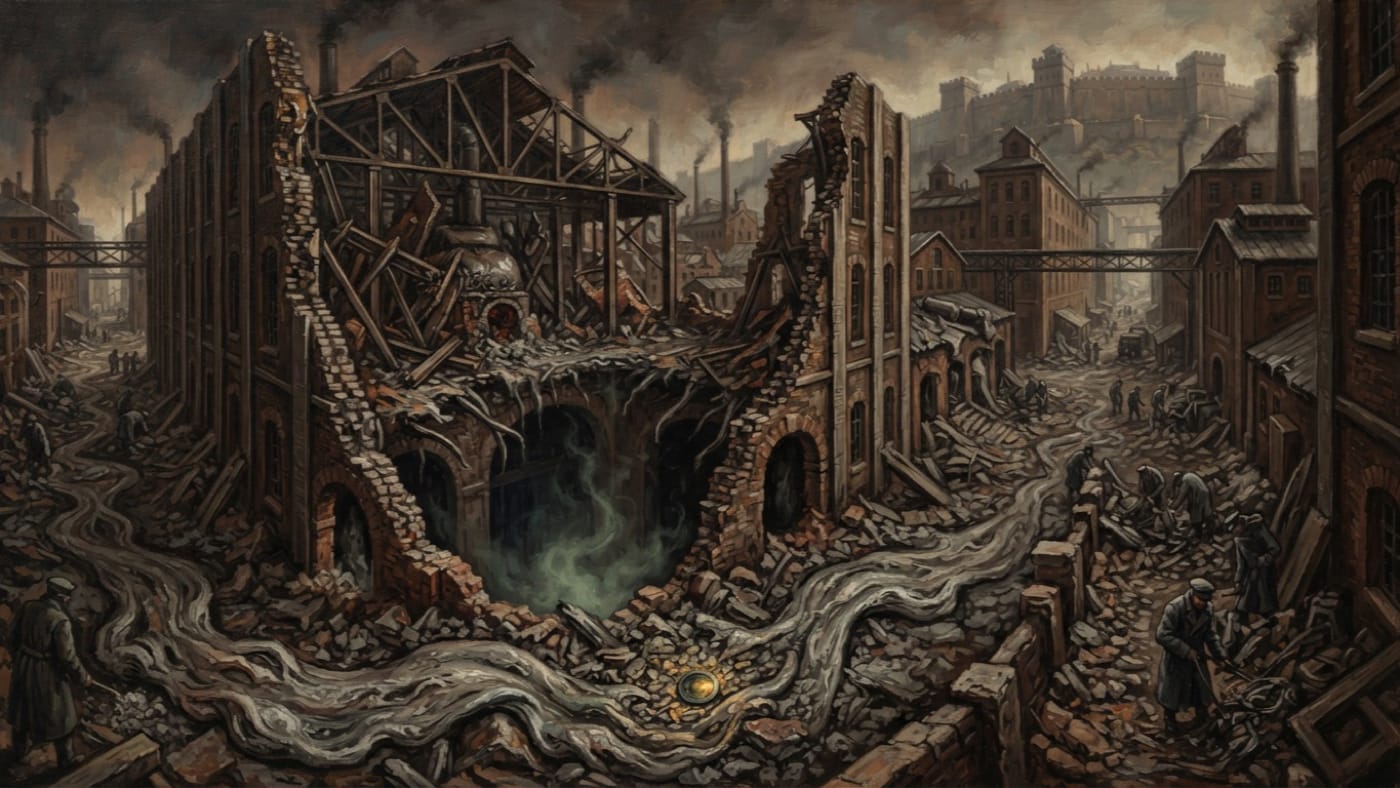
Mill Seven matters for two entries in its file and nothing else on record. The Three-Night Bombard began beneath it. The Screaming Coin was first reliably found beneath it. Between those two entries lies a hole.
#On the Boiler Plate
The Bombard came into the city as freight.
Three corrupted shipments preceded it, each with its own route and its own lie. The first passed through Gate of Correction declared as Rite-Grade Lime, Mortuary Use. The third came in devotional crates marked for the Chapel of Saint Vulcan, which no chaplain cared to open. The second came across the water by harbor barge through the Harbor of Chains, declared as boiler plate for Mill Seven.
Boiler plate is the most innocent cargo imaginable. It is heavy, dull, and expected. A mill with a boiler gallery orders it the way a parish orders candles, and a gate clerk who sees it on a manifest sees nothing at all. Whoever chose the declaration understood inspection better than most inspectors do.
What the declaration proves is narrow. A consignment was routed to Mill Seven's name. The record does not say what the crates held when they were finally opened, whether they reached any particular room, or whether the first charge came from this barge, the lime, or the chapel crates. A routing line puts a building's name on a delivery. It does not put a bomb under the floor.
The method behind all three routes belongs to Velmora, and it was dull, which is why it worked. Her agents bought small failures from people with debts: a shortened inspection here, an acceptance of late cargo there, a signature in the wrong margin from a watchman whose son's apprenticeship fee had vanished from the ledger. Six suppliers shared creditor marks under six different guild-names. By the time the Ordeal clerks matched the marks, the powder had already gone out through seven sheds.
Nothing in the file says that every man who handled the Mill Seven consignment knew what he was handling. Some were bought. Some were in arrears. Some were simply tired at the end of a shift. The Bureau prefers one category for all of them, because one category fits more easily on a placard.
#On the Fourth Quarter Before Matins
The first explosion of the Three-Night Bombard sounded at the fourth quarter before Matins, beneath Mill Seven.
Witnesses compared it to a bell struck underground. The floor rose. The roof came down. The west wall opened along its mortar lines as neatly as a ledger along its gutter-stitch, and three furnaces emptied sideways into the slag gutter, which received more than it had been cut to carry.
The night-watch in the boiler gallery gave the strangest testimony. At the moment of the blast, they said, every pressure gauge turned inward, faces pressed against their glass, needles bending toward a number no instrument had been made to display. That is their testimony, attributed to them and preserved as they gave it. Engineering has never explained it, and Doctrine has never certified anything living inside the dials. I report what the watch saw and I decline to tell them what they saw.
The Quarter then came apart in sequence, and Mill Seven, having opened the proceedings, left the narrative. The cartridge hall went second. The proof range went third. The western sheds were gone by dawn. On the second night the eastern magazine detonated rack by rack at nine-second intervals, an arithmetic the Bureau of War found deliberate. While the alarms still rang, Maldrake's forward batteries opened from the Thracian Plain against the northern ravelins. That shelling was opportunism. The record does not show a joint command, an agreed campaign, or any correspondence between Greed and Wrath. Wrath saw a fire and fired into it.
On the third night the main magazine went down into the earth beneath the Shackled Flame Workshops, and at dawn nothing large enough to explode remained within reach. The Bombard file disposes of the building in four words: Mill Seven was a hole.
The public count for the whole catastrophe stands at two thousand, one hundred and twelve dead or missing. That figure covers the Quarter, the harbor wall, the rescue crews, and the second night's dead who came to dig out the first night's. No count is established for Mill Seven alone. Anyone who offers one has divided a total he was not given by a number he invented.
#On the Sweeper and the Gutter
Weeks after the Bombard, how many weeks the record does not say, a furnace-sweeper named Orek Marr worked the slag gutter beneath Mill Seven.
The gutter was a channel of fused waste by then: furnace discharge, mortar, glass, iron, and whatever else three furnaces had poured into it sideways. In it Marr found a small round piece of metal that was cool. Everything around it was fused. He put it in his boot.
I have mocked that choice elsewhere, and on reflection I withdraw the tone. A sweeper's boot is the one place in a ruin he can be sure of. A man who has spent weeks lifting slag for emergency wages does not hand a curiosity to a foreman who will claim it, or to a clerk who will fine him for removing salvage. He keeps it close.
Two days later Marr died under a furnace door whose hinges had been inspected that morning and certified sound. The account does not say where that door hung, and I will not hang it for them. His death proves nothing about whether Mill Seven had resumed work, and it should not be used to.
The coin was recovered from his mouth. The public accident report omits that detail. I enter it because a man's death should be filed with all its facts, including the ones the report preferred to leave out.
What Marr found was the first reliable record of the object, which is all that recovery can establish. The gutter did not certify its maker, its age, or its cause, and the file draws no line between the coin and the charges that opened the floor. The Bureau of Purity classifies it as a Class IV Unresolved Anomaly, and Purity has withdrawn its earlier grouping of the coin's dead under ordinary Greed contamination. An object found in the wreckage of Velmora's attack is not thereby Velmora's object. The rest of the coin's career, from the mint trials to the returns after destruction to the twenty-three dead, belongs to its own entry.
Summary language attached to the Bombard file states that Velmora's infiltration "birthed the Screaming Coin."
Withdrawn. The Bombard produced a ruin, and a sweeper found the coin in that ruin weeks later. The account supports a recovery site and a first record. It does not support a birth, a mother, or a midwife.
#On What Was Certified
Reconstruction of the Foundry Quarter was certified complete in A.S. 179 / 1889 CE. Four certifications exist. As the Bombard file summarises them, they cover the shell presses, the Carrier Yard, the doctrinal cleanliness of the Shackled Flame Workshops, and the Quarter's return to pre-Bombard capacity. The lower workshops went two levels deeper during the work, and none of the four certificates mentioned it.
As summarised, none of them names Mill Seven.
A district can be certified while a building inside it goes unrecorded, and the Quarter manages it with ease. Whether Mill Seven was rebuilt under its old number, rebuilt under a new one, cleared, filled, or left as a pit is not established in any account I hold. The Bureau of Records has the restored Quarter on file. It does not have Mill Seven's later condition. Later Foundry history belongs to other entries: Arch-Artificer Lute Brann's appointment in A.S. 189, and the Shackled Flame Incident of A.S. 198 in the lower works. Neither touches this site's A.S. 177 record, and I will not let a later disaster wander back into an earlier one for the sake of a better story.
There is one further report. Foundry men say that somewhere beneath Mill Seven they hear a coin strike stone, then another, then another, like someone counting. It is workers' testimony and goes in under their names. It does not establish a second coin, a vault, a living mill, or the present whereabouts of the first coin.