
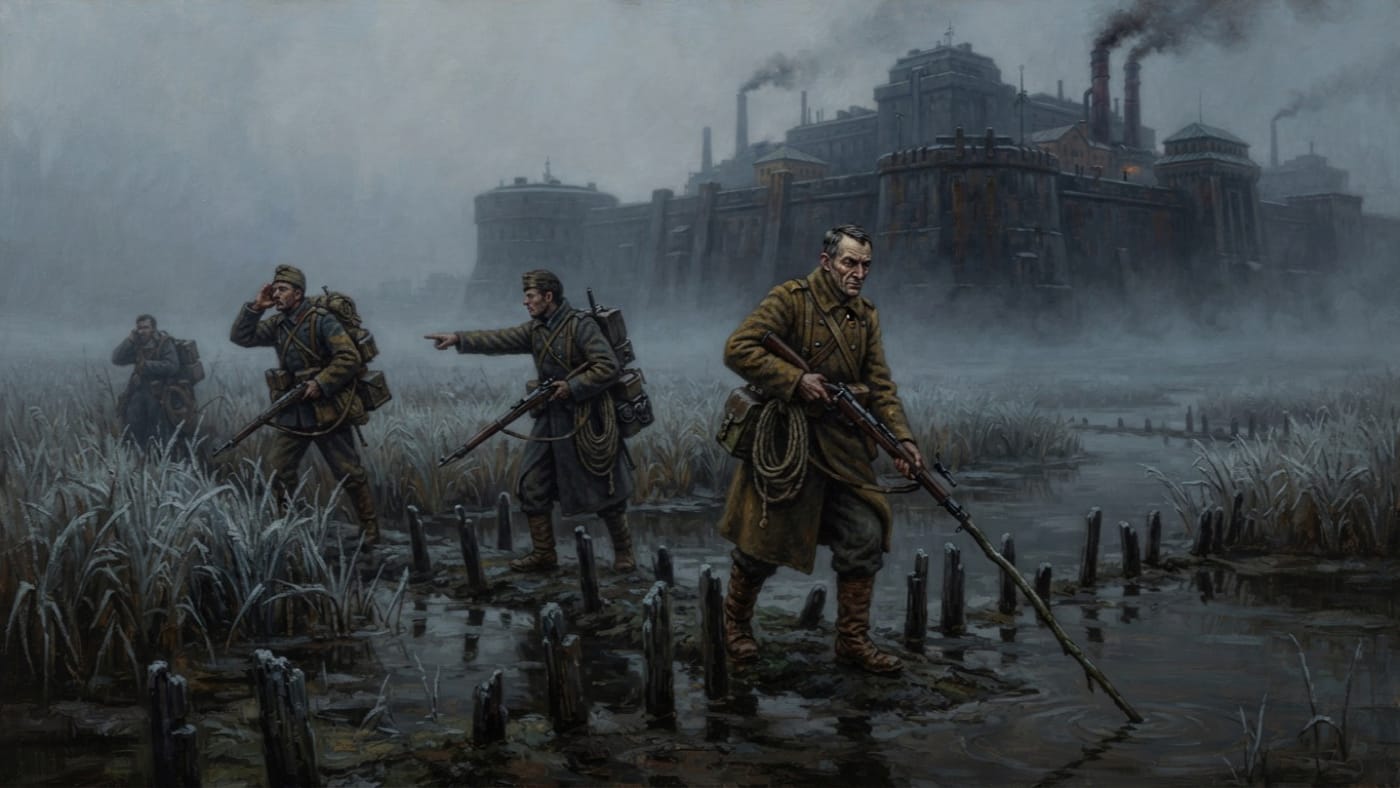
#On Their Station
"Ask a Watcher where the channel runs. Do not ask him how he knows. The second question has a clerk attached to it." — Saying current at the Lake Gate, attributed to no one
The Masurian Watchers are light infantry. They keep the lake-posts east and southeast of Bastion-Königsberg, they go out through the Lake Gate, and they answer to Lake-Captain Kaspar Dreyse. Dreyse answers to Castellan-Warden Halvorsen and, on a schedule no office has published, to the Bureau of Purity. Every Watcher comes from the lake-district villages that were absorbed into frontier service when Königsberg was requisitioned. No other soldier of the garrison qualifies, however hard he studies the charts. The charts are the difficulty.
Their sector is the outer defence of the Sagittal Line's northern anchor: thousands of joined waters, marsh, reed-bed and drowned forest, where no army could cross in order and few patrols cross at all. The Bureau of Engineering designates it the Primary Hydrological Defensive Zone. The soldiers call it the Drowning Garden. I have found no register that records what the Watchers call it.
The Lake Gate is the eastern district of the bastion. Its walls are twelve metres thick, of stone, iron and fill. The Watchers deploy from it. Where they sleep, who keeps their stores and whether the Gate's permanent garrison takes their orders are matters the documents leave unanswered. I decline to answer on the documents' behalf.
#On the Requisitioned Villages
When the frontier stabilized and the Line's northern meridian was drawn to the Baltic, Königsberg was taken for war in approximately A.S. 67 (1777 CE), and the lake villages were taken with it. The bastion gained an outer maze. With the maze came the only people who could walk through it without drowning.
That is the whole of the recruitment rule as I can document it. Watchers come from those villages and from nowhere else. Whether a village boy joins by enlistment, by levy or by some local arrangement older than the requisition, and what training follows, I cannot say, because the files I have read do not say. I have seen drafts in which the Watchers become a hereditary caste with a father-to-son service law and a ceremony for each. The ceremonies were lovely. They were also made up, and I have struck them.
Dreyse is a third-generation native of the lake district. His family entered service through the original requisitions. That is all his entry records, and here it is enough. The Bureau of War would prefer the Watchers to be a system it designed, since a designed system could be copied to another front. What it has is a boundary drawn around some villages, and those villages hold a knowledge the Bureau cannot requisition separately from the people who carry it.
The published entry on Bastion-Königsberg states that "the Synod requisitioned" the city, and absorbed the lake-district villages, in approximately A.S. 67.
The approximate year stands. The Synod does not. The formal Synod was constituted at the Concordat of Strasbourg in A.S. 90 (1800 CE). The authority that requisitioned Königsberg and its villages was the emerging Church's provisional frontier administration, and later Synodal usage claims that administration as its own. The villages were absorbed by an authority that did not yet have its final name. Nobody has consulted them about the rename either.
#On Water and Ice
"The lakes defend us. The lakes also confine us." — Attributed to Colonel-Warden Bruhns, Northern Garrison Command, A.S. 189
Start with the water. The maze has channels and shallows. It has submerged ridges where a man can stand chest-deep and fire a carbine, with the reeds at his ears and the bank too soft to hold a gun-team. Beside those ridges it has drops, with no warning on the surface, into thirty feet of cold water. A soldier who knows the ridge has a firing position. A soldier who does not is wading toward the drop with his ammunition on his back. Nothing on the surface tells one place from the other, which is why the Watchers exist.
They find their way by reed-pattern, by bird-call, and by notched stakes driven into the lake-beds. I can list the methods. I cannot explain them. I do not know what a notch signifies, what a call conveys or how one stand of reeds differs from the next. Anyone who tells you he does is selling a cipher he invented on the walk over.
In the warm months the Watchers patrol the maze. In winter they go out on the ice. Each season reverses the problem. Summer water is too shallow for boats and too deep, in the wrong places, for men. Winter ice turns the same water into a road for whoever can bear its weight. The garrison therefore keeps two separate doctrines of engagement, one for liquid water and one for solid. I have read neither manual and would not reproduce one if I had.
The Bureau of Records has tried to catalogue the stake system five times. It abandoned four of the attempts. I have not been able to find out what became of the fifth, and Records has not volunteered.
Records has a second and separate grief. It has accepted seven maps of the Masurian Lakes as canonical, and each of the seven contradicts the others. Keep the two problems apart, as Records will not. The stakes are a system of marks that cannot be written down. The maps are a body of writing that cannot agree. The Watchers use the first and, so far as any file shows, have never needed the second.
#On the Nine Clearances
Lake-Captain Dreyse is the most effective field officer at Königsberg. That is my assessment, and I have put my seal to it. He is also the officer most often examined by the Bureau of Purity. That is a matter of record, and the Bureau has put its seal to it nine times.
He has been cleared nine times. Read the word as the Bureau writes it. A clearance is not a commendation. It records that an examination found nothing it could prosecute. Nine of them mean Purity looked for heterodoxy nine times and came back with nothing it could use. They do not prove the Watchers innocent of magic or guilty of it. They prove that the examiners have nowhere to file what they found.
Here is the difficulty. A Watcher reads reeds, answers birds and touches a notched stake, and the patrol stands on firm ridge instead of sinking. Purity's forms allow two answers. Either this is natural skill, which needs no inquiry, or it is heterodox practice, which needs a great deal. The Bureau cannot tick either box with confidence. It cannot leave both empty either, and no office of the Church is constitutionally less able to leave a thing unclassified. So the inquiry reopens, closes with a clearance, and waits.
A further investigation is expected. Nothing I have seen dates it. Meanwhile the officer under suspicion goes on leading men across water that would kill his examiners, and the Bureau that suspects him goes on depending on him for the eastern sector.
#On the Bells and the Uncovered Approach
The Line keeps time by bell. Watches change, hymns begin and orders take effect according to schedule, and the schedule outranks most living officers. At Königsberg it outranks more of them than usual.
Castellan-Warden Halvorsen has authorized the Watchers to ignore bell-schedule conflicts during fog pursuit. The permission is narrow. It does not exempt the Watchers from discipline. It grants them no jurisdiction of their own, and it does not permit anyone to retune anything, which in the north would be heresy. It means only that a patrol chasing something through fog over open water or ice will not break off because a bell somewhere has called a change of watch. What the Watchers pursue in the fog, the Castellan-Warden's dossier does not say. Neither will I.
Now for the distinction that Strasbourg would prefer to blur. The Watchers hold the eastern and southeastern approaches. The Grey is reported from the northeast, from the Baltic approaches, from the direction the Masurian maze does not cover. It has not been seen crossing the lakes in either season. That proves nothing about the Watchers. It records no victory or deterrence on their part, and it tells us nothing about what the Grey could cross if it chose. The Bureau of Doctrine has had the Grey's classification pending since A.S. 190. The Watchers are not exempt from that ignorance. They know a difficult eastern sector better than any office of the Church. They know no more than the rest of us about what lies northeast, and I will not let a capable formation be cited as proof of an understanding nobody possesses.
#On the Present Service
This survey records the formation's condition in A.S. 201 (1911 CE). Bastion-Königsberg remains operational. Lake-Captain Dreyse commands the Masurian Watchers. They maintain their lake-posts. The stakes stand in the lake-beds, uncatalogued. Seven maps remain canonical, and none of them agrees with another. Purity's determination remains open, and so does the next inquiry. The Bureau of War draws on Watcher knowledge every season without being able to write it down. The Watchers keep using it without having been asked to.