
#On the Masurian Approaches
"The lakes defend us. The lakes also confine us. The Bureau sees no contradiction." — Attributed to Colonel-Warden Bruhns, Northern Garrison Command, A.S. 189
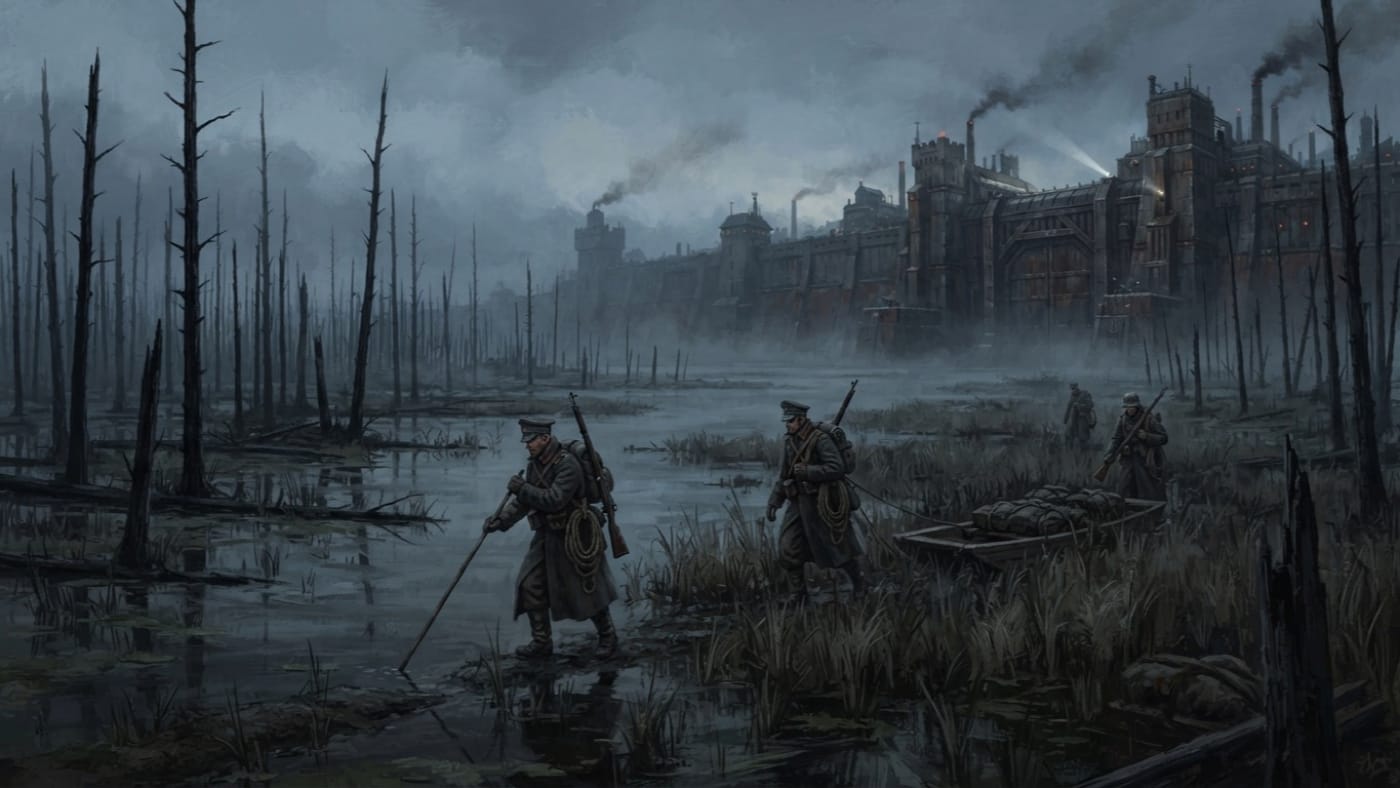
East and southeast of Bastion-Königsberg, the soil of East Prussia stops pretending to be solid. What lies there is the Masurian Lake District. It holds thousands of connected waters with marsh between them, reed-beds thick enough to hide a company, channels that wander like a deacon walking home after a long Vespers, and stands of drowned forest. Those trunks rise black and branchless from the water, a congregation that died on its feet. The older surveys call the district the Masurian Lake Maze. The Bureau of Engineering calls it the Primary Hydrological Defensive Zone. The soldiers call it the Drowning Garden. All three names cover the same wet country, and the garrison uses whichever one the weather has earned.
On the chart of the Sagittal Line, Masuria is the first link of the natural spine. After the lakes come the Bug lowlands, then the Carpathian passes, and so on south for two thousand miles to the Bosphorus. Königsberg holds the Baltic end. Masuria is water and holds nothing, so it is no bastion. It is a moat the Creator dug long before any clerk thought to requisition it, and it was old when the Line was drawn.
#On Water and Ice
Summer comes first because summer kills more quietly. Water, mud, reed, sunken timber and a depth that follows no rule work together to break any formation larger than a file. The Watchers know submerged ridges where a man can stand chest-deep and fire a carbine across open water, with the lake itself for his parapet. One pace past such a ridge, the bottom may drop to thirty feet with no warning at all. A column cannot keep its dressing in reed. Carts go down to the axle in mud that looked like meadow from the saddle. Artillery does not go anywhere. The district is shallow in one place and deep in the next, and it is honest about neither.
Winter turns the sermon around. Ice closes over the channels, and in places the maze becomes a road. Light troops can walk where boats could not pass. A patrol that had to wind for hours in August can go straight in January. A garrison that spent the summer trusting the water to slow an enemy must spend the winter suspecting the ice of carrying one. And ice that looks sound is a liar's oath. Reed-edges rot it and currents thin it from below, while the drowned trees keep their own counsel under the surface. A sheet that carries a Watcher may refuse a sledge, and it may refuse a gun-team with real enthusiasm.
So the garrison keeps two doctrines of engagement, one for liquid water and one for frozen. The Bureau of War calls this a stimulating exercise in seasonal planning, and it does its stimulating from a heated office some hundreds of miles from the nearest reed. Between the two doctrines come the weeks of freeze and thaw, when the water is neither road nor moat. Neither doctrine has a satisfactory paragraph for those weeks.
#On the Masurian Watchers
The Masurian Watchers are light infantry. They are recruited only from the lake-district villages that were taken into service when Königsberg was requisitioned, and the rule has no exceptions. They man the lake-posts and they march out through the Lake Gate. They find their way by reed-pattern, bird-call and smell, and by notched stakes driven into the lake-beds at points they do not publish. What the notches mean is known to the Watchers. The Bureau of Records does not know. The knowledge passes down through families the way a parish passes down its psalter, by use, with the cover worn off.
Lake-Captain Kaspar Dreyse commands them. He is a third-generation native of the district, and his family entered service through the village requisitions. In my judgment he is the most effective field officer at Königsberg. He is also the officer the Bureau of Purity investigates most often, and the reason is simple. Purity cannot decide whether the Watchers' methods are ordinary skill or heterodox practice. It has two drawers for such things, and the Watchers fit neither, and Purity has never in its history tolerated a document without a drawer.
It has cleared him nine times. Each clearance is a full clearance, sealed and countersigned. None of them is a finding. The inquiry ends, the file goes back to its shelf, and in time the shelf gets restless.
The Church is in an awkward position here, and the awkwardness is administrative rather than spiritual. The eastern flank of the northern anchor relies on knowledge that the Church has never written down, could not write down if it tried, and examines every few years in case it has turned into sin since the last look. The Watchers keep going out regardless. The ice does not wait for Purity to finish deliberating.
#On the Charts and the Lake Gate
The Masurian Lakes have been mapped seven times. The seven maps contradict one another, and Records has accepted all seven as canonical. One explanation is clerical incompetence of a high order. The other is that the lakes do not stay still. I suspect the second. I would much prefer the first. Nothing in the file establishes either one, and I record the suspicion as mine alone.
The stakes have done no better under scrutiny. Records has tried to catalogue the notched-stake system five times and has abandoned four of those attempts. The file does not say what became of the fifth. Patrol charts are restricted to Bureau of War custody, which means the most closely guarded maps in the north are the ones most likely to be wrong.
The Watchers set out from the Lake Gate, the eastern district of the bastion, which faces the Masurian approaches. It is heavily fortified and permanently garrisoned. Its walls are twelve metres of stone, iron and fill, the thickest on the bastion. No recorded attack on Königsberg has ever come from that direction. Engineering built for the threat that made sense on paper, and the Lake Gate is the result: the strongest door in the north, opening onto reeds.
The Codex entry for Bastion-Königsberg states that "the Synod requisitioned" the city "approximately A.S. 67," and that the Watchers' villages were absorbed by the Synod.
Corrected. The requisition of approximately A.S. 67, the villages included, was carried out by the emerging Church's provisional frontier administration while the Line was still defensible but incomplete. The formal Synod dates from the Concordat of Strasbourg in A.S. 90 (1800 CE). Calling the earlier authority by the later name is a retrospective courtesy, and the Ledger now marks it as one.
#On the Uncovered Approach
The maze covers the east and the southeast. The Grey comes from the northeast, along the Baltic approaches, from the one direction the lakes do not guard. The Bureau of War's Northern Theater assessment has carried it as Unknown Forces, Extradoctrinal Classification Pending since A.S. 190. It has stayed pending ever since. On the question of where the Grey came from, what it is, and how it relates to anything else in the northern files, the Codex has nothing to add, and it will add nothing it cannot seal.
As far as the record shows, the Grey has never been seen crossing the lakes, in summer or in winter. Some at Königsberg take comfort from this. I do not. A thing that has not been observed crossing has only been observed to be absent, and a sentry's eyes are the only gauge the district has. If the Grey ever passed through the Drowning Garden without being seen in transit, the lake-posts would have no record of it, and neither would the Watchers or the seven maps. The absence proves no immunity and claims no victory. It is a limit on what anyone has seen, and in the north such limits get mistaken for walls.
This leaves the district facing one way while the danger arrives from another. The lakes still matter. A flank that no army can cross in good order is a flank the garrison need not man with regiments, and the regiments it saves go to the Sea Wall. Masuria pays for itself in troops it never has to garrison.
#On the Present Condition
The A.S. 201 assessment of the bastion records that it holds. The Masurian Watchers maintain their lake-posts. They go out through the Lake Gate by the water doctrine in summer and by the ice doctrine in winter, and they come back with reports Records files and does not fully understand. Lake-Captain Dreyse stays in command, between clearances. The seven maps stay canonical. The fifth stake-catalogue stays wherever the file left it.
The Bureau of War lists the district as favourable defensive terrain. The phrase is accurate for any enemy that marches. The garrison, which has to wade through it, puts it differently.