
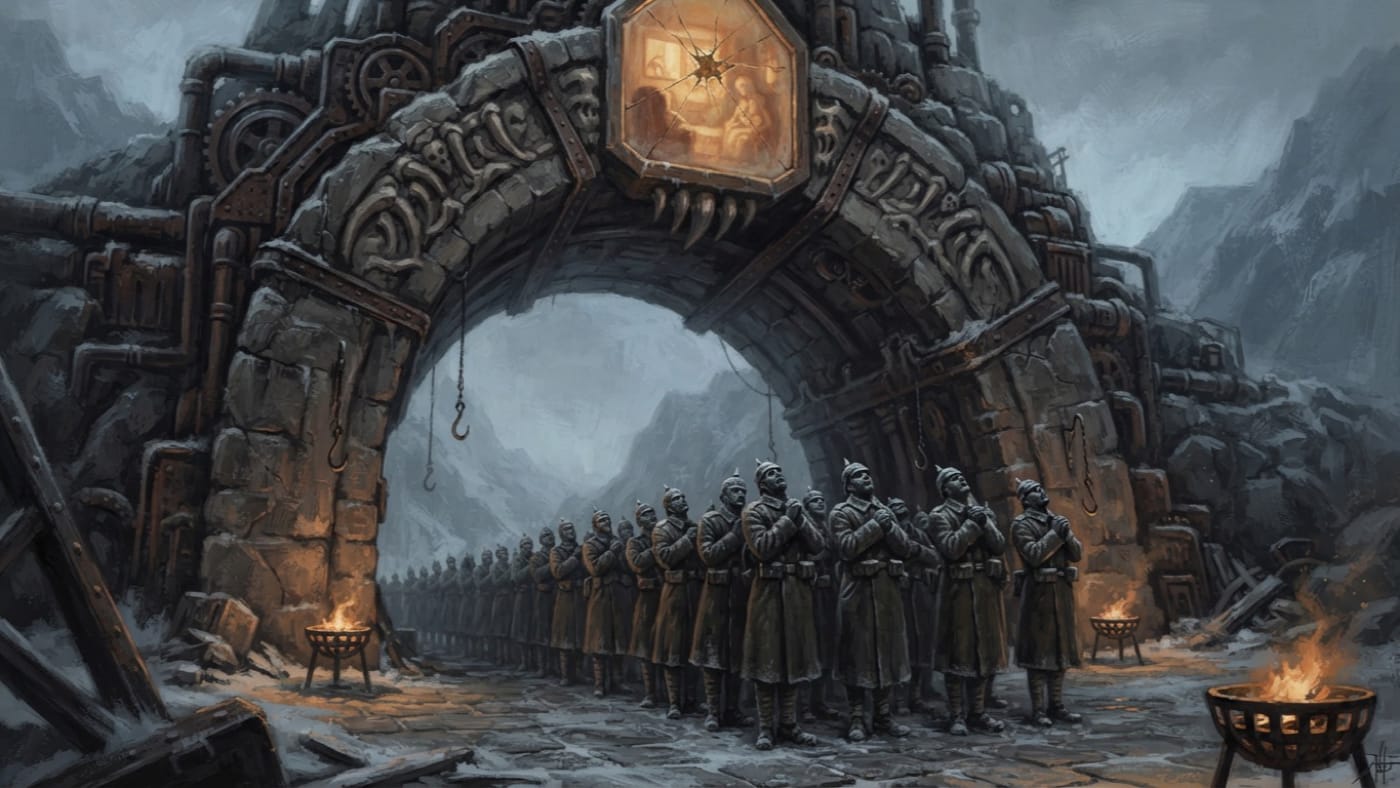
#On the Surviving Account
This is a survey of A.S. 201. It draws on what the public pamphlets admit and what the restricted folios have not yet managed to lose. Its subject is a single night beneath the Arch of Saint Harrowglass, in the Carpathian approaches of the Sagittal Line, and that night goes by two names. The barracks call it the Massacre Beneath the Span. The comparative folios file it as the Massacre of Harrowglass Arch. There was one catastrophe and there are two spellings. The Bureau of Records would prefer three, so that one could be lost without consequence.
The year is withheld. The public pamphlets leave it out on purpose. The private copies disagree by office, because each copyist dated the night to suit the desk that paid for his ink. This survey assigns no year. It records the loss, the findings, the testimony and the classifications, in that order, which is also the order in which the Church grew comfortable with each.
#On the Halt
A levy company came up the approach of the Carpathian Gates and halted beneath the central span for bell-count. Its strength is not recorded. Every surviving copy uses the word company and none gives a numeral. This survey declines to make one up, because a clerk who invents a headcount for the dead has only found a new way to lose them.
The current passage manuals argue over whether bell-count belongs before entry or beneath the curve. The account of that night puts the halt under the span. The argument can be left to the men who write manuals, since none of them was there either.
Two statements survive from the halt. An officer demanded accelerated passage. A quartermaster declared the wind "only weather." Neither man is named, and no regiment or home parish is given. Later sermons have read the officer's demand as the first sound of cowardice, which is a remarkable feat of hearing across an unrecorded number of years. An officer may want his men out of a skull-built throat at night for reasons any confessor would bless. The quartermaster's verdict on the wind has been read as negligence, as innocence and as prophecy, according to the reader's desk.
Then came the night. Nothing of it survives from inside the span.
At dawn the men beneath the Arch stood upright and blackened, with their palms pressed together. The posture looks like prayer, and the record says so and stops there. It does not say whether the last order given was prayer, whether any order was given at all, or whether freezing men fold their hands for the Creator or for warmth. I have read the folios with the patience of a man paid by the hour, and they do not say.
#On the Silence and the Bodies
The Arch did not ring.
Every column that passes beneath that skullwork is taught to fear the hollow ring, the dull knock through bone by which the Arch is said to name a coward. On the night an entire company died in its mouth, the Arch said nothing. The Arch-Warden's platform on the western pier exists so that a man may stand above the span and listen, and it recorded silence. Doctrine has never forgiven the Arch for it.
The Bureau of Purity examined three bodies. Three is the number examined and tells us nothing about the number of dead. Any pamphlet that offers it as a casualty count will be corrected by this office with pleasure. The recorded findings were frost in the lungs, ash beneath the fingernails and no sign of struggle.
Frost in the lungs fits the cold, as most things on that pass do. Ash beneath the fingernails fits nothing else on the list. Blackened skin does not prove fire. Ash does not prove burning. The absence of struggle proves only that whatever came, the men did not fight it, or could not. Purity wrote down what it found and, to its credit, wrote down nothing more.
The Bells tested the surrounding air and found a tone below common hearing. No frequency survives, and neither does the name of whoever did the testing. Nothing in the record connects that tone to the deaths except that the two happened in the same place. Being nearby has sent more innocent men to the pyre in this Church than heresy ever has.
#On the Pane
Above the central span hangs the cracked shrine-glass that the Arch's guide-priests attribute to Saint Harrowglass, Martyr of Ulm. Even on an ordinary day it does not reflect cleanly. On that night, according to one man, it showed something the company turned toward.
The Arch's sealed addendum gives the account to the last man outside the span. He was not under the curve. The addendum does not say whether he belonged to the company, and it calls him nothing else it might later have to defend. What became of him is sealed.
SEALED ADDENDUM — ARCH SCRIBE COPY, AS SURVEYED Account of the last man outside the span: the company turned together before freezing. They turned upward, toward the shrine-glass. The pane showed "a warm room full of our mothers." Further deposition removed by order of █████████. Disposition of witness: █████████████.
A second record exists, and it does not agree. The restricted Gate folio for the Harrowglass span reports domestic interiors in the pane that do not match the company's known home villages. It also reports three faces that matched the mothers of men not assigned to the company. This survey keeps the two records apart, as the Bureaus did. They agree only on the upward turn and on the warmth in the glass, and each record vouches only for its own version. The Gate folio closes with an instruction to maintain motion and not to interpret comfort. No one has yet explained how a man is to obey the second half.
#On the Classification of the Loss
War entered the loss as weather attrition. A company killed by the enemy requires an after-action report, a culprit and frequently a court. A company killed by weather requires a ledger line and a fresh levy. Weather is the Creator's paperwork, and the Creator does not sit for inquiry.
Doctrine named it a zealous freeze. The phrase can mean that the men froze from too much devotion or that the Arch froze them for too little. Doctrine has preached both readings and objected to neither. The phrase spread through sermons and barracks jokes alike, and it fixed the authorised cult of Harrowglass more firmly than any translation of relics had. A massacre nobody can explain can still be put to use.
The two classifications sit side by side in the files. They contradict each other only for someone who reads both, and the Bureaus have arranged their filing so that nobody has to.
The Massacre Beneath the Span proves that the Arch judges cowardice, and that the company was found wanting.
Withdrawn. No surviving copy establishes cowardice in any man of the company, and the Arch did not ring. The Arch's judgement of cowardice remains authorised teaching. This event does not verify it.
#On Passage Afterward
The Bureau answered the dead with furniture. Side braziers were set along the approach. Confession hooks were hung where a man could make his peace without leaving the line. Anti-frost bells went up beneath the span. A rule was written that no column may halt more than nine minutes beneath the central curve without written cause. No surviving copy dates any of these additions or shows that they have saved anyone. They are recorded as having been added, which in the Church counts for most of having worked.
The nine minutes deserve precision. They are an administrative limit and nothing more. The record gives no length for the company's halt, and nobody has tested how long a man can stand under the curve before the cold takes him, so the nine came from neither. A clerk chose it and a seal approved it.
The Arch was not closed. Closing it would have admitted that passing beneath a sanctioned shrine could itself be the danger, and passage is the reason the shrine exists. Columns still halt under the span for bell-count. Men still look upward against instruction. The soldiers still give their recruits advice older than any manual surveyed here: keep moving if the glass shows a warm room.