
#On the Origin of the Commentary
The Bureau of Doctrine issued the Masonry Commentary in A.S. 103, three years after a Hierarch from Trier told a hall of bishops that the walls of their capital listened better than they did. Doctrine arrived late to its own scandal. Exegesis always moves at that pace. A sentence is spoken, the clerks put it to work, the provinces resent it, and only then do the theologians come down the stairs, still wiping their pens, to prove the sentence had been true since the Creation.
The sentence belongs to Hierarch Odo of Trier. At the Council of Cologne in A.S. 100, beneath the vaults of the Cathedral of the Holy Column and during the readings of the Edict of Cologne, a western prelate asked whether the decrees of Strasbourg required provincial confirmation before they bound cathedral chapters. Odo answered him: "When we speak, the stones of Strasbourg listen." In my published account of that council, the prelate withdrew his question and the withdrawal was entered as enthusiasm. I stand by the account. I am less comfortable standing beside the entry.
It was a dangerous question because it was simple. It asked who must answer before a decree binds. Ten years after the Concordat of Strasbourg had made the Synod a formal government, and seven after the Council of Mainz had confirmed the Hierarchs in their Seals, nobody in Cologne could pretend the question was academic. Odo's reply settled it without addressing it. Nobody need answer. The stones had already heard.
#On the Substance, or Three Clauses and a Cudgel
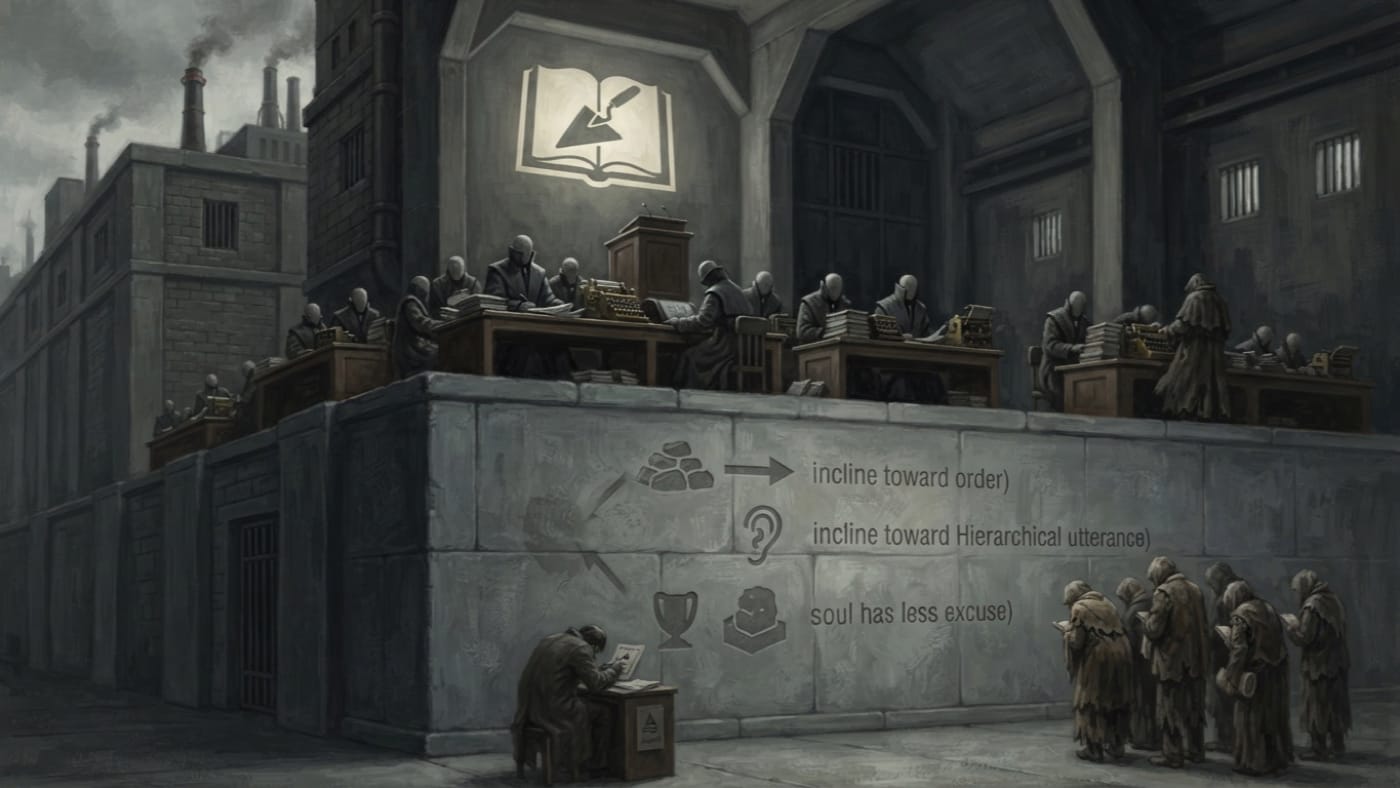
The passage the Bureau permits in citation reads in full:
"Created matter inclines toward order; ordered matter inclines toward Hierarchical utterance; the soul, being higher than stone, has less excuse."
I have read heavier tracts that accomplished less. The argument takes three steps, and each one sets its foot on the step below.
First, created matter inclines toward order. A stone sits where the mason set it. Mortar cures. A wall left alone stays a wall, and Doctrine treats that persistence as a disposition, the Creator's preference written into gravel. The Bureau calls this doctrine, and it does not need to be natural philosophy to be enforced. The Academy may measure the wall's lean, but the Bureau decides what the lean means.
Second, ordered matter inclines toward Hierarchical utterance. Here the wall acquires ears. Whatever has been put in order now faces upward toward the office that speaks. The stones of Strasbourg are the most ordered stones in the Church, squared, consecrated and inspected, and so by the Commentary's reasoning they are the most attentive. Nobody claims to have heard them reply. Their silence is what qualifies them.
Third, and this is the cruel part, the soul, being higher than stone, has less excuse. Every catechism in the Church teaches that the soul outranks the mineral. The Commentary accepts this and sends the bill. Rank used to buy privilege. Under this clause it buys liability. A stone that fails to answer is simply a stone. A parishioner who fails to answer is a stone with fewer excuses and a name the Ledger can spell.
I admire the economy. Nobody has to threaten anyone. The threat lies in how the clauses are arranged, and the reader puts it together himself on the way home.
#On Records, Which Had Already Begun
The order of events matters, so I will set it down plainly. Odo spoke in A.S. 100. Within two years the Bureau of Records had brought his phrase into filing practice. Doctrine's Commentary followed in A.S. 103. The clerks acted first and the theology came after, like a priest arriving to bless a house the bailiffs had already emptied.
The early entries are recorded in my dossier on Odo, and I will not improve them. Unanswered writs were marked stone-assent. Closed parish doors were marked passive concurrence. One monastery, which I leave unnamed because its abbot's successors still pay the consequences, failed to answer a series of letters because, the published account says, its couriers had been eaten by wolves on the road. Records entered the silence as obedience. The wolves were not disciplined. The monastery was taxed.
Read that entry slowly. The monastery did not refuse anything. It simply could not reply. The Ledger records whether a reply arrived and has no column for the reason. Bad roads, a dead courier, a sick prior and a frozen river all produce the same blank, and Records filled the blank with consent.
The Commentary did not invent this. Strasbourg obtained unwilling signatures long before Odo opened his mouth, and Kratzian procedure had been treating objection as participation since before the formal Synod existed. The Commentary's contribution was to give the practice a pulpit. A clerk marking stone-assent before A.S. 103 followed a habit of his office. A clerk marking it afterward performed an act of doctrine, and anyone who complained about him was now quarrelling with Creation.
#On Objection and Authorised Language
The Commentary has an obvious objection waiting for it. A man who answers is not silent. If he writes back and says he does not consent, the formula should fail.
It fails only if the Bureau recognises the answer. The doctrinal application recorded in my dossier states the rule plainly: objection requires authorised language, and unauthorised language returns the petitioner to silence. Doctrine keeps the list of what language is authorised, and Doctrine updates it. A reply in the wrong form is not counted as a reply. In the Ledger it is simply more silence, now with a postage cost.
The rule is elegant, and I helped teach it to provincial seminarians. A bishop who objects in the correct terms has used the Synod's vocabulary, so his objection is entered as participation in Synodal process. A bishop who objects in his own terms has used no recognised language, so he is entered as silent, and silence is assent. I have looked for a third kind of bishop and not found one. The Bureau of Records says there was a rumour of one in the Tagus provinces. It was filed and closed.
The Commentary has also suffered from devout readers who took it literally. Odo's formula was figurative from the start and the Bureau holds it figurative still. Stones are said to listen in the same sense that a ledger is said to remember: the office speaks on their behalf.
A devotional engraving circulated in the Rhine provinces, and was sometimes bound with teaching copies of the Commentary's cited passage, showing Odo of Trier laying his hand upon a speaking stone.
Withdrawn. No speaking stone has been authenticated in relation to Odo. The Commentary claims that matter inclines toward Hierarchical utterance and makes no claim that masonry has ever answered back. Teachers who own the engraving may keep it privately, as a warning about artisans who read too literally.
#On the Present Application
A hundred and one years on, in A.S. 201, the Commentary is still at work. Doctrine supplies the justification and Records makes the entry, and the provinces have long stopped asking which of them came first.
It is cited in rulings on parish submission, where a parish that sends no protest by the stated term is entered as submitted and its silence is read aloud as loyalty. It is cited in sealed succession, where an office whose holder has died or been sealed away cannot object to the arrangements made for it, and the dead are taken to agree. In the published application they are named outright: dead bishops and sealed offices appear beside walls and absent petitioners. It is cited in confessional defaults, where a penitent who does not appear has said nothing, and the Commentary has already taught everyone what nothing means.
The same application names populations under curfew. I have nothing to add to that line. The people are ordered indoors and forbidden to speak in the streets, and the streets are recorded as quiet and content.
None of this needed new law. The Edict of Cologne, Records' filing habits and the Commentary's three clauses were enough. Each new ruling cites the old ones, the old ones cite Odo, and Odo cites nobody, since the stones were his only authority and they have never once disputed his claim.