
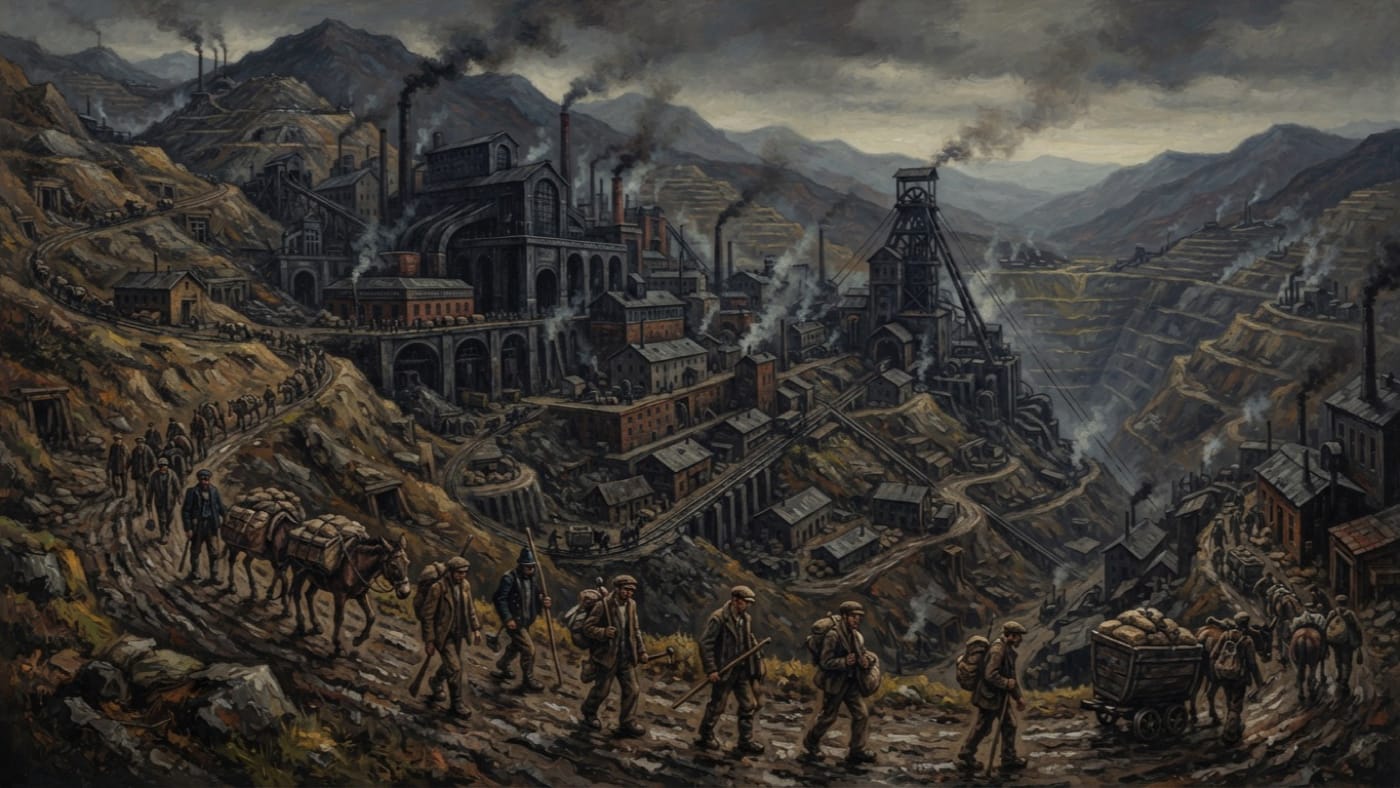
#On the Highland Marches
The Macedonian Highlands mostly appear in this Codex inside other people's sentences. The entry on the Gilded Chasm tears through them. The entry on Velmora lists them as part of her reach. Both entries hurry past toward molten rivers and locked vaults, because molten rivers sell copies. The highlands are left at the side of the road like a mule nobody has paid for.
They deserve a plate of their own. Before they belonged to a Sin-General they were upland country: ridge behind ridge, stony pasture, cold streams, pine on the north faces and scrub on the south. There was ore in the rock and there were people above it who meant to get the ore out. That last clause is most of the history. The Serpent did not have to invent desire in these hills. She found it already shovelled into carts.
I give no boundaries. No office I would trust with a ruler has surveyed any. The honest description is the one the Bureau of Records hates most. The highlands run south of the Transylvanian passes into the old Macedonian ground. They hold the Chasm, or the Chasm's southern reach. They belong to the Greed-held East. No instrument has been permitted to say where they stop.
#On the Old Mines
The hills were worked before the Sundering, and worked hard. The Chasm's own archival tradition records the usual furniture of extraction. There were shafts, adits and mule roads cut into switchbacks. There were claims and counterclaims, concessions held by men who never saw the rock, and settlements that existed only because the rock was there. Miners dug. Carters hauled. Clerks disputed. Somebody always owed somebody else for the lamp oil.
I decline to decorate this with Roman engineers and saintly abbots. The older pages do so freely, and the evidence stops following them after the first paragraph. What can be said is plainer and more useful: a mine is already a contract. The wage is a contract. The company store is a contract in worse handwriting. The claim-stake is a contract hammered into the ground. The highlanders lived inside paper long before anyone wrote in blood.
The difference between that life and the present one is concrete. An ordinary seam runs thin and stops. An ordinary debt can be paid, fled, or forgiven at a funeral. An ordinary shaft goes as deep as men dig it. By the Chasm entry's account, each of those limits failed in the highlands after the Sundering. Each failure was welcomed at first as good luck.
#On Grain and Mine Rights
Famine came first, and it was not hers. After A.S. 45 the blight of Kargath reached the uplands as it reached everywhere east. Fields failed, stores spoiled, animals sickened in the fold, and the soil gave out. Upland country feeds itself badly in a good year. In those years it did not feed itself at all.
Velmora came after the hunger, carrying exactly what the hunger lacked: grain, salt, cloth, and mules to haul them up roads the starving could no longer walk. The provisions were real. I insist on this because the Bureau of Doctrine prefers its demons to deal in illusions, and everyone would be more comfortable if the bread had been made of ash. It was bread. Children ate it and lived.
Then came the terms. As the Chasm entry reports it, the archive later gathered at Sibiu holds fragments showing that by A.S. 50 seven highland communities had pledged mine rights to lenders whose seals matched no mortal house. I repeat the figure as that entry's tradition and cannot improve on it. The pattern behind it needs no archive. Winter grain was lent against the next season's ore, and seed against the season after. Then came a little protection, at interest, against the consequences of the first two loans.
Why did they sign? Because the alternative was a child dead before the thaw. Spare me the sermon on prudence from men who have never pledged anything they could not afford.
Here the Codex must be exact, and older entries have not been. A signature is a choice. So is the next one. The Church holds, and I sign my name under it, that no pact takes a man's will from him, and that every person in those hills could still choose otherwise. What the pact could take was his ore, his road, his tools and his credit. In demon-held ground it could also take his body. Shackled labour exists in the deep workings. Shackled consent exists nowhere. The Serpent would like men to forget the difference, because a man who thinks his will was sold stops bothering to use it.
#On the Country of Extraction
Away from the wound, the highlands still look like highlands, and that is the particular insult. Terraced spoil tips stand on hillsides that once held goats. The old mule roads remain, rutted deeper by heavier carts. Smoke rises from settlements that keep miners' hours: up before light, lamps along the ridge, a bell at shift change. Pack trains move both ways. Ore goes down. Provisions come up, at prices.
The people are still there. Some are debtors still working off a grandmother's winter. Some are clerks and lenders who took up the trade with open eyes and grew comfortable in it. Some, nearer the rim, are held by chain and guard, and they work because the alternative is the gully. I refuse to file all three as cultists. The Hierarchy of Debt would like me to, because it recruits from the confusion.
Toward the Chasm, the rock starts to show what it carries. Gold runs in the cliff faces. Copper greens over abandoned iron. At the margin stand the rim settlements described in the Chasm entry: winch towers, assay sheds, mule yards, barracks, clerks' houses, and kitchens with working chimneys. Every account places the Binding Markets, the Assessment Halls and the Hollow Vaults below them. Below those lies the Vault of Ten Thousand Keys, where, the Ten Thousand Keys teach, every serious compact ends. I have not been down. Those who have make poor witnesses, being either absent or solvent.
The Chasm entry also reports that the wound grows by acquiring property. A district falls into debt, the ground under its counting house warms, and the streets begin to tilt toward the new opening. I record this as a process attested at the Chasm itself. It does not explain every ravine in Macedonia. Some hills are steep because the Creator made them steep.
#On the War Financed There
Ore leaves the highlands. Money turns up somewhere else. What happens in between is the war.
Velmora's front faces Bastion-Sibiu, behind the Transylvanian Alps. That is a great many cold miles from Macedonian ground, and the two must never be confused. She fights Sibiu mainly through its supply economy: bought quartermasters, generous toll-clerks, and ration-chits that appear in hungry pockets. The canonical account places her richest gold-vein operations beneath the Transylvanian Alps themselves. The highlands are one of her purses rather than the purse that buys Sibiu. They are the older purse, though, and their people were the first to learn what relief costs.
What the highlands supply is metal and precedent. The metal passes through lenders and intermediaries until a coin reaching the Sibiu Market Ring has been lawful in a dozen hands. The precedent is subtler. Every winter-grain contract signed in these hills refined her method. Contract Theurgy grew up beside a mountain storehouse with a queue outside it.
The Bureau of Tithes tried to assess the Chasm in A.S. 114 and again in A.S. 180. The first party was paid in full and ruined by the payment. Of the second, one auditor in three came back, and his tongue had been gilded. Neither party attempted the highlands. Nobody had the authority or the map to tax them.
Earlier field digests file the Macedonian Highlands, the Gilded Chasm and the Sibiu sector under a single heading as "the Velmoran gold country."
Corrected. These are three entries. The highlands are a region. The Chasm is a wound associated with that region and its marches. Sibiu is a bastion in the Southern Carpathians and is not in Macedonia, whatever a quartermaster's freight-sheet may claim. The digest's compiler argued that one heading saved paper. It did. It also taught two intakes of cadets that Sibiu stands in Macedonia, and I have had to examine them.
#On the Present Record
As of A.S. 201, the Macedonian Highlands remain within Velmora's domain and outside Synodal administration. This entry is compiled from the archive. No Synodal party has walked the ridges for this file, and I do not pretend otherwise. The documented condition is hostile influence, debt bondage, physical captivity in the deeper workings, and a mineral trade flowing toward her purposes. Population, yield and extent are unrecorded.
The Synod's remedies are its general ones. Assay every coin. Read every contract. Distrust any gift larger than the giver's station. Preach without tiring that a debt to the Serpent binds a man's purse and never his will. At Sibiu these measures succeed in part. In the highlands they have not been tried, since there is nobody to try them on but defectors.
Defectors exist. They come down out of the hills thin and suspicious, carrying their accounts in their heads. At a Synodal post, most of them first ask what they owe for the bread.