
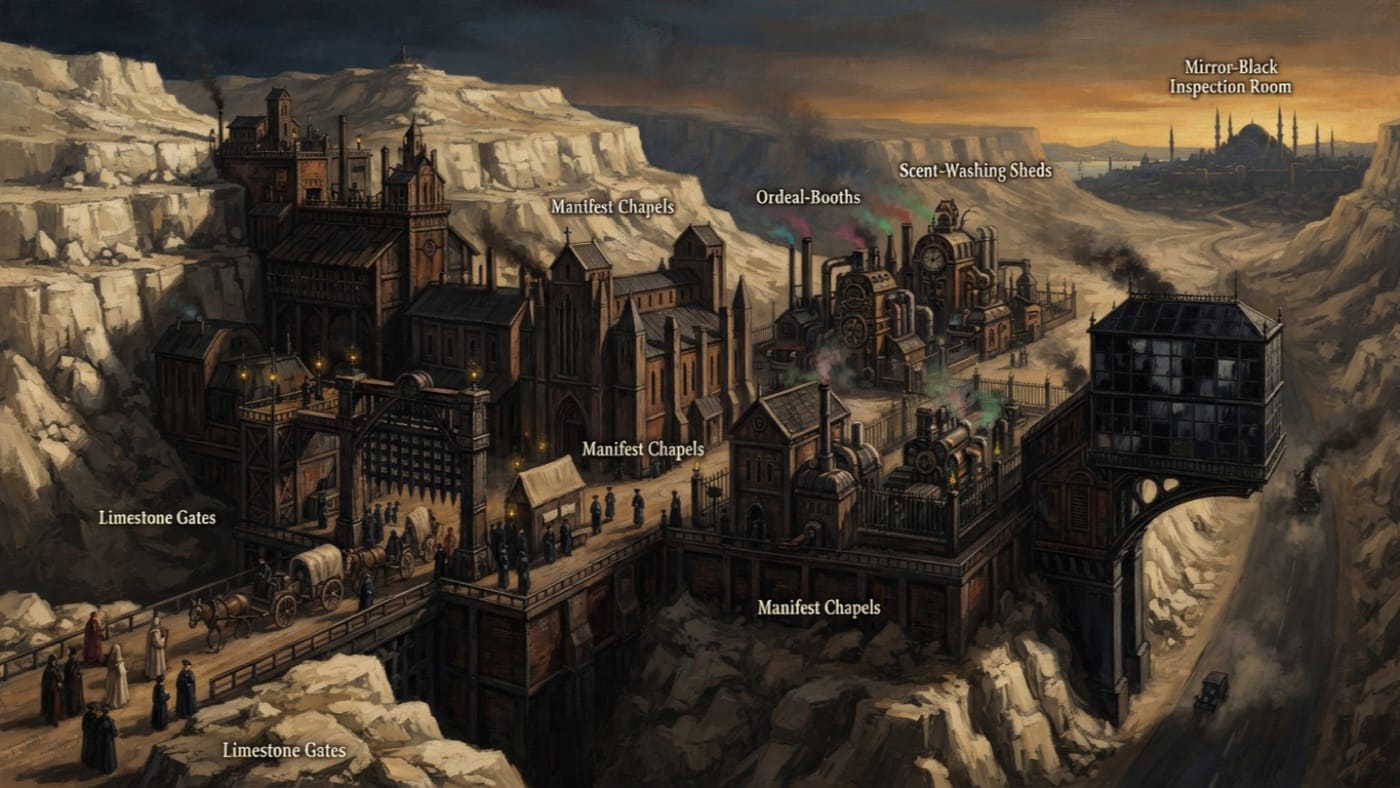
#On the Roads and Gates
Every wagon that leaves the western Escarpment chain for Bastion-Constantinople carries two loads. The first is written on its manifest: sacked grain, surgeons' chests, relic-cases, couriers' satchels, coffers under wax, pilgrims and their credentials. The second is written nowhere and stamped everywhere. It is the assurance that the wagon reaching the Bosphorus is the same wagon that went into the limestone. The first load can be weighed on a scale. The Bureau weighs the second with a pen.
The Macedon Escarpments stand northwest of the bastion. They are broken terraces of pale limestone, split by ravines and seamed with gold veins that catch the low sun and throw it back at unhelpful angles. Estimates go wrong there. Escorts misjudge how far a ravine runs. Two clerks at one toll table will describe the same face differently, and both will sign. The Bureau records these misjudgments and has never recorded their cause. I decline to supply one. Theology that guesses gets quoted, and a quotation is how a careful man ends up in somebody else's errata.
The checkpoints belong to the supply roads of the southern theater and are not part of the wall of the Sagittal Line. They work like a grate across a culvert, and Constantinople, the southern anchor of the Line, drinks whatever comes through. It cannot drink less. Kargath works the Black Sea approaches, where stores rot and convoys sicken. Maldrake keeps Thrace at a simmer to the north. A fortress pressed from two sides lives on what comes up the back stair, and the Escarpment roads are the back stair.
#On Passage and Inspection
The traffic is ordinary, and that is the trouble with it. It consists of caravans, pilgrims, couriers, surgeons, relic-cases, grain wagons and sealed coffers. Each must satisfy the installations of the route, and each installation asks its own question.
The limestone gates ask for route seals. The ravine tolls ask for payment and countersignature. The manifest chapels ask whether the merchant-quartermaster's list agrees with the wagon, and whether the wagon agrees with Doctrine's opinion of wagons. The ordeal-booths put their question to the body, by methods the Ordeal-teams keep to themselves. The scent-washing sheds ask what a man smells of once he has been made to smell of nothing. The mirror-black inspection rooms ask whatever one asks a mirror that has been backed with iron. In A.S. 194 I stood in such a chamber above Checkpoint Seven. I can vouch for the mineral damp sweating out of the walls and for the iron behind the glass. I cannot vouch for what the mirrors think, because nobody has published it.
Legate-Inspector Theron Vast has added three refinements under his own seal. Caravan captains who pass through the pale amber ravines after dusk must now be witnessed twice. Quartermasters must swear affidavits of scent-abstinence, so a man who arrives at the washing sheds perfumed has already perjured himself. The questioning rooms have been fitted with iron-backed glass. No register states the chemistry of the wash, what the mirror returns, or what share of hostile travellers either has ever caught. The procedures are recorded. Their yield is not.
What the apparatus catches is discrepancy: a seal that does not match its register, a manifest one sack too heavy, an oath-record filed in the wrong parish, a driver who will not wash clean. Vast has told me, on the record, that the checkpoints detect discrepancies, and that some substitutions produce none. The Velvet Choir, which Doctrine has long filed beside the name of Velkara, uses these roads when a body must change and its name must stay valid. The Crimson Concord, whose heresy recommends alliance with demons over war on them, uses the same roads to refresh its people. Where a name stays valid, its paper stays correct. A correct paper certifies a name. Nobody has ever asked it to certify that the person carrying the name is the same person, and it could not do so if asked.
CHECKPOINT SEVEN — INCIDENT LOG, A.S. ███ (excerpt) Manifest, escort, pilgrims: cleared. Driver failed scent-wash. Removed. Replacement driver presented baptismal scar, dental irregularity, childhood oath-record: identical. Both drivers detained in separate mirror-black rooms. Sext: both rooms empty. None: no anomaly report filed. Vespers: caravan released under seal.
#On the Legate's Writ
The checkpoints answer to the Bureau of War, and within War they answer to Vast. His writ covers route seals, pilgrim credentials, merchant-quartermaster manifests, escort rotations, the scheduling of Ordeal-teams, and the emergency suspension of passage when a doctrinal hazard is declared.
He began with three gates. A first promotion, undated in every register I have been allowed to read, extended his command to the whole western Escarpment chain. I will not say how many gates that chain now holds. Checkpoint Seven proves that a seventh designation existed. It proves nothing about an eighth. A second promotion, also undated, gave him emergency co-seal over Purity ordeals held in the route chapels. An ordeal at a manifest chapel may now carry a War signature next to the Purity one.
The suspension power is fenced. Vast may halt passage for a doctrinal hazard. He may not close a necessary route on his own authority. That kind of closure goes to War review. "Necessary" is War's word, assessed by War, at War's pace. A Legate-Inspector who suspends passage is exercising his writ. A Legate-Inspector who asks to keep passage suspended is petitioning, and petitions queue.
#On the Proposal of A.S. 187
In A.S. 187 (1897 CE), Vast proposed closing the Macedon supply routes in full, pending doctrinal review of every active manifest. That date belongs to the proposal. The checkpoints have no founding date on record, and I have not invented one. The Bureau may note that restraint in my file.
Consider what the sentence asks. Every manifest then live would be called back into the chapels and read again under Doctrine. Every wagon would wait among the limestone while the reading went on: grain, surgeons, relics, and the sealed coffers whose contents no toll clerk is cleared to know. For as long as the reading lasted, Constantinople would live off its stores, against Kargath's rot and Maldrake's next campaign. No one has estimated how long the reading would take, because no one has been told to.
The proposal went to War. In A.S. 201 it is still under review, fourteen years after filing.
In those fourteen years, War has promoted its author twice. I record the sequence without ornament. The man asked for the roads to be shut. The roads stayed open, and he was given more of them to command. A proposal that War will neither grant nor refuse has become, by sheer duration, part of the furniture of the route: as permanent as the gates and nearly as heavy.
#On the Present Condition
By War's measures, the Escarpment roads are well run. Compared with neighbouring routes, they lose fewer caravans, clear manifests faster and leave fewer credential disputes unresolved. These are comparative claims. I report them as War reports them, without figures, because War has given Doctrine none.
The western Escarpment chain, per Bureau of War commendation: "doctrinally secure."
Narrowed. As War applied it in commending the western chain, "doctrinally secure" covers the custody of manifests, the continuity of seals and the keeping of route-chapel records. It does not extend to any traveller, driver, quartermaster, pilgrim, draught animal or reflection in iron-backed glass. Copyists who carried the phrase from the commendation into descriptions of the route are directed to carry it back.
Performance answers one question: did the cargo arrive, under seal, on its papers? Security answers another: did the people who set out arrive as themselves? The ledgers of the western chain answer the first in good ink. They have no column for the second. The Concord still uses the roads. Nobody has shown that the Choir has stopped. Every cleared caravan remains cleared. Its clearance has never proved it compromised, and never proved it clean.
Through A.S. 201, the Bureau of Purity has opened no formal inquiry into the chain's commander. Doctrine registers that absence the way it registers a missing confession: as a fact that certifies nothing.
In A.S. 201 the gates stand open. Wagons enter the limestone, wash, swear, sit before iron-backed glass and leave under seal for the Bosphorus. The proposal of A.S. 187 waits in War's review, and its author still commands the gates it would close.