
#On the Term and Its Two Customers
The word lust-palace has two employers and draws a wage from both. Engineers and Purity instructors use it for a class of hostile building: a palace, or a complex of palaces, given over to Lust and arranged for the pursuit of sensation. Glass-workers use it for a provenance. A crate marked Lust-palace in the Maskwright Lanes makes no claim about any particular roof. It claims that the glass inside came out of such a building and did not come off Wrath's slag-plains, which the Lore Book names as the other principal source of demon glass.
No single building answers to the name. Readers who came for an address, a proprietor and a founding year may apply to Cartography, which will give them a form.
The class is known best by its largest specimen. The Lore Book describes the Shattered Courts of Belgrade, nominal seat of Velkara, as palaces of glass multiplying like a fever-dream, each princeling glimpsing himself as emperor in a hall of endless mirrors. The Courts have their own entry. This one concerns the type and what the type sheds when it breaks. The recovered material is filed under Lust-court debris, and the reader is spared a second tour of the bench.
#On Glass, Perfume and the Failure of Recognition
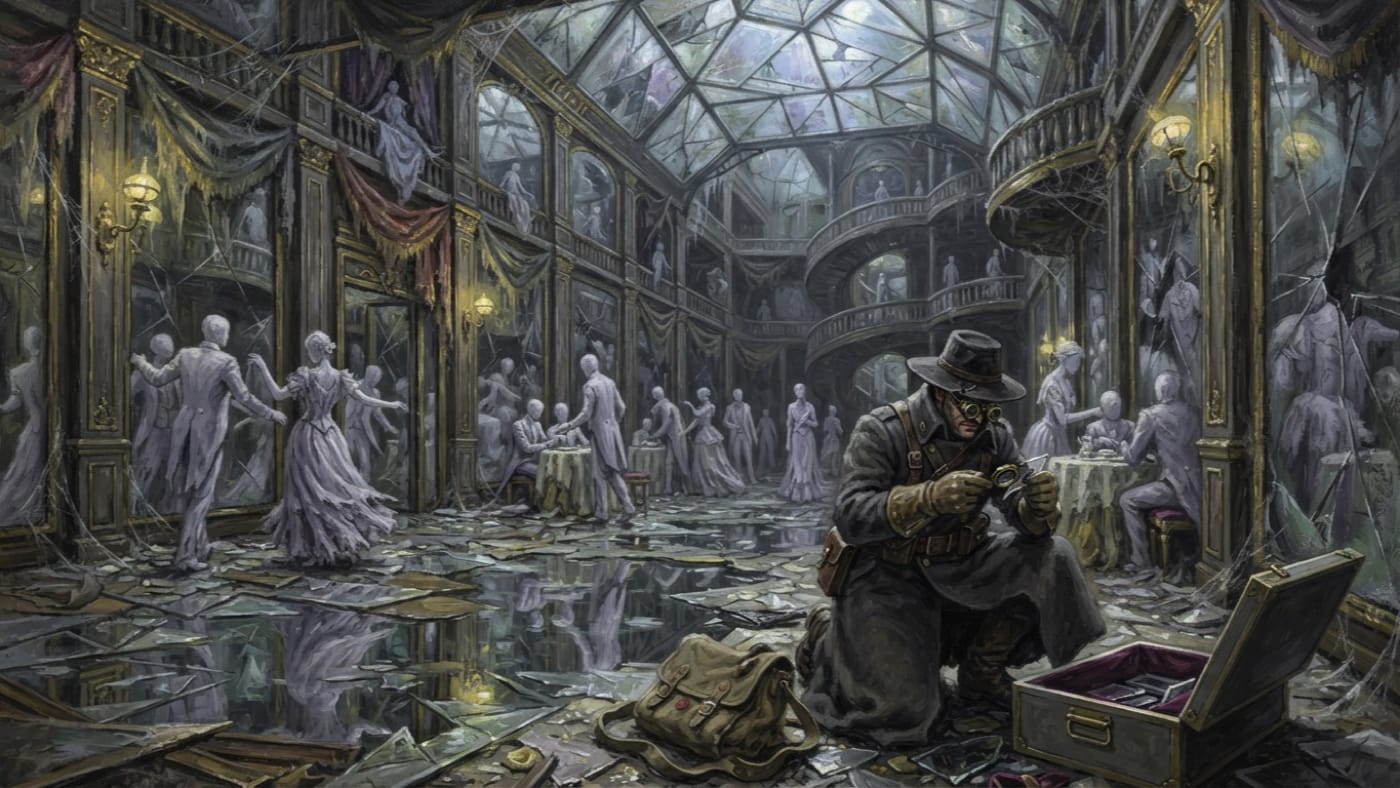
A lust-palace is built of surfaces. Survivors agree on little else, and on this they agree with tiresome unanimity: mirror on mirror, polished floors, gilt frames, glass ceilings, basins of still water, the lacquered doors of rooms that were salons before they became anything worse. The Mirror and Perfume Arts do the rest. The Lore Book reports that at the Courts reflections open like gates, and that a man who steps through may come out with his face slightly altered or not his own at all. It also reports perfume-fogs that enter the lungs and replace memory, so that confessions are recalled as trysts and daughters as lovers. I record these as reports. The Church has no instrument for measuring a recollection, and I will not pretend that the Bureau of Engineering keeps one in a cupboard.
The accounts describe hospitality without friction. A door stands open before anyone tries it. A table is laid. Music starts in the next room just as a guest's resolve begins to tire. Perfume makes a warning smell like home. A soldier kneels to kiss his mother's hand and later remembers kissing someone else's. The Lore Book supplies that example, and it is worse than anything I could compose. Judgment survives in such rooms the way a clerk survives a fire in the archive: still present and still employed, but working from papers someone else has already altered.
Survey fails there. Engineers who have tried it report rooms that change between paired witnesses, routes that disagree when each witness draws them separately, and interiors larger than the shells that contain them. These field conditions are attested often enough to train recruits against. A floor plan they are not, and I will not produce one by stacking testimony until it looks like masonry.
#On the Occupants and the Grey
The dedicated lore on Velkara calls the type Pleasure Palaces: complexes given over to stimulation, where everything is available, nothing is forbidden, and nothing satisfies. Purity's sermons have reduced this to brothels with better glazing. The sermons are wrong, and they fill the benches.
The charge Doctrine lays against the palaces is narrow and exact. They turn persons into experiences. A guest becomes a sensation to be extracted, and the next guest is the same sensation with a different face. Pursuit becomes the only labour that still registers. Each conquest buys a shorter interval before boredom returns, and the intensity has to rise to keep the same account in credit. Affection, the body and the ordinary wish of one person to be known by another appear nowhere in the indictment, whatever the Lenten preachers say.
Velkara's other territories show where that arithmetic ends. Hunting Grounds formalise the chase. Trophy Halls keep faces, the part that was looked at, and discard the rest. Escalation Courts push sensation into pain because pain still registers. The Grey Wastes are what remains once nothing registers at all: colour drained from the rooms, inhabitants dancing, feasting and coupling as routine, faces blank. Whether every lust-palace holds each of these as a wing, nobody has walked enough of them to say. They describe a logic, and the logic holds.
The human cost sits in the grey. Survivors describe touch that does not land and warmth that fails to warm. Some had been prey so long they forgot they had been anything else. The palaces still house such people. They are the furniture the inventory never lists.
Field abstract heading, standing usage: "Shattered palace — structure cleared."
Corrected. Shattered describes the architecture. It certifies nothing about occupancy, conquest or abandonment. The Shattered Courts remain hostile and active, and a fragment arriving at a western bench proves only that the fragment left. Clerks who read broken glass as a cleared building are directed to stop sending men inside on the strength of an adjective.
#On What Leaves the Palace
Breakage leaves a lust-palace's business intact and divides it into pieces small enough to carry.
Recovery belongs to the Demon-Glass Scavengers, and inside the mirrored ruins to the Palace-Crawler, who works the crawlspaces while a partner watches the reflections. The kit is short and ugly: tongs, a dull hammer, waxed wraps, an ash-salt rinse and perfume-cloth over the mouth. The dangers are local and particular. Memory slips, and the trade says a man who comes back with gaps has "Lust fog in the skull". Reflections lie about distance and company. Mirror predators hunt the corridors. Crews will not say their own names inside.
A fragment keeps its building's habits. Polished, it gleams like a church window, and the Polishers report movement and voices behind the gleam. Lust-palace glass is said to work through what the viewer already wants. The Pelas dossier draws the contrast with Wrath-slag plainly: slag shows violence bluntly, while palace glass offers tenderness with a hook inside it. The Polishers call this difference the glass's temper and argue about it at market edges, which is where most provenance in this Church is decided.
At the bench the piece goes into a quiet-box and is then washed, ground, tested and mounted in lead. Each step lowers its activity. No step certifies it harmless, whatever is stamped on the frame.
#On the Evidence at Thessaloniki
Thessaloniki is a Zone 7 harbour on the Aegean, well downstream of any palace the Church has located. Fragments reaching its Lanes have not brought the palaces with them. The port matters here as the place where the danger can be seen surviving extraction.
In A.S. 198, three Grit-Runners in the Lanes handled active Lust-palace shards. Pelas, a Stainwright, broke their fingers before the precinct runner arrived. His dossier presents the act as containment that stopped a wider reflection event in a crowded lane. The boys survived. The record cannot show what the contact would otherwise have done, and the method is no general treatment, whatever the Purity sermons that cite it for either side insist. Pelas was later arrested on an unrelated charge. His workshop had already been emptied. His whereabouts remain unknown.
A separate relationship runs across the water. Pilot-King Nenos works Drowned Row and the under-quays, and his dossier credits him with knowing which glass hum means Wrath-slag and which means Lust-palace. The skill is his own. Dockhands swear to it, and no one has reduced it to an assay a clerk could repeat. He does not let boys carry quiet-boxes after dark. No document ties his cargoes to the shards Pelas's runners touched, and I tie none.
Then come the institutions. The Bureau of Purity condemns the trade, raids the benches and preaches on the shards. The Bureau of War receives the finished lenses, some sold with the promise that they reveal the enemy's soul. That promise belongs to the sellers. Buildings designed to make people want what harms them have found their most faithful customer in procurement. This establishes appetite, not allegiance. Nothing on file shows that every buyer serves the Great Deceiver, or that any palace directs its own supply.
#On the Present Disposition
As of A.S. 201, the lust-palaces remain a recognised class of hostile architecture, best attested at the Shattered Courts and in no condition to be counted. They appear in no register. No map has survived a second witness. A determined broker can defeat any provenance mark, and the temper by which Polishers sort their stock is a craft judgment offered at a price. Pilgrims who buy fragments hoping for glimpses of possible salvations report what they saw, and the Ledger records the report.
The buildings have not been eradicated. Their glass keeps arriving in the west wrapped, quieted and requisitioned, and the benches that receive it go on handling it as though it still wants something.