
#On the Card at the Hearing
Say it the safe way, son. The card is listening. (a hearing-table saying, northern sector, unattested in any circular)
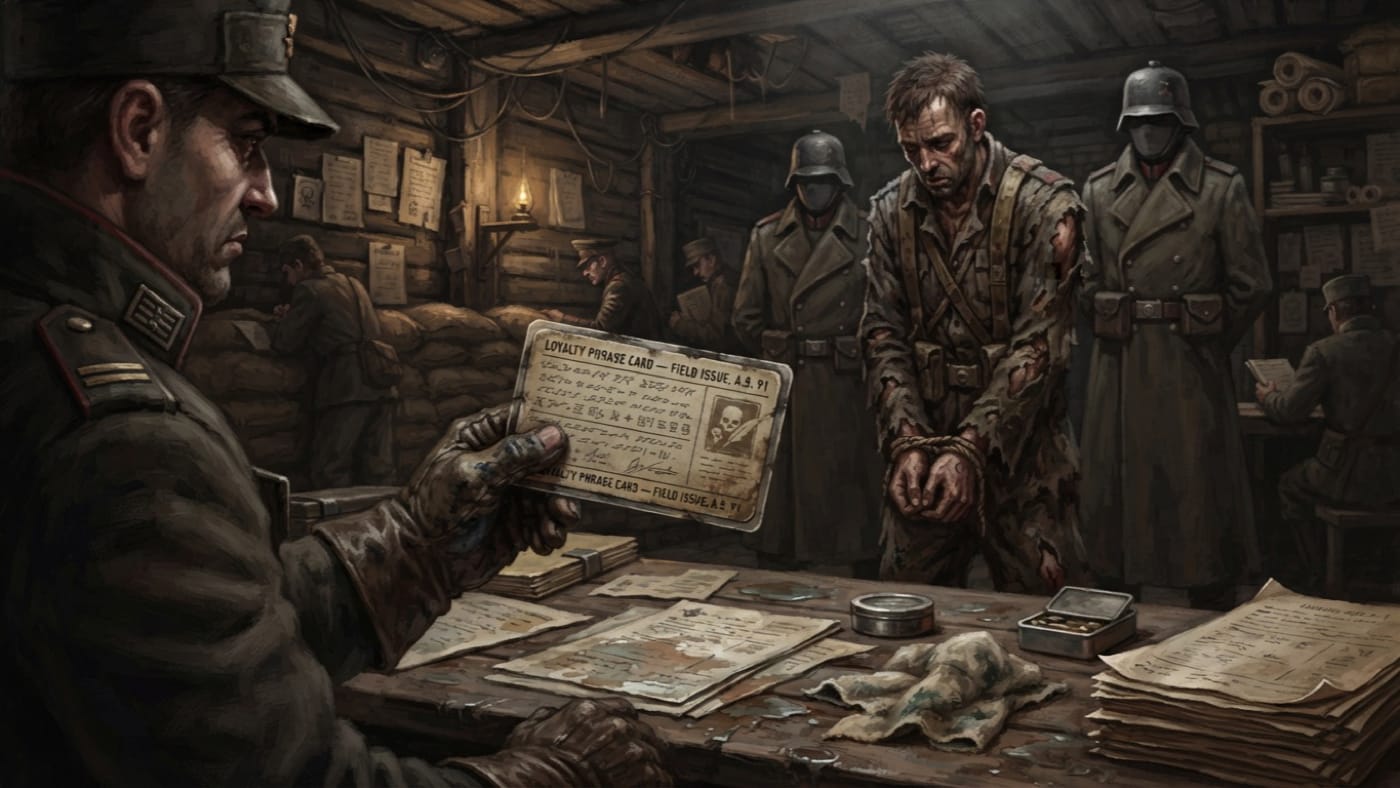
The Loyalty Phrasing Rubric is a card small enough to hide in a palm, and it decides what a man meant. It sits in a clerk's hand at the hearing table of a Trench Court, beside the waterproof sheets, the tags, the seal tin and the brine cloth. Its task is to sort a suspected deserter's account of his absence by the words he chooses for it. Where he went has already been asked. Three identity questions and five absence questions have done that work, after their fashion. The rubric asks only how he says it.
So the instrument is simple. It holds a short list of sentences the Church can live with and a longer list it cannot. A Trench-Court Clerk hears the suspect's account, holds it against the card, and offers him one better sentence. The suspect then either speaks it or refuses, and that choice is entered with the same care a confessor gives to a sin.
#On Its Issue During the Purges
The Uncounted Winter produced the need. Its exact year is still argued somewhere inside A.S. 87–91, and I will not settle the argument by stretching one winter across four years. It left the northern sector of the Sagittal Line with fifty thousand dead and no attestation for any of them. That is the official figure, and officials love it as a bishop loves a relic that cannot be tested. In A.S. 91 a Joint Mandate of the Bureau of Records and the Bureau of War constituted the Trench Courts. Death began to be stamped close to the wound.
Every death the courts attested made each unattested survival easier to see. The reconciliation tables of the Deserter Purges set unit rolls against casualty sheets, and living men against death records that had been convenient to somebody until those men walked back into the ledger. The hearings that followed had to be fast and many, and they had to be repeatable by a clerk with frozen fingers and no theology. A card met that need.
The parent account calls the rubric the Purges' great invention. Clerical lore speaks of refinement. I will commit the Codex to what A.S. 91 can bear: the rubric was standardized and issued to the field during the Purges. Whoever first set grammar against a deserter left no signature I have found, and I will not forge one for neatness. The cards were laminated by Engineering and approved by the Bureau of Doctrine. War and Records supplied everything around them: the table, the witness, the roll and the rope.
#On Acceptable Formulations
The surviving extract is brief, and I reproduce it as it stands. It is a quotation from the field. It is not a recovered manual.
Read it as a grammarian would and the design shows itself. In the safe sentence nobody acts. Bombardment is the subject, and bombardment can neither be court-martialled nor sue for a pension. In the suspect sentence the unit becomes the subject: comrades acted, and the man was what they acted upon. The dangerous sentence moves the verb up to command. The terminal sentence gives it to the Synod. Each rank names a higher author of the soldier's misfortune, and the card goes cold as the author rises.
Commentators on the Purges give their own ladder of examples: “I was separated from my unit,” “They left me,” “The officers lied,” “I will not go back.” These illustrate the same habit of ear. They are not further ranks of the card, and I will not stitch the two lists into a seven-line catechism that no clerk ever carried.
Note well that “My unit abandoned me” is sometimes simply true. Units abandon men. They do it under shellfire, in fog, on orders, or because a sergeant counted wrong and marched. A man who says it may be a coward rehearsing his excuse. He may be concussed, or full of morphine, or giving an exact account of a bad night. The card cannot tell these apart, and it was never asked to.
#On the Answer Entered
The clerk offers the corrective prompt once. Once is the rule because twice would look like coaching, and the court prefers its coaching unwitnessed. If the suspect takes the safe sentence, the hearing may reclassify his absence as drift and return him to the line. Acceptance buys utility. It does not buy acquittal. He may go back branded, beaten, on reduced ration, or set to work that kills more slowly than rope. Some who accepted were hanged anyway, because the sentence clears the grammar and leaves the record untouched.
If he refuses, the refusal is written down, and from then on his refusal is evidence against him.
Keep the classifications in their proper drawers. Safe, suspect, dangerous and terminal belong to the loyalty card. Faithful, drift, contrition and contagious doubt are the confession categories of the wider clerk system, and they are applied to what a man is finally entered as. Cadence anomaly was added later, after Wound-Site 14, and is not a fifth loyalty rank. Its examinations belong to other folios. Identity also stands apart. The Gatewarden-Notary checks three rolls: regimental muster, Records ledger and local conscription registry. When the rolls agree, they have proved who the man is on paper. They have proved nothing about what he did.
An accusation that touches command goes to the contradiction pouch and passes into separate custody. Marking a phrase dangerous does not give a clerk the furnace. Authorized destruction falls under the Contradiction Doctrine and Burn Directive 7-C, with their orders, routing and logs. I set this down because the terminal label has been misread as an execution rule. It is a ladder of escalation in courts that keep their discretion. Doctrine's own records show an accusation against the Synod handled differently according to who said it, where, and how much the hearing could afford to know.
#On Correction and Concealment
Over the table hangs the question of what exactly is being corrected. Sometimes it is a lie. More often it is fear, or a head wound, or the exhausted habit of telling the plain truth, and the prompt walks every one of them toward the same approved sentence. A man who repeats it may be loyal. He may only have learned in time which noun keeps him alive. The file cannot tell, and in practice the file was all that mattered.
Discretion entered with the first clerk who held a card, and corruption came soon after. Clerical lore records forged loyalty phrasing, reclassifications bought with ink, oil or coin, and auditors leaning on whoever left the pouch too full. No tariff survives, and I will not invent a price list to amuse the cynical.
The Rubric Clerks defend the card on grounds that are not contemptible. A soldier entered on a safe sentence keeps his household's pension and keeps the Bureau of Purity away from his mother's door. A shorter file keeps morale. The Record-True Clerks answer that the exact words are the evidence, and that the sentence the card struck out may have named the captain who sent a company into the fog. Both sides are right on the same page, which is why the page is never settled. One stamp shields a household and an officer together, and only the officer chose that protection.
An A.S. 94 training note quoted in the Rubric Clerks' record calls the rubric card “a neutral aid to field comprehension.”
Corrected. The note speaks of the general rubric card, and this office allows it its referent. No card that settles brands, pensions and the routing of accusations is neutral. The loyalty card makes no pretence of being neutral, and its instruction line says so.
#On Present Field Use
By A.S. 201 the loyalty card has outlived the men it first sorted and most of the clerks who held it. Revised cards are still issued to the field, and forward hearings still ask the corrective prompt. I have no complete chain of its revisions and will not draw one from my imagination for a reader who wants tidy dates. Revisions happened. The prompt survived them.
A suspect at a forward court today hears much what a suspect heard in A.S. 91. He hears an invitation to remember his absence in the passive voice and a pause while the clerk waits. Then the stamp comes down.