
#On a Name Without a Boundary
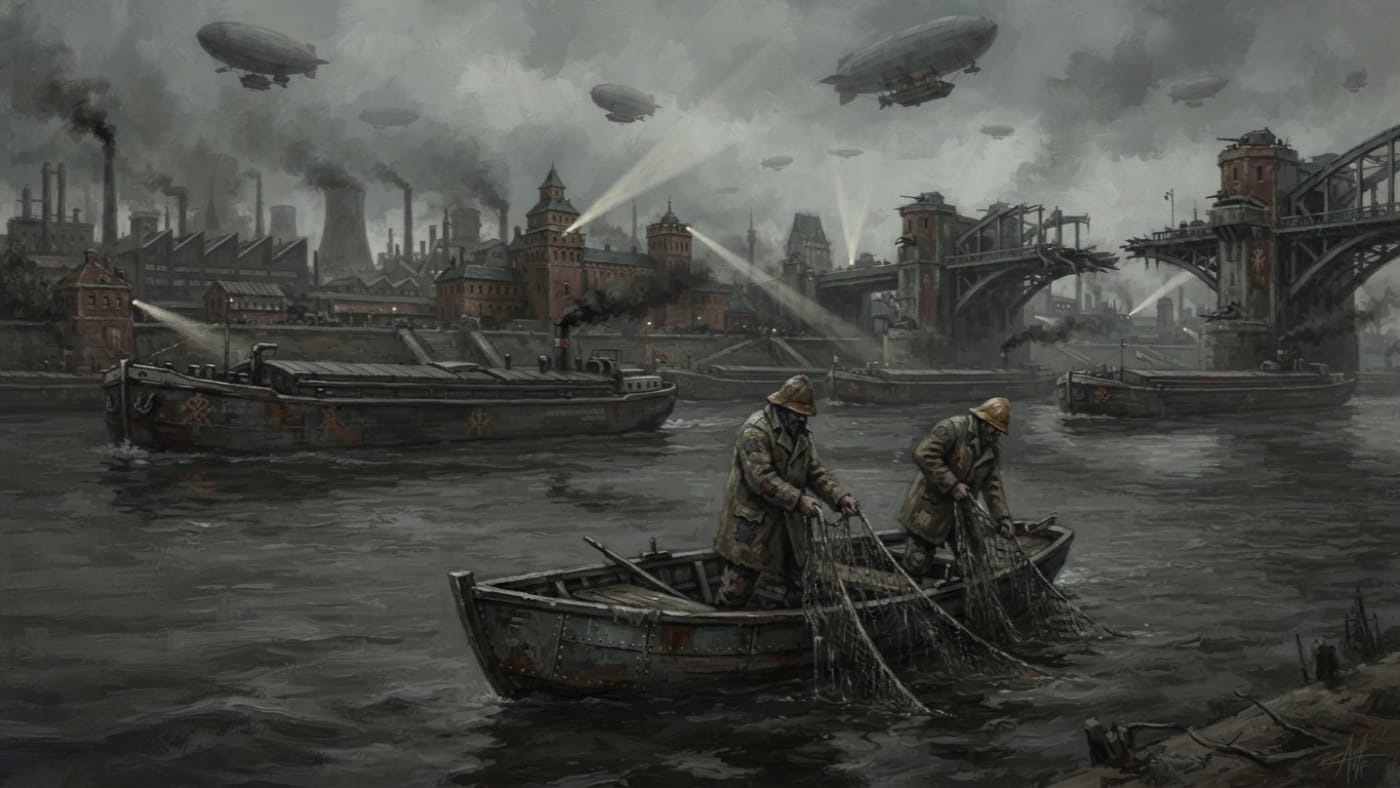
The lower Rhine is a direction before it is a place. Upstream clerks use the phrase the way a sacristan says "the back pews". Everyone knows roughly where they are, nobody has measured them, and the people sitting there are assumed to be paying less attention. It refers to the river's downstream reaches, past the great administrative cities, where the water widens, slows and starts to smell of the sea.
No ordinance fixes where it begins. It is not a province, a diocese, a military command or a customs district, and anyone who drafts it into one will hear from this office. The Rhine is a river and a wet jurisdiction. The Rhine Corridor is the logistics and law laid along that river like a stole over a shoulder. The Rhineland is a province of towns, vineyards, archive-banks and bridge courts. These three names get used interchangeably at dinner, but they are not interchangeable in the Ledger. "Lower Rhine" is something different again: the phrase men use for the stretch with more fishermen than magistrates.
Somewhere downstream the river stops being wholly ours. The Netherlands keeps its own counsel, ships and ledgers. It answers to no Synodal authority and is no enemy. The Church does business with it the way a bishop takes snuff from a Calvinist's box: often, gratefully and with a face like a wet Lent. The point where the Church's water becomes Dutch water belongs to treaty clerks. I will not settle it in an article about fish.
#On Nets, Barges and Cargo Law
Taken whole, the Rhine is the western heartland's great working vein. It carries grain, relic traffic, pilgrims and administrative obligations by barge, ferry and bridge court, under a body of cargo law so thick it has its own sediment. Upstream, at Strasbourg, the River Quarter does its trading under scrutiny that would make a confessor blush. At Rheinscarp, cargo climbs a cliff and pays at every landing for the privilege. Those are their customs. I name them only so the reader knows what kind of river the lower reaches inherit: one where nothing floats without someone wanting to count it.
The fisherman works the edges of this procession. His boat is small, and the barges are not. He sets his nets in water that also carries sacred freight and grain under seal, and he learns which wakes to ride out and which to avoid. His livelihood is older than the cargo law and smaller than any part of it. In the Ledger's eyes he is a nuisance with a hook: never important enough to watch closely, and always close enough to see what passes.
He also keeps hours that the river sets and no clerk does. Lines go out in the dark and nets come up heavy and cold. Men pulling in rhythm need something to pull to. Every working trade in the Church's dominions has discovered this, and the Bureaus spend a good deal of their energy trying to make sure the something has been approved.
#On the Fisher-Litanies
The evidence comes first, because it is thin and I refuse to fatten it.
The only firm record I can cite is a single line in a personnel dossier. Among the papers of Deputy Archon Werrenrath were copies of old working tunes, frontier vigils, fisher-litanies from the lower Rhine and three pump-room calls from Shipka. That establishes that such litanies exist, that they are tied to this river and that at least some of them reached paper in a Strasbourg official's hand.
It establishes nothing more. The record gives no titles or count. It names no village, landing, singer or composer, and gives no age for the songs and no notation beyond the fact that copies existed. Anyone hoping to find a quoted verse in this article should take their hope to a tavern, where verses are cheaper and less often true.
What a litany is, in form, the Church can say with some confidence, since she invented most of the forms worth having. It is a sequence of petitions repeated until the list turns into a rhythm. One voice calls and the rest answer, and the answer stays the same while the petitions change. You do not have to read to join one, and you do not need a hymnal. You need a memory and a reason to keep going. Men hauling wet line before dawn have both in plenty. Beyond that I will not speculate about what the lower Rhine fishermen ask for, or of whom. The Creator hears the petitions, and the Bureau of Records has not been given a copy.
The difficulty is administrative, and administrative difficulties are the only kind this office respects. A hymnal can be licensed, and a printed sheet can be seized. A tune passed from a father to his son over a net-mending bench has no binding to stamp. It has no printer to fine and no first edition to burn. It lives in the throat. The Bureaus have spent two centuries perfecting instruments for paper, and they are still embarrassed by the human mouth.
#On Who Owns a Tune
Two Bureaus claim authority over what a Christian may sing or ring. A careless reader will merge them, and a careless clerk will merge them in triplicate.
The Bureau of Orison licenses hymnals and polices melody. It judges words and intervals: whether a tune is sanctioned, whether its phrasing has drifted, and whether a workshop's labour song has crept one step past what was authorised. Unauthorised melody is its business, and it pursues that business with a seriousness that has, on recorded occasions, reached the tongue itself.
The Bureau of Bells governs sanctioned peals, and with them time and jurisdiction. Its standard is the Bell Codex, ratified in A.S. 115 / 1825 CE on top of bell practices much older than the ratification. Bells decides when a parish wakes, prays and stops work. A fisherman humming over his nets is outside its competence unless he takes it upon himself to ring something. I have not heard that any lower Rhine fisherman has. If one does, he will discover the difference between the two Bureaus at first hand.
A second distinction matters more. Suspicion and danger are not the same thing. Some tones are dangerous in fact, and the frontier has paid in sleepers and worse to learn which ones. Genuine acoustic hazards exist, and the men who catalogue them have earned the right to be humourless. It does not follow that every unlicensed tune is one of those hazards. Far more unapproved melodies survive because they comfort someone than because they summon anything. I find no record that any lower Rhine fisher-litany has caused a breach, served a smuggling ring or protected a single boat from a single fog. The songs are irregular, and that is all they are proven to be.
#On a Deputy Archon's Copies
Werrenrath served in Strasbourg's subordinate archonal administration, at a desk that handled chapel licences, procession timing and musical dispensations. He was not born on the lower Rhine. He did not collect on its landings in person, as far as the record shows, or compose, sponsor or found anything there. How the river songs reached him is unrecorded. The guesses I have heard in corridors are worth exactly what corridors charge for them.
His collection was mixed. Some of it was unlicensed only because no clerk had got round to classifying it. Some of it had been classified, and badly for him. The dossier does not say which river litanies fell on which side of that line, and I will not sort them for it.
A Confessarius noted his affection for unlicensed hymnody. A Bureau of Shadows packet followed. Then came a clean administrative transfer to the supply depot at Bastion-Shipka, on the Balkan frontier, about as far from a Rhine fishing landing as one can get without leaving the Church's maps. There, his ear for cadence turned out to be useful, which embarrassed everyone involved.
The lower Rhine litanies must be kept apart from what he found or judged at Shipka. The pump-room calls are Shipka's. The lull pattern he caught in the depot belongs to another matter, and so does the rail-quarter call compared against an enemy sequence. They share a list with the river songs and nothing else. A fisherman's petition is not a frontier countermeasure because a clerk once filed them in the same oilcloth.
Corridor accounts hold that Deputy Archon Werrenrath was banished to Shipka for keeping forbidden fisher-songs from the lower Rhine.
Corrected. No charge was filed, no tribunal sat, and no sentence was recorded. The river litanies are not entered as proscribed. Deputy Archon Werrenrath was transferred administratively, with the stated reason being competence required in rail-quarter allocation. The official record acknowledges no causal link between his hymnody and his posting, and this office records exactly that much.
#On the Present Condition
As of the A.S. 201 survey, the lower Rhine has no boundary on file and no office of its own. Nobody in the record has counted its litanies. The barges still go downstream toward water that is not entirely ours, and the cargo law still runs alongside them. Somewhere along those banks men still put out nets in the dark, and the Ledger cannot tell me whether they still sing to the same petitions. The only copies the Church can point to went east in a deputy's trunk and now sit at a supply depot beside a marsh. The songs themselves have never applied for a licence, and the river has never been asked to sign for them.