
#On the River Below the Gates
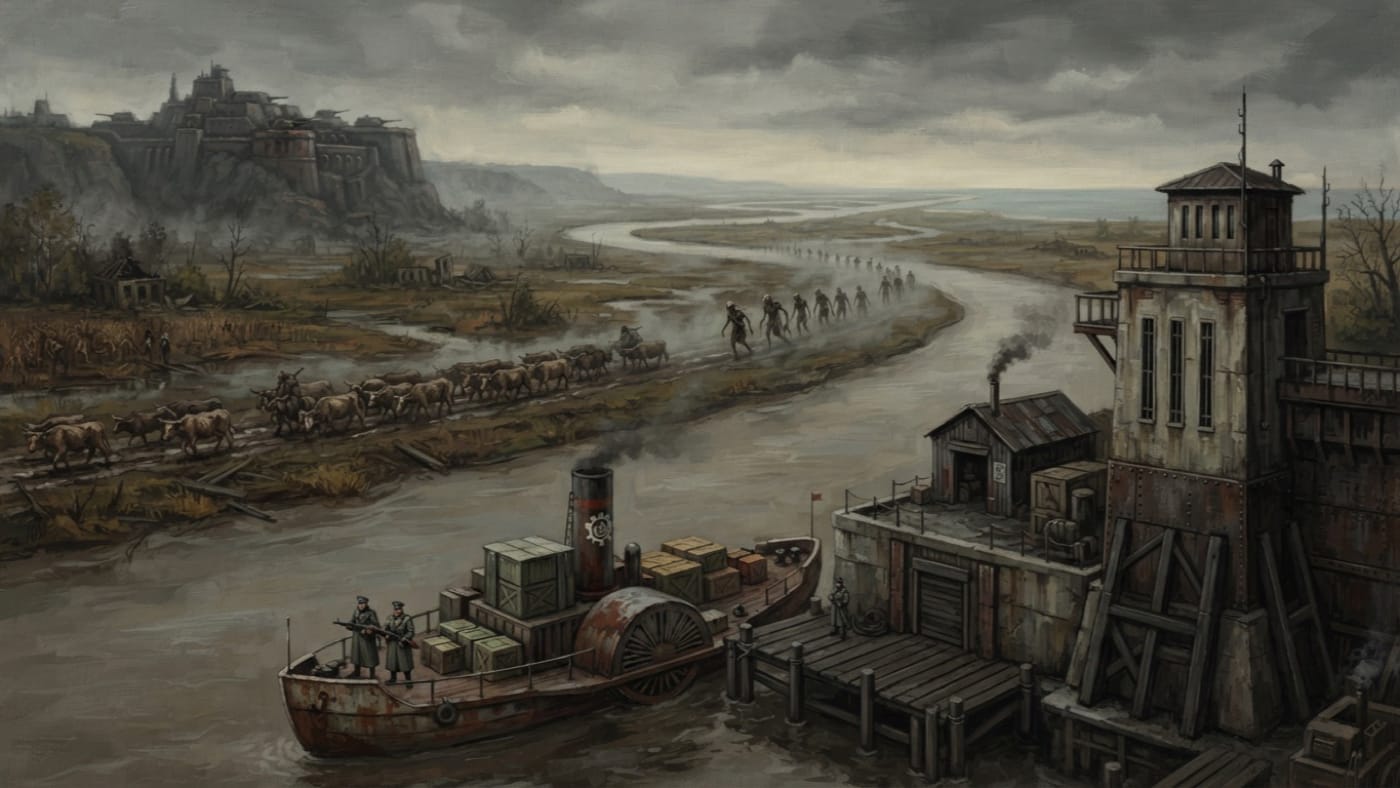
Above Bastion-Irongate the Danube is a corridor with opinions. Budapest, Novi Sad and Belgrade each claim it, every quay keeps a dispatch book, and every bend has a grievance. In the gorge it becomes artillery country, squeezed between cliff batteries and chain-booms until two ships abreast is a matter for negotiation. Below the gorge it stops arguing. The water widens and slows and turns a grey-brown colour across the Wallachian and Bulgarian plains, and it goes on toward the delta and the Black Sea carrying silt, reed and whatever the banks have failed to keep.
This is the Lower Danube. The Codex uses the name the way geographers use it, for the river and its approaches downstream of the Gates. No command bears the title and no prefect signs for it. The Synod's maps put it east of the Sagittal Line, in country the Synod lists among its temporarily occupied territories, a listing it has kept up with great patience for roughly a century and a half.
The Bureau cares about the river for a reason the plain makes plain. Flat ground grows things and broad water moves them. Anything grown, herded or carried in the lower country travels along this river or within smelling distance of it. In the Bureau's view, anything that moves food through hostile country is a subject of military intelligence, whether or not it consents.
#On the Pressures Along Its Approaches
Three appetites press on this water, and none of them owns it outright.
At the western threshold stands Morwen, whose host works the Danube approaches opposite Irongate. Her quarrel is with the gorge itself: its beauty, its batteries, the insolence of a fortress cut into living rock. She imitates, she steals faces, and she ruins what she cannot become. Her presence explains why every passage of the Gates is watched. It explains nothing about cattle.
To the north and east lie the provinces of Velmora: Wallachia, Moldavia, eastern Romania, and the Transylvanian approaches where Bastion-Sibiu intercepts more bribed convoys than it repels assaults. Velmora trades in ownership, debt, counterfeit value, and relief that comes with a contract stitched into the sack. To her a starving district is a market with poor manners. Her river roads and tollhouses touch the lower Danube the way a ledger touches a page, lightly and everywhere.
To the south and east, toward the sea, presses Kargath. His dominion is the Blightmarsh, in the old Hungarian grain country along the Drava, far upstream and well away from this river. His active front is the Black Sea and Thracian approach to Bastion-Constantinople. A great deal of edible country lies between those two facts, and his famine-carriers do not consult the cartographers before crossing it. Kargathite blight is recorded as a carrier-effect even inside Velmoran Moldavia. That is a symptom. It confers no title.
Dossier Carmine states the resulting rivalry briefly. Velmora hoards what Kargath would eat, and she profits from the scarcity he leaves behind. Each recruits clients for the other while loathing the bill. The Lower Danube is broad and slow and full of things worth eating or owning, so an analyst can see both appetites there at once and mistake which one he is looking at.
#On the Cattle Train
In A.S. 193 the Bureau observed a Blightbearer movement toward the Lower Danube.
Three analysts of the Bureau of Inter-Infernal Analysis received the report and did what the Bureau trains men to do with a report: they made it worthy of themselves. They noted the direction. They noted how close the river ran to Velmoran roads and creditor markets. They noted the famous rivalry, which every analyst notes. By the end of their work the movement had become a symbolic strike at Velmora's liquidity operations: Gluttony addressing Greed through the medium of walking famine, a sermon in rot delivered to a counting-house.
The theory ran to fourteen pages, with structure, apparatus and a title: On Caloric Semiotics in Kargathan Lateral Movement. The title deserves to be kept the way certain specimens are kept, in a labelled jar on a high shelf, away from students.
The entities had smelled a cattle train.
A butcher's manifest settled it. It was one document from the commissariat side of the war, written by a man whose trade requires him to know where the meat is, and it displaced fourteen pages by men whose trade requires them to know everything else. The record does not say where the train stood, whose beasts were in it, where it was bound, how many head it carried, or what became of them. Clerks who have since filled in those details took them from appetites of their own.
Assessor-Tertiary Haugen read the manifest, read the theory, and instituted the Carmine Rule: every Carmine hypothesis must survive the question was there food there? The memorandum was withdrawn and its author reassigned to commissariat mathematics. The file does not record what became of the other two analysts, and the Bureau has not offered to say.
The Blightbearer movement of A.S. 193 toward the Lower Danube constituted a symbolic strike upon Velmora's liquidity operations and demonstrated a Kargathite capacity for inter-infernal signalling.
Retracted. The movement followed cattle. No Velmoran bank, treasury or convoy is shown to have been its object. The fourteen pages are withdrawn and the one manifest is retained.
#On Famine After Passage
The embarrassment is comic. What walked toward the cattle is grim.
Kargath's Blightbearers carry his curse, and they starve a country without needing to eat it. Crops rot near them. Stored food spoils in sound sacks. Water turns brackish. Animals sicken. Even the soil loses its power to nourish, so a field can be ploughed, sown and weeded in perfect obedience and still yield nothing. The Blightbearers are starving themselves the whole time, and they move toward food because the starving do. Their attraction to a cattle train needs no theory at all. What happens to cattle near such things belongs to the dossier's general entries, and the A.S. 193 record reports nothing on it.
Those general entries describe the aftermath in the flat language of men who have stopped expecting a better word. Wheat fails three years after passage. Wells sour, run clear, then sour again. Storehouses rot without any breach. Sealed rations come to taste like ash. A river country fed by plains, moving its food by water and road, gives every one of these failures somewhere to happen. Each arrives late, after the scouts have filed and the host has moved on, when someone unbars a granary and the smell answers before the inventory does.
The abundance entries are worse: fruit out of season at a marsh's edge, grain heavy enough to bow the stalk, harvests where nobody sowed, and then the fed starving with full cheeks. The Bureau records no such field on the lower river. It records enough of them elsewhere that a commander who finds one should treat it as an enemy battery.
#On Carrying Food Through Hunger
Every army is a mouth. The Line feeds garrisons, convoys, refugees, labourers, horses and clergy, and all of their food has to travel. In a region with three enemies and broad, slow water, carrying food and advertising it are the same act.
Herds draw famine-carriers. Hunger drives the hungry into Velmora's relief-credit, where a sack of meal becomes a debt and a debt becomes a province. A district that loses its harvest to Kargath may live through the winter by selling itself to Greed. The Bureau then files the two events in two dossiers and wonders why the totals disagree.
Carmine's denial doctrine answers with the brutality its subject has earned: burn grain before retreat, poison wells already lost, shoot livestock rather than let them wander east. The doctrine is established. Its use on the Lower Danube in A.S. 193 is not. Nothing in the record says the train was destroyed, saved or abandoned, and nothing licenses a reader to choose. The general cost is known. A herd shot to deny a famine-host is a herd no village will eat, and the village hears so from men who will be fed that evening out of a commissariat ledger. Doctrine calls this necessity. The village has a shorter word for it.
#On the Present Account
This synopsis follows the A.S. 201 geographical survey. On it the Lower Danube is broad water below the Gates, east of the Line, crossed by Velmoran roads and marked by Kargathite carrier-effects, watched from Irongate's cliffs at its western edge and left unresolved in its particulars toward the sea. No command bears its name. Dossier Carmine remains open.
The Carmine Rule remains in force. Analysts still bring elaborate readings of Kargathite movement along the river, and the Bureau still asks the butcher's question before the theologian's. The Bureau of Records keeps the river under its geographical name and has declined every proposal to give it a grander one.