
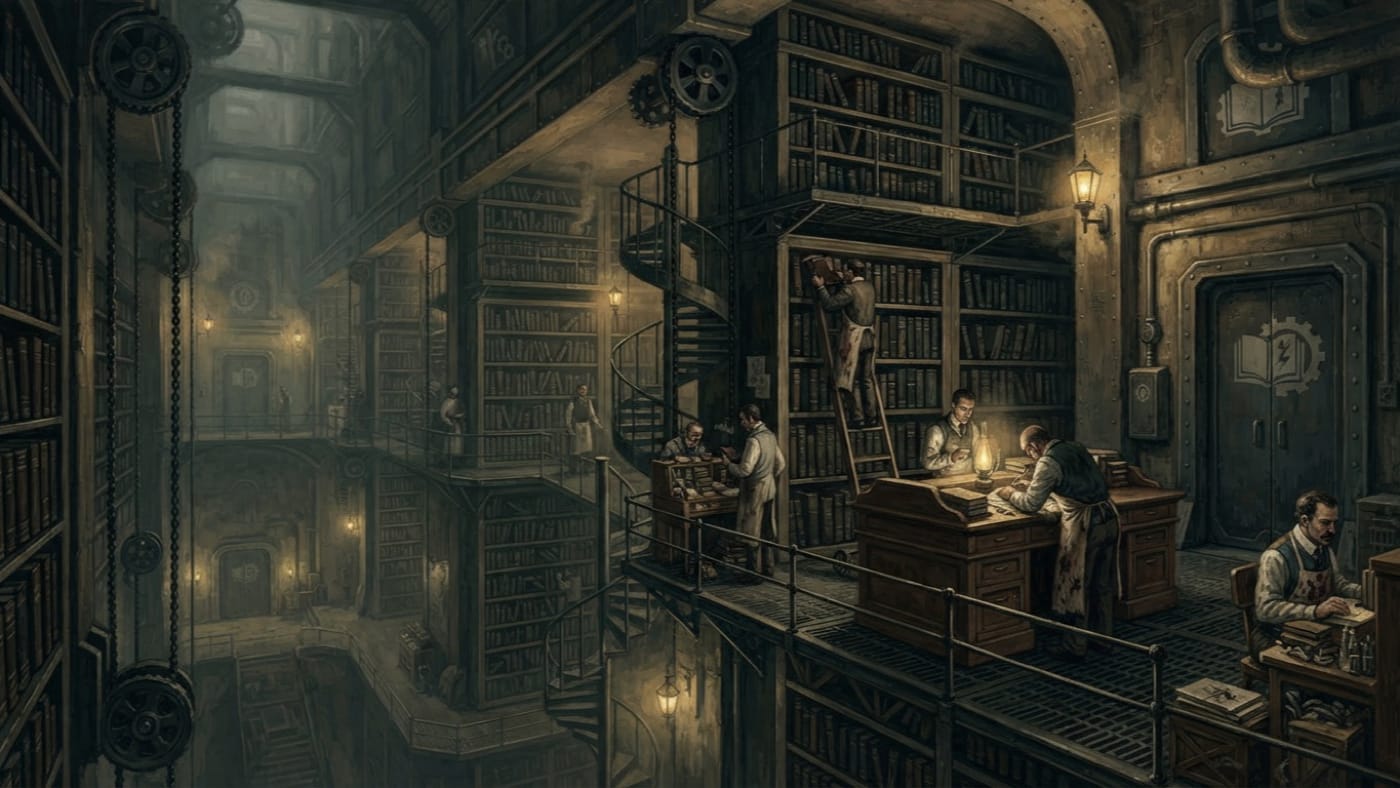
#On the Library in the University Precinct
The Library of Saint Origen holds two hundred thousand volumes. Every one of them has been counted by someone who was paid to be bored. It stands in the University precinct of Strasbourg, so close to the Academy that students cross between them in winter without a coat, and far enough from the Sanctum Mile that the Bureaus can treat it as someone else's expense. Where the library's walls end and the Academy's begin is a question for surveyors. I am a theologian. I have watched students settle the question with their feet.
Two hundred thousand is the official figure, so it is quoted more often than it is checked. The catalogue does not say whether it includes what lies beneath the building, because the catalogue has not been told there is anything beneath the building.
The Synod does not keep two hundred thousand books out of affection. It keeps them because a province cannot be governed without precedent, a heresy cannot be refuted without its text, and a tithe dispute cannot be settled by prayer, though Doctrine has tried. Every canonist, notary and tribunal clerk the Academy sends out into the Dominion has first been made to find something on these shelves and put it back exactly where it was. The second half of that instruction is the real education.
#On Readers, Tutors and Indexers
The arrangement with the Academy is a trade in bodies. Saint Origen supplies many of the Academy's tutors. These are men who have spent years among the shelves and know which commentary contradicts which, which edition has been corrected, and which corrected edition must still be cited as the original. In return the Academy sends the library its interns, copyists and indexers, the young and ink-stained, who come to learn scholarship and stay to learn obedience.
Copying is the first discipline. A copyist must reproduce a page exactly. That sounds simple until he finds that "exactly" means the approved text, and the approved text is not always the one in front of him. He learns to carry a correction forward without remarking on it. He learns that a smudge is an offence and a marginal note in his own hand is a confession. By the end of the first term his letters are beautiful and his opinions cannot be seen. Both are graded.
Indexing is worse, and more useful. An indexer must read the whole book so that he can tell other people which parts they may read. He has to know exactly where the dangerous passage lies, so that his entry can lead the reader politely around it. A good index at Saint Origen works like a processional route: it passes the reliquary at a respectful distance and never stops at the crypt. The Academy considers this the finest possible training for a future Records clerk. Records agrees. Records needs people who can read.
The Synod's whole difficulty fits on one desk. The state needs administrators who can read a contested deed, a forged register, or a Rationalist argument laid out in good Latin. Such men are dangerous because of their training. The Bureau of Purity regards every graduate as a heresy not yet scheduled, and it watches the tutors who trained them the way a butcher watches the man who sharpens his knives. Professor Aldric Sane's lectures on the Sin-Generals fill Academy benches and Purity notebooks in equal measure. He draws on the same precinct shelves as every other lecturer. The shelves have not been arrested. Neither, so far, has he.
#On Permission to Read
No book in the Dominion is simply read. It is licensed, defined, indexed, audited and, when required, burned, and each of those verbs belongs to a different office of the Holy Bureaus.
The Bureau of Silence licenses every library and archive under the Synod's jurisdiction, from a village shelf of fourteen psalters to the two hundred thousand of Saint Origen, and it governs the physical handling of whatever must not circulate. The Bureau of Doctrine, my own house, defines heresy, which means we decide what the other offices should be afraid of. Purity maintains the Index Damnatus and enforces its condemnations by methods that have nothing to do with bibliography. Records audits the Academy and supplies the documentary authority that lets any of the rest prove they were ever told anything.
Earlier editions of this Codex attributed the Index Damnatus to the Bureau of Doctrine.
Corrected, as the Purity entry has already corrected it. The Index is Purity's instrument. Doctrine advises on which truths require suppression. Purity lists the books and visits their owners. A library that consults Doctrine about its catalogue receives an opinion. A library that consults the Index receives a list of what it may no longer own. Examination candidates who confuse the two are reminded which office carries tongs.
Permission to keep a book and permission to open it are separate mercies. A library may be licensed to hold a volume that almost nobody is licensed to read, much as a cathedral may hold a relic that nobody is permitted to touch. The Silence licence covers the collection. Doctrine's definitions and Purity's Index govern the reader. I will not set out how the three are reconciled for any particular shelf at Saint Origen. Part of the reason is discretion. The rest is that the reconciliation happens in rooms I have not been invited into. The librarians manage it. They have had practice.
#On the Secret Stacks
The Academy divides the library into public stacks, restricted stacks, Secret Stacks, and rooms whose door plates bear no words but still make the librarians pale. Students boast of having entered the second. Graduates lie about the third. Nobody boasts of the fourth. I give the classification as the Academy gives it. It is not a floor plan and I will not draw one. A reader who wants a staircase can look for it somewhere else.
The Secret Stacks lie beneath Saint Origen. The official position deserves to be quoted in full. The books there do not exist. The room in which they do not exist does not exist. The librarians who maintain the nonexistent books in the nonexistent room do not exist either. The formula is complete. It leaves no gap for a question to enter, and that is its purpose. Every clerk in Strasbourg also hears the threat folded inside it: a man who walks into a room that does not exist may find his own file corrected to match.
Admission below the restricted stacks is granted by ██████████ on presentation of ██████████████. The register of persons admitted is kept ████████████. The register of persons returned is kept separately.
The Academy sends its interns down to work. The Academy's own account says they learn, after one month underground, that books can stare back. I attribute the phrase to the Academy and to no particular book. The students who repeat it do not smile when they do.
Visitors from the provinces confuse the Secret Stacks with the Forbidden Stacks. They are separate repositories. The Forbidden Stacks are entered by the south catalogue stair of the Records House beside the Basilica, under Silence custody and a Records–Doctrine co-seal. Their contents are counted, catalogued and hated under licence. No document I have handled joins the two by tunnel, title or shared key. Any clerk who hopes to keep his post will not add their tallies together. The Forbidden Stacks at least admit what they hold. The Secret Stacks admit nothing, which is a more thorough kind of honesty.
#On Present Use
As of A.S. 201, the year of this survey, the exchange continues. Tutors cross from library to Academy carrying the habits of the shelf: exact citation, slow speech, and a reflex of glancing at the door before answering. Interns cross the other way carrying ink, ambition and the conviction that they will be the first to read everything. That conviction lasts about a term. Copyists copy. Indexers lead readers around the crypt. The catalogue still claims two hundred thousand volumes, and Records still needs people who can read them.
The Academy supplies the questions and Saint Origen supplies the answers that are permitted. Purity takes notes on both. Beneath the floor, in a room that does not exist, someone keeps the shelves in order, and I am not obliged to know who.