
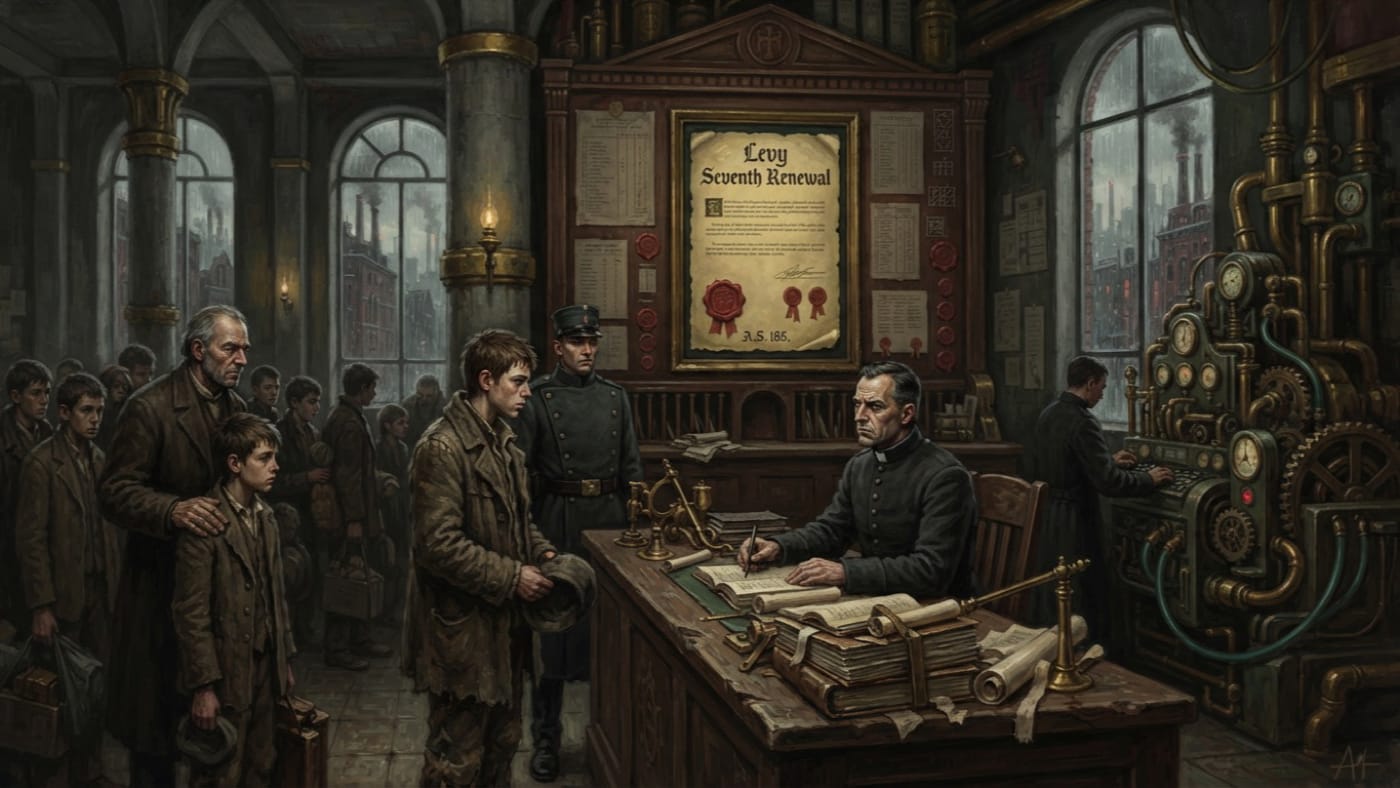
#On the Seventh Renewal
In A.S. 185, which the Rationalist almanacs would have called 1895, the Church renewed its claim on the sons of the continent for the seventh time. The Bureau of Conscription records the year in two places. Its charter page says, in the flat hand of a clerk who expects no applause, that the charter was renewed in that year under the name Levy Seventh Renewal. Its restricted annex, kept for provincial wardens and for persons of my clearance, says that the quota of one son in ten was revised to another figure in provinces classified under a Martial Edict whose number has been inked out.
That is everything the accessible record holds: one year, one renewed charter and one revised quota. The surviving pages do not say whether the charter and the revision travelled in one packet or two, or whether they were ratified together or apart, and I will not improve on them.
The rest is under wax: the revised fraction, the number of the edict, the names of the provinces, and the count of households processed under the new figure by A.S. 200. A codex abstract that claimed to know these things would be a forgery. The Church already has enough forgers, and most of them work for the other side.
The record does show how far the instrument reached. A renewal of the levy is drafted in Strasbourg and carried out in a kitchen. The paper passes from a Doctrine desk to a provincial depot to a parish roll, and at the end of that road a father learns which of his sons the fraction has chosen.
#On the Original Grace
The levy was already old by A.S. 185. The First Continental Levy was declared in A.S. 110 / 1820 CE, when Gluttony had eaten Brașov in a week and the passes of Thrace were burning. It demanded a tenth of every household's sons. The decree carried the joint seals of the Bureau of War and the Bureau of Doctrine. For two years no office was responsible for delivering the boys, and so the pastures, the riots and the dead Assessors of Bruges took on the work themselves. The Bureau of Conscription was constituted under the same joint seal in A.S. 112 to put an end to that improvisation.
Seventy-five years separate the first fraction from the Seventh Renewal. In between, the renewals acquired numbers and two dialects. The Bureau of War calls each one a Continuation of the Original Grace, as though the Creator had extended a lease. The Bureau of Conscription calls each one an updated quota allocation. War's phrase suits a pulpit and Conscription's suits an invoice. Both appear on the same documents, and neither Bureau has ever found the pairing strange. The Third Renewal, of A.S. 150, is remembered mainly for one province that refused it and for the length of the Bureau of Purity's reply. That length is now sealed under Ninth-Ratification, along with the province.
The public formula stayed at one in ten, the figure printed on parish notices since A.S. 110. By the time of the present survey, the Bureau's standing practice sets one in eight beside it for provinces classified as spiritually surplus. That classification is a provincial habit of the Bureau. It is not the concealed figure of the Seventh Renewal, and readers who mix the two up will be corrected in the margin.
#On the Provincial Account
The accessible record contains three figures with three different standings. The first is the public formula, which every literate farmer can recite. The second is the surplus assessment, which every provincial warden applies. The third is the allocation under the Martial Edict, which the provincial wardens of the affected territories presumably apply as well, though the record will not tell me which territories those are, or on what grounds an edict described as martial reached into the nursery.
The machinery that turned any of these figures into boys standing in a line was in place long before A.S. 185. The renewal did not build it. The renewal fed it a new number.
The Bureau of Records keeps the census. The Bureau of Conscription's Levy Assessors check that census against parish birth-rolls, confession ledgers and the Great Ledger of Souls, and they count the eligible sons in each household against whatever fraction the province has been given. They then consult the Book of Promise, in which every child baptised in the Church is enrolled with a future already written beside the name: levy, choir, ledger. When the allocation and the Promise disagree, the allocation wins and the Promise is reconciled with a stamp. I have never seen a household appeal that stamp, because the household is never told that the stamp exists.
When a boy is on the birth-roll but missing from the confession ledger, the Assessor files a Discrepancy Writ, and the matter passes to the Bureau of Purity, which does not regard missing sons as clerical errors.
What follows is the mustering. The notice goes up on the parish door, held by a single nail through a printed fraction. Fathers walk their sons to the field. The boys are measured, given a quick confession, and stamped on the inner wrist with the Triune Knot. The brass die leaves ink that will not wash out for nine days, which is long enough for every parish between the field and the hills to read it. The recruits go on to War's garrisons, and in time to the Line.
Mothers have their own way of reading a renewal notice. They look past the theology and the fraction, count the boots by the door, and work out which pair the fraction will need.
#On Concealment and the Pale Kin
A quota is a fraction, and a fraction needs a denominator. The Pale Kin Runner works on the denominator.
The trade was not born in A.S. 185. It took its specialised form after the Nursery Levy Decrees of A.S. 152, when the Bureau of Conscription decided that an unregistered infant was a gap in its forecasting and that a gap in forecasting was heresy. Midwives were the first to understand what the first stamp on a child meant. Some of them started lying, and the ones who lied well trained successors.
Their methods were set long before the Seventh Renewal was drafted. A living birth is recorded as a stillbirth. An ash-dummy entry, the name of a dead woman's dead child copied back onto the roll, fills the slot in the ledger. The runners have a rule, "Don't carry the name with the body," so the paper and the child leave the house by different doors and in different hands. The child goes out under a quiet cloth, felted wool treated with lanolin and ash that softens a cry until it sounds like the street. A decoy bundle, kept warm by a heated stone, goes out in the runner's other arm. No runner carries a child for more than one stage of the route, and no runner knows the whole chain. Under interrogation a Bundle-Carrier can name one laundry house and one ossuary door. Then she runs out of answers, and the Bureau runs out of patience.
Every child hidden this way leaves the household's count shorter, and the fraction applied to a shorter count yields fewer sons. The Assessor looks for the missing son with arithmetic, using stillbirth rates, milk rations and wet-nurse records. In the worst cases the household gets a visit from the Purity Fume-Inspector, who tests the air of a room for the traces of a recent birth. A household found out ends up in the Index Damnatus. A household that is never found out ends up counted wrongly, which the Bureau considers almost as serious.
As for what the renewal did to all this, the record speaks once and then only in part. A restricted intelligence report says that Pale Kin operations in Zone 3 have increased since A.S. 195, by a percentage that has been removed. The same report says the Levy Seventh Renewal "is believed to be" something, and the rest of that sentence is removed as well. "Believed" is the most expensive verb in the Bureau of Purity's vocabulary, used when it has a suspicion and no audit. The report puts the renewal and the runners side by side. It does not say what joins them, and it does not measure anything that ten years of other pressures might not also explain.
#On the Surviving Record
The Bureau of Doctrine ratifies a levy renewal with its seal set beside the seal of the issuing Bureau, two seals in all, as has been customary since the joint decree of A.S. 110. The restricted annex records that the Seventh Renewal's ratification carried more seals than that. It does not say how many, or whose, or why. A codex reader might guess that each added seal meant another Bureau insisting on a share of the instrument, or a share of the blame, or simply the right to be told. I record the guess and do not endorse it, since it is mine and has no authority.
Several dates need to be kept apart. The ratification belongs to A.S. 185. The Zone 3 intelligence belongs to A.S. 195 and the years after. The accounting of processed households, also withheld, runs to A.S. 200. This abstract is written in the survey year A.S. 201, sixteen years after the instrument it describes and still outside most of its annexes.
Revised quota under the Martial Edict: ████. Edict designation: ████. Provinces so classified: ████████████. Seals affixed at Doctrine's ratification beyond the customary two: ████. Households processed under the revised quota as of A.S. 200: ████████. Contents of these fields not held by the compiler of this abstract.
An earlier draft of this abstract stated that the Bureau of Conscription was established in A.S. 110, together with the First Continental Levy, and administered every renewal from the first.
The Bureau was constituted in A.S. 112, two years after the Levy it now administers. The Levy came first and the office to run it came second, and the Bureau of Conscription has not found that order of events flattering.