
#On the House in Millwrights' Row
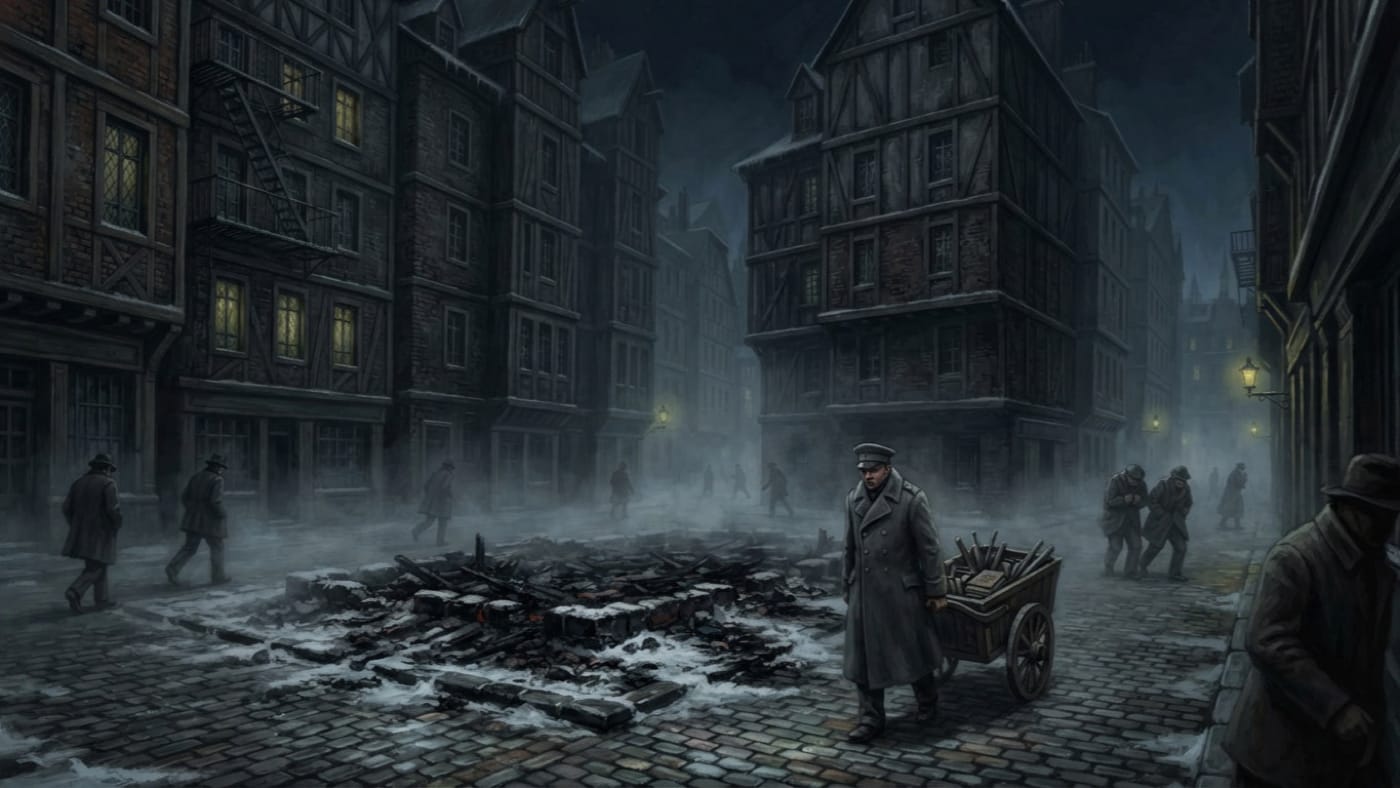
The Laughing Swan Inn stood on Millwrights' Row in Strasbourg until A.S. 102, when the Censorium of Taverns burned it to its foundations. The Codex files it among places as a courtesy. What remains on the Row is a rectangle of char that the city walks around. What remains in the archive is a case citation that the Censorium reaches for whenever a publican needs instruction.
The record of the house itself is thin. It names no keeper. It gives no founding year, sets down no bill of fare and preserves no sign. What the Swan held can only be described as what every licensed house of the Dominion held then and holds now. There was weak beer and black bread. There was a sanctioned hymn sung at a volume suitable for the dying, shutters hung with cloth of the assigned grade and a placard above the bar. After Ninth Peal the curfew-fume rose from the floor pipes and settled on the tables like a second clientele. A Licensed Housewarden kept the room, and a Fog Clerk kept the count. The two offices must not be confused, although the Housewarden's livelihood depended on the Clerk's arithmetic as a hanged man's depends on the rope-maker.
The name has been held against the house ever since. A swan that laughs is a bird already in breach of its allocation. The file does not say whether the name was a provocation or just the sort of thing millwrights find amusing after a second cup. I call it an unwise name. I say so afterwards, which is the only time any Bureau says anything.
#On the Three Entries
Every licensed house keeps the List of Laughters nightly, bead by bead, in the hand of a clerk who does not laugh. It was never meant as a chronicle. It is a pressure gauge, and the Swan's entries survive because a gauge that has burned a building becomes evidence. The relevant pages are cited as List of Laughters, Ward Copy 14-M. That is the whole of their public identity. I would not advise anyone to ask for the rest.
Three chuckles in one week. They are entered in order.
The first came during a reading of tariff notices. A tariff notice read aloud is the nearest thing the Synod has to secular liturgy: rates, weights, duties and the price of salt, recited in the cadence of a psalm. Someone in the room heard it and chuckled. The clerk entered the cause. That was reasonable, because the cause was audible and the tariff was enforceable.
The second came while a Purity Fume-Inspector tried to tell consecrated lamp-smoke from onion steam. The office is real and its instruments are serious. A kitchen, however, is a kitchen. Onions do not consult the Index before releasing their vapours. The room watched a sworn officer of Purity sniff a stewpot with the gravity of an exorcism and found, briefly, that the gravity was more than it could hold. Cause entered.
The third has no cause listed.
That blank is the hinge of the case. A blasphemous laugh has an object, and the object can be confiscated. A laugh at a tariff can be answered with a sterner reading of the tariff. A laugh at Purity can be answered by Purity, which enjoys the work. A laugh with nothing written beside it leaves the Censorium nothing to correct except the room. The Censorium treated the empty column as a finding. In that reading the house had begun to laugh at nothing, therefore at everything, therefore at the Order that furnishes everything.
The ledger does not say the laugh had no cause. It says the clerk wrote none. These are different sentences, and the Censorium has always preferred the more useful one.
The allocation that three chuckles exceeded was sealed then and remains sealed. The public copy does not say whether three would have condemned any house in Strasbourg, or only one that had already laughed at a tariff and at an inspector.
#On the Preventive Fire
The beams were inscribed before the fire: Joy without creed is sedition. The order of operations matters. Nobody letters a beam they intend to keep, and nobody letters a beam that no one will read. The words were addressed to the Swan for as long as it burned and to the Row for as long as the Row remembered them. The beams went with the rest.
The Censorium filed the act as preventive maintenance. Older and plainer copies call it a preventive measure. Its administrative description is structural nullification by authorised flame. The phrase is built so carefully that it can be read aloud at supper without anyone putting down a spoon. The charge was devotional levity excess, repeated. That is the wording the file carries today, and it has the polish of the A.S. 199 revision. I do not undertake to say what the clerk of A.S. 102 actually wrote beneath the varnish.
The licence was revoked after the house had ceased to exist, which is the correct sequence. A licence is a document, and a building is merely its premises. Burn the premises first and the document is left defending an empty lot, a position no document holds for long. Records, by the published account, had filed the fire before the last wall fell. Records is never late.
The extract records the building. It does not record who was inside at the hour of the flame or who had been sent out beforehand, and I decline to supply either column. One account has people burning with the Swan, another has everyone walking out in good order singing an approved hymn. Both rest on the same evidence, which is none.
In 402 A.S., the Laughing Swan Inn was burned after clerks discovered it had hosted three unauthorized chuckles in one week.
Corrected to A.S. 102 / 1812 CE. The older figure survives in earlier copies of the Lore Book. It put the fire two centuries beyond the present year, a degree of prevention the Censorium has not yet claimed. The Seville figure in the same copies is withdrawn with it.
#On the Precedent
A case becomes precedent when it is more useful repeated than resolved. The Swan qualified at once.
The Bureau of Festivals, under which the Censorium sits, values the case for its deterrent value: one house, three chuckles, foundations. The sum is short enough for a frightened publican to remember and long enough to print on a placard. Records values its form. The Swan's file is complete in a way few files are. It has the entries, the charge, the action, the revocation and a classification of residue, each in its proper column. Purity's interest is narrower. An inspector of Purity stood inside the second entry, and Purity's later contribution to the file is the word rumour.
Doctrine has never ruled whether a building is capable of levity. The Censorium did not wait for a ruling. It has rarely needed theology to act. It uses theology to file.
Fifty-one years later, the Laugh Riots of Seville of A.S. 153 tested the doctrine at scale. The Swan proved that a single house which laughed out of turn could be removed by authorised flame and cited for ninety-nine years. Seville proved that a city reading its own quota clauses aloud could not be burned to its foundations without the Church noticing the smell. The Lists filled sideways, and the Lictors came. Afterwards the Censorium stopped treating taverns as moral risks and began treating them as ordnance. The Swan had been the first small detonation on file.
#On the Ashes
The site is still there on Millwrights' Row, charred to the footings and damp under the mist the Row collects on humid nights. Locals avoid it on those nights. They say small laughter rises from the char: short, low giggles of the kind a List would enter as a single bead.
Three Bureaus have heard the same report and filed three different things.
Records lists the sound as acoustic residue, non-actionable. Purity lists it as rumour. Festivals lists it as precedent and as proof of deterrent value. Its reasoning is that a city which crosses the street to avoid a giggle has learned what the fire was lit to teach. All three classifications are in force, and none has been withdrawn. They disagree about whether anything is there. They agree entirely that it should be avoided.
The Censorium's extract mentions a replacement wall on which the moral was posted. It does not say what the wall replaces. The file records no inn behind it.
I offer no ruling on the giggles. Doctrine has not issued one, and a Hieromnemon who gets ahead of Doctrine on a question of residue deserves whatever laughs at him from the ground. I can certify the ledger's position. A laugh entered without a cause condemned a house. A laugh reported without a source has since been entered under three causes at once. The List has never been better supplied.